Soft vs hard chemical varroa treatments: which should you use?
TL;DR
- Soft treatments (oxalic acid, formic acid, thymol) are organic acids and plant compounds that leave no synthetic residue in wax.
- Hard chemicals (amitraz, tau-fluvalinate, coumaphos) are synthetic miticides that work faster but build up in comb and drive resistance.
- Smart beekeepers rotate both, choosing by brood status, temperature, and mite count, not by dogma.
What's the actual difference between soft and hard varroa treatments?
"Soft" and "hard" are beekeeper shorthand, not regulatory categories. Soft treatments are naturally derived compounds: organic acids like oxalic acid and formic acid, plus essential-oil products like thymol. Hard treatments are synthetic acaricides, mainly amitraz (Apivar), tau-fluvalinate (Apistan), and coumaphos (CheckMite+). The EPA registers all of them as pesticides. The split still matters for residue, resistance, and your own comfort level.
Soft treatments break down fast or evaporate. They don't bind to beeswax the way synthetics do, so comb treated with oxalic acid doesn't carry a contamination load into next season. Hard chemicals are lipophilic. They dissolve into wax and stay there. Research has found tau-fluvalinate and coumaphos in beeswax at levels that affect brood development years after the last treatment [1].
"Soft" doesn't mean gentle. Formic acid at the wrong temperature kills queens. Oxalic acid applied during heavy brood misses most of the mite population. Neither category is inherently safer or more effective. Each has a different profile of risk, residue, and efficacy that shifts with your colony's condition and the season.
What are the approved soft chemical treatments for varroa, and how do they work?
Three soft treatments are registered by the EPA for use in the United States, and each hits mites a different way.
Oxalic acid dihydrate (Api-Bioxal) is the only EPA-registered oxalic acid product for honey bees in the US [2]. It kills by contact: mites on adult bees die when the bees walk through treated areas or touch treated surfaces. Oxalic acid does not reach mites inside capped brood, which is its main limit. Dribble and spray applications during a broodless period (midwinter in most climates) show the highest efficacy, often above 90% mite kill in a single treatment [3]. Vaporization (sublimation) coats the hive in oxalic acid crystals and can be repeated every 5 days during broodless periods, or run on extended protocols through brood-rearing season. The Honey Bee Health Coalition's Tools for Varroa Management Guide notes that vaporization in colonies with brood runs much lower, typically 40-60% per treatment [4].
Formic acid (Mite Away Quick Strips, FormiVap) is the only soft treatment that penetrates capped brood and kills mites inside cells [4]. That makes it the go-to when brood is present mid-season. The catch is temperature. MAQS and similar products need ambient temperatures roughly between 50°F and 85°F (10-29°C). Go above that and you risk queen loss and heavy worker mortality [4]. Go below and it won't volatilize enough to work. Don't apply this one casually in midsummer heat.
Thymol (Apiguard, ApiLifeVar) is a compound from thyme oil. It works by vapor contact over a slow release, usually 4-6 weeks. Like formic acid, it depends on temperature: efficacy drops below 59°F (15°C) and bees get stressed above 105°F (40°C). Thymol isn't registered in every state, so confirm your state's pesticide registration before you buy [5]. Study efficacy runs from 54% to over 90% depending on conditions, better in warmer, well-ventilated hives [4].
What are the approved hard chemical varroa treatments?
Three synthetic acaricides run the US market, each with its own active ingredient and its own problem.
Amitraz (Apivar) is the synthetic most extension services and IPM protocols point to first. Apivar strips hang between frames for a minimum of 6 weeks, releasing amitraz slowly. Done right, efficacy often clears 90-99% [4]. Amitraz is a formamidine that disrupts the mite's nervous system. It accumulates in wax, but at lower levels than coumaphos or fluvalinate under normal use. The label bans use during a honey flow when supers are present [6].
Tau-fluvalinate (Apistan) was once the standard. It's a pyrethroid, and varroa developed widespread resistance to it across the US by the late 1990s. Resistance is common enough now that extension apiculturists at Penn State, the University of Minnesota, and others no longer recommend Apistan as a first-line treatment [7]. In a few regions with light treatment history it might still work, but test before you trust it. Fluvalinate loads up in beeswax: one study measured up to 5.75 ppm in old comb [1].
Coumaphos (CheckMite+) is an organophosphate. It worked once. Now it's hit by documented resistance in many varroa populations, and it has the worst wax-residue profile of any registered treatment [1]. Most integrated varroa guidance has dropped it as a routine option. It still has niche uses (small hive beetle control, Africanized colony management), but for varroa in a typical hobbyist or sideliner operation, it's a last resort.
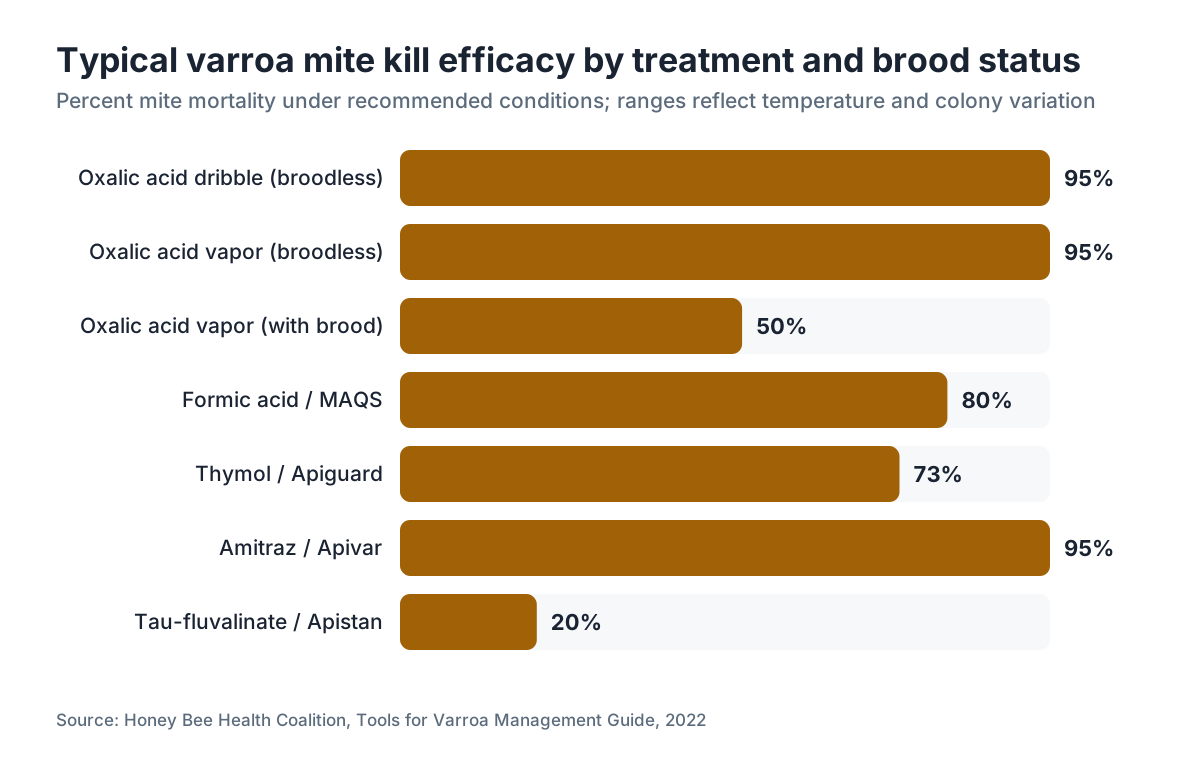
How do efficacy and mite kill rates compare across treatments?
Here are commonly reported efficacy ranges from the Honey Bee Health Coalition's Tools for Varroa Management Guide (2022 edition) and associated university research [4].
| Treatment | Active Ingredient | Brood Penetration | Typical Efficacy Range | Residue in Wax |
|---|---|---|---|---|
| Api-Bioxal (dribble, broodless) | Oxalic acid | No | 90-99% | Negligible |
| Api-Bioxal (vapor, broodless) | Oxalic acid | No | 90-99% | Negligible |
| Api-Bioxal (vapor, with brood) | Oxalic acid | No | 40-60% per treatment | Negligible |
| MAQS / FormiVap | Formic acid | Yes | 63-97% | Negligible |
| Apiguard / ApiLifeVar | Thymol | No | 54-92% | Very low |
| Apivar | Amitraz | No | 90-99% | Low-moderate |
| Apistan | Tau-fluvalinate | No | Low (resistance widespread) | High |
| CheckMite+ | Coumaphos | No | Variable (resistance) | Very high |
Read the table this way. Oxalic acid's 90%-plus number only holds when you treat during a broodless period. Vaporize into a colony packed with capped brood and you're only hitting the 20-30% of mites riding on adult bees, not the 70-80% sealed in cells. That math bites hard when your mite load is already high.
Formic acid's wide range (63-97%) is all about temperature. Work published by the University of Minnesota Bee Lab found results closer to the top of that range when temperatures stayed inside the recommended window for the whole treatment [9].
Apivar is genuinely reliable where amitraz resistance hasn't appeared. But resistance is documented in Europe and is turning up in some US apiaries with heavy treatment history [8]. That's the whole reason you rotate active ingredients.
Which treatment is better for colonies with brood vs broodless colonies?
This is the question that decides which category you actually reach for.
For broodless colonies (winter clusters, or after a brood break), oxalic acid dribble or vapor is the best single treatment there is. The mites have nowhere to hide. One well-timed application in late fall or early winter, after the last brood emerges and before the cluster tightens, can cut mite counts by 95% or more. If you only do one varroa treatment a year, make it this one.
Colonies with brood give you fewer options. Formic acid (MAQS) is the only soft treatment that reaches mites in capped cells. Use it when temperatures are stable and in range: 50-85°F ambient, no multi-day heat wave in the forecast. Apivar is the hard-chemical pick with the best current efficacy; it works regardless of brood state because the strips stay in for 6-8 weeks and the colony cycles through it. Thymol works with brood present too, but efficacy is lower and temperature limits still apply.
Here's a rotation many beekeepers run. Treat with oxalic acid vapor or formic acid in spring before populations explode. Hit again in late summer, often Apivar if mite loads call for a reliable knockdown. Then the big oxalic acid dribble or vapor in the broodless window. Soft first, hard chemical as backstop.
Do varroa mites build resistance to soft treatments the same way they do to hard chemicals?
No. This is the strongest biological reason to lean on soft treatments.
Tau-fluvalinate resistance in US varroa was confirmed as early as 1999 and is now effectively universal in most regions [7]. Coumaphos resistance is widespread too. Amitraz resistance, once rare in the US, is confirmed in multiple states and tracked by USDA-ARS and state apiculture programs [8].
Oxalic acid and formic acid work by a different mechanism. They aren't enzyme inhibitors or neurotransmitter blockers that a mite can dodge with a gene-level change across a population. They cause physical and chemical damage. There's no documented clinical resistance to oxalic acid or formic acid in varroa after decades of use in Europe, where both predate their US registration [10]. Resistance isn't theoretically impossible, but the mechanism makes it far slower to evolve.
Thymol resistance hasn't shown up in field populations either, despite long use in Europe. The Honey Bee Health Coalition's guide states there is "no current evidence of resistance" to organic acid or essential oil treatments [4].
For hard chemicals, resistance management means rotating active ingredients and never treating with the same synthetic acaricide in back-to-back cycles. Use Apivar every cycle and you're breeding amitraz-resistant mites. Mixing soft and hard treatments in rotation is standard IPM advice.
What are the risks to bees, queens, and honey of each treatment type?
Every treatment carries some risk to the colony. The real question is how much, and under what conditions.
Oxalic acid at label rates poses minimal risk to adult bees and queens when used correctly. Overdosing by vapor (too many treatments over too short a stretch) can cause some bee mortality. Dribble at very high rates can knock bee populations back slightly, but Api-Bioxal label rates are well established. Oxalic acid already exists in honey at trace levels, so contamination isn't a concern at label rates [2].
Formic acid is the most bee-aggressive soft treatment. Queen loss in MAQS field trials has ranged from under 5% to over 20% depending on temperature and colony strength [4]. Weak colonies are more exposed. Always check for a laying queen 2-3 weeks after treating.
Thymol at label rates is generally well tolerated. Some colonies pull partially capped honey from supers during treatment because of the scent. That's an annoyance, not a health problem.
Amitraz (Apivar): the main label restriction is removing honey supers before treatment. A 6-8 week treatment window means no harvestable honey during that period [6]. Direct bee and queen toxicity at label rates is low.
Fluvalinate and coumaphos both build up in wax, and sub-lethal effects on brood from contaminated comb are documented [1]. That's less a treatment risk than a cumulative exposure risk from old comb. If you use these, cycle out old foundation on a schedule.
On honey safety: no EPA-registered varroa treatment is approved with honey supers in place, with one exception. Api-Bioxal is labeled for vaporization with supers on, though some beekeepers pass on it anyway. Read the current label. That's the legal document.
How much do soft vs hard varroa treatments cost?
Cost swings with colony count and treatment frequency, but here are approximate retail ranges as of 2025.
Oxalic acid (Api-Bioxal): roughly $25-35 for a 2.1 oz package that treats about 10 colonies by dribble or 35-50 by vaporization, depending on dose. A vaporizer runs $100-300 depending on the model (electric wand-style versus oxalic-specific units). For a one-time broodless treatment of a small apiary, it's the cheapest effective option per colony.
Formic acid (MAQS): about $25-35 for a 2-pack that treats 2 colonies. Scale that to a sideliner with 20-30 hives and costs pile up fast. FormiVap and generic formic acid pads run cheaper per colony in some states.
Thymol (Apiguard): roughly $30-40 for a package treating 10 colonies over a full 6-week course.
Apivar (amitraz strips): roughly $50-70 for a pack of 10 strips (5 colonies). Two strips per hive for 6-8 weeks is the label rate, so about $10-14 per colony.
Time counts too. A winter oxalic acid dribble takes 3-5 minutes per colony. A full Apivar treatment is quick to install but needs a follow-up visit to pull the strips. Extended oxalic vaporization protocols during brood-rearing take more total time but may let you skip late-summer synthetics.
For help building a seasonal treatment budget and schedule by colony count, the varroa mite management resources on VarroaVault include a treatment protocol calculator that factors in colony count, brood status, and regional timing.
Can you use soft and hard treatments at the same time or in the same season?
You can use them in the same season, and most IPM protocols do. You should never run two treatments at once in the same hive.
The integrated approach sequences treatments, it doesn't stack them. A typical season: spring oxalic acid vapor when the cluster breaks and brood is still minimal, a midsummer formic acid treatment if a mite wash exceeds the 2% action threshold, and Apivar in late summer if formic wasn't enough. Then the big oxalic acid dribble after the fall brood break. Soft-heavy rotation, synthetic backstop.
Avoid treating with two products simultaneously. Combining miticides can raise bee toxicity, and there's no good evidence that dual treatments beat properly applied single treatments. The Honey Bee Health Coalition recommends against concurrent treatments [4].
Mind the timing between treatments too. Apply Apivar and then immediately try to read efficacy with an alcohol wash or sticky board, and you'll get a muddled signal. Let one treatment cycle finish and give the colony a week before you evaluate.
One practical habit: run a sticky board under a screened bottom board during any treatment. Falling mite counts over time tell you it's working. A plateau or a climb tells you to reassess before the treatment window closes.
When should you choose a hard chemical treatment over a soft one?
There are real situations where reaching for Apivar is the right call, and pretending otherwise is bad advice.
Mite count high (above 3-4% on an alcohol wash, or above 2% during summer buildup), heading into peak honey season with no broodless window in sight? Apivar's reliability earns its keep. A soft-only approach during a high-mite crisis can cost you the colony.
Weather making formic acid risky (sustained heat above 85°F), thymol not registered in your state, spring oxalic already done? Apivar is the logical choice. Don't let ideology get your bees killed.
Colony weak and you need a reliable, low-manipulation option? Apivar's long-acting strip fits. Hang the strips, walk away for 6-8 weeks. Soft treatments usually demand tighter timing, repeat visits, or specific weather.
The case for soft treatments as a default isn't that hard chemicals are bad. It's that resistance and residue are long-term problems, and the more you handle with soft treatments, the more you save the hard chemicals for the moment you truly need them. If you're shopping for both categories, knowing what you're buying before you walk into a store saves a lot of confusion. Our roundups of beekeeping supplies cover it.
What does the science say about wax residue contamination from hard chemicals?
This is where the hard-chemical case falls apart most clearly.
A peer-reviewed study in PLOS ONE found tau-fluvalinate residues in beeswax up to 5.75 ppm and coumaphos up to 94 ppm in samples from commercial operations [1]. Those levels are tied to sub-lethal effects on developing larvae and queens in lab studies, including reduced queen weight, lower sperm viability, and slower brood development.
Work in PLOS ONE and Apidologie shows miticide residues in wax persist for years because old comb rarely gets fully replaced. In one survey cited by the Honey Bee Health Coalition, over 90% of wax samples from US colonies carried detectable pesticide residues [4].
Amitraz (Apivar) accumulates at lower levels than fluvalinate or coumaphos under normal use, one reason it's the preferred synthetic where treatment is needed.
Soft treatments don't leave a meaningful residue. Oxalic acid occurs naturally in honey at around 8-58 mg/kg [3]. Formic acid is also present naturally in honey in small amounts and is fully volatile, leaving nothing behind. Thymol at label rates leaves detectable but very low concentrations in honey that fade after the treatment comes out.
The takeaway: if you're running drawn comb more than 4-5 years old that's seen repeated fluvalinate or coumaphos treatments, replace it, no matter what you use now. Old, dark, contaminated comb is a slow drag on colony performance.
How should hobbyists and sideliner beekeepers decide which approach to take?
Start with your mite counts. No treatment decision is sound without monitoring. Run an alcohol wash or sugar roll at least once a month from spring through fall. The 2% threshold (2 mites per 100 bees on a wash) is the widely recommended action threshold for most of the US, per the Honey Bee Health Coalition [4].
Then work through these questions in order. Is the colony broodless or nearly broodless? If yes, oxalic acid is your cleanest, cheapest, most effective option. Is it brood season with a count above 2% and temperatures in range for formic acid? Start there. Is it late summer with counts spiking, extreme temperatures, or a need for absolute reliability going into winter buildup? Apivar.
For sideline operations (say, 50-200 hives), the per-colony cost and labor math shifts. Oxalic acid vapor is economical at scale for broodless treatments. Apivar gives you consistent results across many colonies without weather derailing the plan.
Keep records. Write down what you used, when, the pre- and post-treatment mite counts, and how the colony came through. That's how you learn what works in your microclimate with your bee stock. No published IPM protocol beats your own apiary data.
VarroaVault's free treatment protocol tools (varroavault.com) help you build a seasonal plan that sequences soft and hard treatments by region and colony count, so you're not starting from scratch every year.
What do extension apiculturists and the Honey Bee Health Coalition recommend?
The Honey Bee Health Coalition's Tools for Varroa Management Guide is the best consensus document available, updated regularly and free to download [4]. The 2022 edition recommends an integrated approach: monitor often, intervene at threshold, rotate active ingredients across treatment classes, and treat the broodless window with oxalic acid as the most cost-effective winter tool.
Penn State Extension recommends an IPM approach that begins with mite monitoring, uses economic and action thresholds, and picks treatments by brood status and temperature. Their materials flag Apistan resistance as a reason to skip fluvalinate as a first-line treatment [7].
The University of Minnesota Bee Lab publishes similar guidance and stresses that amitraz resistance, though still limited in the US, is a reason to rotate rather than lean only on Apivar [9].
Every product here went through the EPA's pesticide registration review. The label is a legal document. Using any of these treatments off-label (wrong dose, wrong timing, supers on when prohibited) is a federal violation under FIFRA [5].
One quotable line from the Honey Bee Health Coalition's guide: "Oxalic acid is most effective when used during a broodless period" [4]. That's not a suggestion. It's the core logic behind timing your treatments to the colony's brood cycle, which matters as much as which product you pick.
Frequently asked questions
Is oxalic acid safe to use with honey supers on?
The Api-Bioxal label allows vaporization with honey supers on. Oxalic acid occurs naturally in honey, and at label-rate vapor applications the EPA considers the residue increase negligible. Dribble and spray applications are not approved with supers in place. Read the current product label before treating, since label language can change between registration cycles.
How long after an Apivar treatment can I put honey supers on?
The Apivar label requires strips out before you install honey supers. There's no mandatory waiting period after removal before adding supers, but most practitioners wait until they've confirmed the strips are gone and the hive smells clear. The legal requirement is simply no supers while strips are in the hive. Don't cut corners: amitraz residue in honey is a serious issue.
Can varroa mites become resistant to oxalic acid?
No documented field resistance to oxalic acid has been confirmed in varroa populations despite decades of European use. Oxalic acid kills by direct chemical damage rather than by disrupting a specific enzyme or receptor, which makes resistance mechanistically harder to evolve through standard genetic selection. This is the main long-term biological advantage of soft treatments, though the theoretical possibility isn't zero.
What's the best varroa treatment for a beginner beekeeper?
Oxalic acid dribble during a winter broodless period is the best starting point: cheap, 90%-plus effective when timed right, and hard to misapply. The Api-Bioxal label gives clear dosing. Pair it with a basic mite wash in spring and fall so you actually know your counts. If mid-season counts spike above 2%, MAQS or Apivar are the practical next steps depending on temperature.
How often should I treat for varroa if I use only soft treatments?
There's no fixed calendar. Let alcohol wash results drive timing. Most soft-only beekeepers treat 3-4 times a year: an early spring oxalic vapor when brood is minimal, one or two formic or thymol treatments mid-season if counts warrant, and the critical late-fall oxalic dribble or vapor in the broodless window. Skipping that winter treatment is the most common reason colonies crash by February.
Do soft varroa treatments affect queen quality or egg laying?
Formic acid carries the highest queen risk of any soft treatment. MAQS field trials have recorded queen loss from under 5% up to over 20% in high-temperature conditions. Oxalic acid at label rates poses minimal queen risk; overdosing via repeated vapor treatments in a short period can cause some adult mortality. Thymol at label rates is generally queen-safe. Check for a laying queen 2-3 weeks after any formic acid application.
Is Apistan still worth using for varroa?
In most of the US, no. Tau-fluvalinate resistance in varroa became widespread by the late 1990s and is now near-universal in many US populations. Penn State Extension and other university programs no longer recommend Apistan as a primary treatment. If you have a very isolated apiary with no treatment history and want to confirm it still works, run a mite wash before and after a trial treatment before relying on it.
What temperature constraints should I know about for soft varroa treatments?
Formic acid (MAQS) needs ambient temperatures roughly between 50°F and 85°F (10-29°C) for safe, effective use. Thymol products (Apiguard, ApiLifeVar) need temperatures above 59°F (15°C) to volatilize and shouldn't be used above about 105°F (40°C). Oxalic acid has no significant temperature constraint within normal beekeeping conditions, part of why it works so well as a winter treatment.
How do I know if a hard chemical treatment has stopped working in my apiary?
Do a mite wash before treatment and again 2-4 weeks after finishing the full course. If counts don't drop by at least 90% from the pre-treatment level, resistance is a likely explanation (assuming correct application and brood cycles that exposed the mite population). Penn State Extension and the Honey Bee Health Coalition both describe this before-and-after monitoring as the standard efficacy check.
Can I use formic acid and oxalic acid in the same season?
Yes, in sequence, never simultaneously. A common approach is a formic acid treatment in midsummer when brood is present and counts are rising, followed by an oxalic acid vapor or dribble in the broodless fall window. They use different mechanisms and different timing, so there's no interaction concern. Give the colony a week after one treatment ends before evaluating results and planning the next.
Do I need a prescription or license to buy varroa treatments?
In the US, Api-Bioxal (oxalic acid) and Apivar (amitraz) currently require a Veterinary Feed Directive (VFD) from a licensed veterinarian under the applicable antimicrobial rules for certain products. MAQS (formic acid) and thymol products are generally available over the counter at beekeeping retailers, though state rules vary. Check with your state department of agriculture for current requirements in your region [5].
What's the cheapest effective varroa treatment per colony?
Oxalic acid via vaporization during a broodless period is the lowest cost per colony of any effective registered treatment. A single 2.1 oz package of Api-Bioxal can treat 35-50 colonies by vaporization at roughly $0.50-$1.00 per colony in product cost. The vaporizer is a one-time cost of $100-300. At scale that's far cheaper than Apivar ($10-14 per colony) or MAQS ($12-18 per colony).
How does wax residue from hard chemicals affect my bees long-term?
Studies have found tau-fluvalinate up to 5.75 ppm and coumaphos up to 94 ppm in beeswax from commercial operations. Lab research links these levels to reduced queen weight, lower drone sperm viability, and impaired brood development. The effect is cumulative from repeated treatments on the same comb over years. Replacing old foundation every 4-5 years and prioritizing soft treatments reduces this burden significantly [1].
Should I use soft or hard treatments if I want to sell my honey as natural or organic?
USDA Organic standards prohibit synthetic pesticides including amitraz, tau-fluvalinate, and coumaphos. Organic certification requires approved materials, which can include oxalic acid, formic acid, and thymol under a certified organic system plan. Formal USDA organic honey certification is complex and involves the whole operation. If organic marketing matters to you, contact your state's organic certifier before making treatment decisions.
Sources
- PLOS ONE: study on pesticide and acaricide residues in beeswax and colony losses: Tau-fluvalinate residues up to 5.75 ppm and coumaphos residues up to 94 ppm found in beeswax samples from US commercial operations
- EPA: Pesticide Registration (Api-Bioxal registration): Api-Bioxal (oxalic acid dihydrate) is the only EPA-registered oxalic acid product for honey bee varroa treatment in the United States
- USDA Agricultural Research Service: Oxalic acid dribble and vapor in broodless colonies achieves over 90% mite kill; oxalic acid occurs naturally in honey at 8-58 mg/kg
- Honey Bee Health Coalition: Tools for Varroa Management Guide (2022): Formic acid is the only soft treatment that penetrates capped brood; oxalic acid vaporization efficacy in colonies with brood is 40-60% per treatment; no current evidence of resistance to organic acid or essential oil treatments; over 90% of wax samples from US colonies contain detectable pesticide residues; 2% action threshold; recommends against concurrent treatments
- EPA: Pesticide Registration and FIFRA label compliance: Thymol registration varies by state; using any registered treatment inconsistent with the label is a federal violation under FIFRA
- Elanco (Apivar) EPA Registered Label: Apivar label prohibits use when honey supers are present; minimum treatment duration is 6 weeks
- Penn State Extension: Varroa Mite Management: Tau-fluvalinate resistance confirmed in US varroa populations by late 1990s and now widespread; Apistan no longer recommended as first-line treatment; 2% action threshold standard for mite management decisions
- USDA ARS: amitraz resistance monitoring in Varroa destructor: Amitraz resistance has been confirmed in varroa populations in multiple US states and is actively monitored by USDA-ARS
- University of Minnesota Bee Lab: Varroa management recommendations: Amitraz resistance is a reason to rotate active ingredients rather than rely exclusively on Apivar; formic acid efficacy approaches the upper range when temperatures remain within the recommended window
- USDA National Agricultural Library: No documented field resistance to oxalic acid in varroa populations despite decades of use in Europe predating US registration
Last updated 2026-07-10