Thymol residue in honey: how to avoid contamination
TL;DR
- Thymol from products like ApiLife VAR and Apiguard can leave residues in honey if you apply during a nectar flow or above the label temperature range.
- To keep your harvest clean: treat only with supers off, stay inside 59 to 69°F (15 to 25°C), and wait 2 to 4 weeks after the last pad comes out before adding supers.
- EU and US tolerance thresholds sit around 0.8 to 1.0 mg/kg.
What is thymol and why does it end up in honey?
Thymol is a monoterpene phenol that comes from thyme oil. In beekeeping, it's the active ingredient in Apiguard (a slow-release gel) and ApiLife VAR (a vermiculite tablet), both registered with the EPA for varroa mite control. It kills mites by vaporizing inside the hive and wrecking their nervous system.
Here's the trouble. Thymol vaporizes into the same warm air the bees use to ripen and cure honey. When there's an open super on the hive and nectar coming in, that vapor gets pulled straight into the uncapped nectar. It also sticks to beeswax comb and leaches back into honey stored near the treatment. The result is a minty, medicinal off-flavor that most people taste right away, even at concentrations well below what regulators allow. [1]
Thymol is not synthetic. That helps with marketing. It does nothing for honey quality. Natural origin does not exempt it from residue rules, and it definitely does not mean your customers won't taste it.
What are the legal residue limits for thymol in honey?
The United States has no numeric Maximum Residue Limit (MRL) for thymol in honey. Thymol is classified as a natural substance and holds Generally Recognized As Safe (GRAS) status in food. The control instead lives on the EPA-registered labels for Apiguard and ApiLife VAR, which both require honey supers off before treatment. That label requirement is the functional rule, not a number. [2]
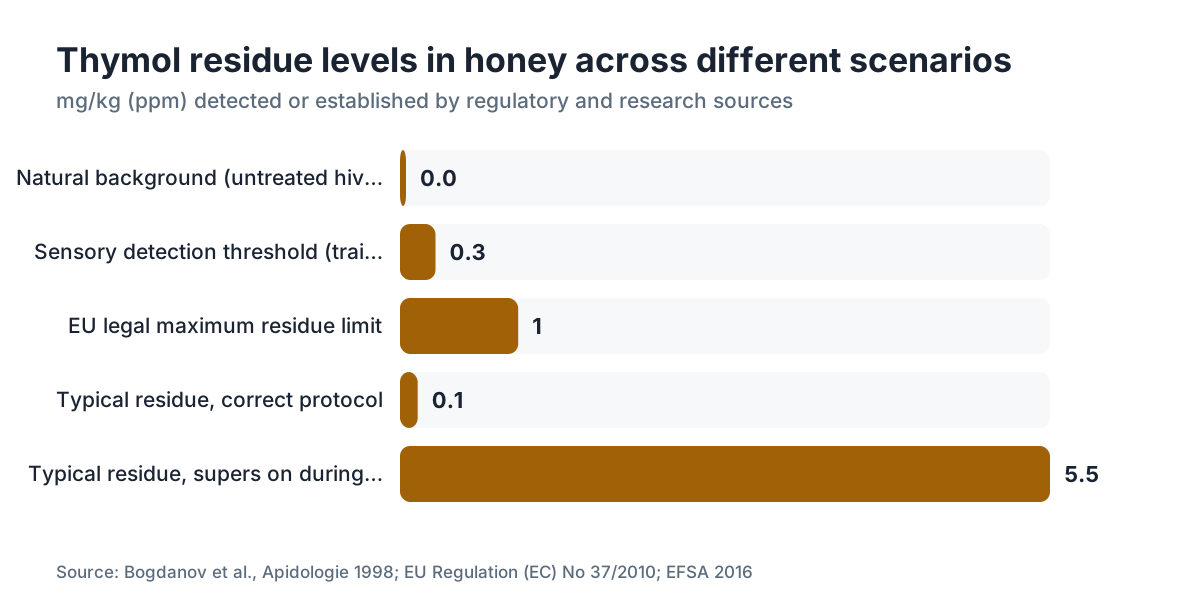
The European Union sets an MRL of 1.0 mg/kg (1.0 ppm) for thymol in honey under Regulation (EC) No 37/2010. [3] Switzerland and other countries following Codex Alimentarius guidance use 0.8 to 1.0 mg/kg as their reference point. Selling into international markets or to specialty packers who test residues? That 1.0 mg/kg figure is the line you stay under.
Background thymol in honey from untreated hives usually measures below 0.02 mg/kg. After a botched treatment (supers left on, warm weather, active flow), residues of 2 to 10 mg/kg have shown up in the lab. [4] The gap between normal background and a contamination event is so wide that a bad application is almost always obvious on a test report.
| Jurisdiction | MRL / Standard | Legal basis |
|---|---|---|
| United States | No numeric MRL; label requires supers off | EPA product registration |
| European Union | 1.0 mg/kg | Regulation (EC) No 37/2010 |
| Codex Alimentarius | 0.8 mg/kg (draft) | CAC/MRL reference |
| Natural background in honey | <0.02 mg/kg | Published residue studies |
How do Apiguard and ApiLife VAR labels tell you to avoid honey contamination?
Both labels spell it out, and reading them carefully is the single best move you can make. The Apiguard label (Vita Bee Health, EPA Reg. No. 80399-2) states that honey supers must be removed before treatment starts and cannot go back on until the treatment is done and the hive has had time to clear residues. ApiLife VAR calls for application between 59°F and 69°F (15°C to 25°C). Apiguard lists a wider window (59°F to 105°F), but residue risk climbs sharply above 25°C because heat accelerates vaporization. [2]
ApiLife VAR (EPA Reg. No. 9688-192-83529-1) runs on the same logic: supers off, temperature range respected, and a defined course of typically three applications over 6 to 8 weeks. [5] Both labels warn against treating during a nectar flow, because incoming nectar acts like an open solvent bath for thymol vapor.
The EPA label is a legal document. Treating with supers on is a federal label violation, full stop. That holds no matter how long you've kept bees or what somebody told you at a club meeting.
What temperature and season conditions make thymol residue worse?
Temperature is the biggest residue driver, period. Thymol's vapor pressure rises steeply above 25°C (77°F). At 30°C inside a hive (common in a summer cluster), vaporization runs roughly three to four times faster than at 20°C. [4] A dose meant to release slowly over three weeks can dump most of its thymol into the hive air in a few days during a heat wave, faster than the bees can clear it before it touches honey stores.
Season matters for three overlapping reasons. Nectar flows fill frames with uncapped nectar that soaks up thymol. Summer heat speeds vaporization. And bees haul water in warm weather, so thymol (which is somewhat water-soluble) can travel through the hive and land on brood and honey frames far from the treatment.
Early fall is the sweet spot across most of North America. Harvest is off, temperatures are dropping below 25°C, there's no real nectar flow, and the colony still has time to rear varroa-free winter bees. It's also when varroa numbers usually peak after a summer of brood, so treatment is both safe and well-timed. The Honey Bee Health Coalition's Varroa Management Guide names fall as the primary treatment window for thymol products in temperate climates. [6]
How long do you have to wait before putting honey supers back on?
This is where beekeepers slip up. They finish the course, pull the last pad, and add supers the next week. Too fast.
A full Apiguard course is two applications of 25g gel, 2 weeks apart, for a treatment period of about 4 weeks. ApiLife VAR runs three applications at roughly 10-day intervals over 6 to 8 weeks. After the last application comes out, thymol is still sitting in the wax and in any honey stores that were in the brood box during treatment. Penn State Extension recommends waiting a minimum of 2 weeks after the last treatment is removed before supers go back on, and notes that 4 weeks gives a more conservative margin when temperatures ran high during treatment. [7]
Treat in August with a fall flow through October and the timeline is easy to hit. Treat in spring trying to knock mites down before a big flow and you're in a bind, which is a sign thymol is the wrong tool for that job. Spring applications ahead of a flow are where most honey contamination starts.
For planning your full-season calendar, the varroa mite management overview covers how to sequence treatments across the year without wrecking your honey crop.
Can you use thymol treatments during a nectar flow?
No. Don't do it. This is not a gray area.
During a flow, bees pack fresh nectar into every open frame within days. That nectar is uncapped and exposes a huge surface area to hive air. Thymol vapor concentrates in the warm air above the cluster and gets absorbed straight into it. Even a correctly dosed treatment at the right temperature will leave detectable residue in honey harvested from a hive treated during a flow. [4]
If you're fighting varroa mid-flow, reach for a treatment with a friendlier honey-safety profile. Oxalic acid dribble or vaporization (supers removed) has no documented honey residue problem at label doses, because oxalic acid already occurs naturally in honey at 196 to 760 mg/kg, far above anything a treatment adds. [8] Formic acid (MAQS or Formic Pro) is another option, though it carries its own temperature and ventilation limits.
Thymol is a genuinely good varroa treatment in the right context. It just has a narrow window, and a nectar flow sits outside it.
Does thymol residue affect honey taste even below the legal limit?
Yes, and this is where the legal limit and the consumer limit split hard.
The EU's 1.0 mg/kg MRL is a safety and residue tolerance number, not a flavor threshold. Trained sensory panels detect thymol in honey at concentrations as low as 0.2 to 0.4 mg/kg, and some studies put the untrained-taster threshold around 0.5 mg/kg. [4] You can sit below the legal limit and still hand someone honey with a medicinal or herbal note that drops its value or gets your batch bounced by a packer.
For varietal honeys or competition entries, even a trace of thymol is disqualifying. For table honey sold locally, most customers won't complain unless the contamination is heavy. A small share will notice, and those people don't come back.
The practical target is zero detectable residue, more than under 1.0 mg/kg. You get there by following the protocol in the sections above. No treatment trick lets you use thymol during a flow and pull clean honey out the other side.
What practices actually prevent thymol residue in harvestable honey?
Here's where the evidence and the label language line up. These aren't suggestions. They're the protocol.
Supers off. Every time, before any thymol product gets opened in the apiary. Beeswax in empty supers left in the same building during treatment can adsorb thymol vapor even without bees present. Store your supers away from the treatment area.
Time it right. Target ambient temperatures of 15 to 25°C (59 to 77°F). Across most of the continental US that means September and October in fall, or occasionally April in the mid-Atlantic for an emergency spring treatment with no flow on the horizon.
Run the full course. Cutting treatment short to re-add supers faster does not lower residue risk. Partial treatments leave unabsorbed thymol in the gel or pads, and it keeps off-gassing after you think you're finished.
Ventilate. Apiguard and ApiLife VAR both work better and safer with good hive ventilation. Open bottom boards move thymol-laden air through the hive faster and drop the peak vapor concentration around honey stores.
Wait after treatment. Minimum 2 weeks, preferably 4, after the last pad or gel comes out before any super goes on. Keep the treatment end date in a log so you're not guessing.
Test if you sell commercially. A basic honey residue panel from a certified lab costs roughly $30 to $80 per sample (prices vary by lab and panel scope). Move more than a few hundred pounds and that's cheap insurance.
Are there any thymol treatment mistakes that are impossible to fix after the fact?
Pretty much, yes. Once thymol is absorbed into capped honey, you cannot get it back out. No extraction, filtration, or processing method available to a small producer will strip thymol from contaminated honey without ruining the honey too. A few industrial processes (molecular distillation, activated carbon filtration) can cut thymol in bulk honey, but those aren't options for a hobbyist or sideliner.
The one recoverable mistake is catching it fast. If you put a treatment in and then realize supers are on or a flow just started, pulling the treatment immediately and getting the supers off within 24 to 48 hours reduces (but does not erase) residue in honey that was uncapped during exposure. Honey already capped during exposure is probably fine, because the wax cap slows absorption a lot. You won't know which frames were capped and which weren't without uncapping and testing.
The honest answer: treat contaminated honey from a bad application as a loss for human consumption. You can feed it back to the bees during a non-flow period, knowing it'll recirculate through the hive. Don't blend it with clean honey hoping to dilute residues below detection.
How does thymol compare to other varroa treatments for honey safety?
Each treatment class carries a different honey-safety profile, and knowing them helps you pick the right tool for the moment.
Oxalic acid (OA), dribbled or vaporized, is the benchmark for honey safety. It occurs naturally in honey at 196 to 760 mg/kg per a European Food Safety Authority review, and label-compliant OA treatments add less than 10% to those natural levels. [8] There's no withdrawal period, and supers can be on or off (though vaporization with supers on needs a specific label authorization in your state). The catch is that OA only kills phoretic mites riding on adult bees, so it needs a broodless period or repeated applications.
Formic acid (MAQS, Formic Pro) also raises no MRL concern in the US, because formic acid is naturally present in honey and beeswax at levels that dwarf treatment residue. In some US states it can go on with supers under specific label conditions, which makes it more flexible during shoulder-season flows. Temperature and ventilation limits are real, and queen loss risk runs higher than with thymol. [9]
Amitraz (Apivar strips) leaves amitraz and its metabolite DMPF in wax, and those persist for years in comb. Supers must be off during treatment and, ideally, kept off contaminated frames for the life of the comb. With amitraz, the chronic wax residue is the honey-safety problem, not a single application.
Thymol lands in the middle: better than amitraz for wax persistence, worse than OA and formic acid for volatility into honey, and very sensitive to temperature and flow timing.
| Treatment | Honey supers during treatment? | Withdrawal period | Primary residue concern |
|---|---|---|---|
| Oxalic acid (dribble/vapor) | Generally no (label-specific) | None (US) | None at label doses |
| Formic acid (MAQS, Formic Pro) | Yes (label conditions) | None (US) | Negligible; natural substance |
| Thymol (Apiguard, ApiLife VAR) | No | 2 to 4 weeks post-treatment | Vapor absorption into honey |
| Amitraz (Apivar) | No | No explicit US period | Wax accumulation; metabolite DMPF |
Where can you get reliable protocol guidance and treatment records?
The Honey Bee Health Coalition's Varroa Management Guide (at honeybeehealthcoalition.org) is the most referenced practitioner resource in the US. Universities, government agencies, and industry groups built it together, and it gets updated as new evidence comes in. The 2023 edition includes treatment windows, timing guidance, and decision trees for each registered product class. [6]
State university extension programs are another solid source, especially Penn State Extension (extension.psu.edu), the University of Florida IFAS (ifas.ufl.edu), and NC State Apiculture. [11] Each gives regionally calibrated timing that accounts for local nectar flows and temperature norms, which a generic national guide can't match. [7]
For records, keep a simple log with application date, temperature, product lot number, and super removal date. It's good practice and it saves you in a residue dispute with a buyer. VarroaVault's free protocol tools include treatment tracking built around exactly this kind of record, worth a look if you run more than a handful of hives.
Whatever you use, the record that matters most tells you when the last pad came out and how long until supers went back on. That gap is where most honey contamination events live or die.
Frequently asked questions
Can I use Apiguard with honey supers on if the supers are empty?
No. The EPA label for Apiguard requires supers off before treatment whether they're empty or not. Beeswax in empty supers adsorbs thymol vapor, and those supers would then carry residue into your next honey crop. Store empty supers away from the treatment area entirely.
How long does thymol stay in honey after a contamination event?
Thymol in capped honey doesn't break down quickly. Studies have found measurable residues in contaminated batches stored at room temperature for 6 to 12 months after treatment. Thymol in wax hangs on even longer. No practical home remedy pulls thymol back out of honey once it's in there.
What temperature is too hot to use thymol treatments?
Above 25°C (77°F) ambient, vaporization accelerates and residue risk rises. The ApiLife VAR label specifies 59 to 69°F (15 to 25°C). Apiguard lists a wider range but notes reduced safety margins in heat. In plain terms, if daytime highs sit consistently above 77°F, hold off on thymol.
Does thymol affect the beeswax in frames after treatment?
Yes. Thymol adsorbs into beeswax and off-gasses slowly for weeks after treatment ends. That's one reason for the 2 to 4 week wait before replacing supers. Wax in frames that held brood during treatment carries the highest residue load, so don't pull those frames into honey supers right after treatment.
Is honey from a thymol-treated hive safe to eat even if it has residues?
At levels below the EU MRL of 1.0 mg/kg, honey is considered safe to eat, and thymol holds GRAS status in the US. The real concern is flavor. Tasters detect thymol at 0.2 to 0.5 mg/kg, well under the safety limit. So contaminated honey can be legal and still unsellable because of the off-flavor.
Can I use thymol in spring before a major nectar flow?
Risky, and generally not recommended. A spring application has to finish with a 2 to 4 week post-treatment period before supers go on, and that window must clear before the flow peaks. In most of North America, spring flows start too soon for that math to work. Oxalic acid vaporization during a broodless period is usually the better spring option.
How do I know if my honey has thymol residue without a lab test?
You probably can't tell by taste alone at low concentrations. Heavy contamination carries a distinct medicinal, herbal, or menthol-like note that's out of place in most honey. If you smell the open jar and get a strong thyme or oregano character that wasn't there before treatment, send a sample to a lab before selling or showing that batch.
Does thymol residue affect pollen stored in the hive?
Thymol turns up in beebread (fermented pollen) in treated hives, though the data on pollen residue levels is thinner than for honey. If you harvest pollen (see our overview of beehive pollen for context), treating with pollen traps active carries the same contamination logic as honey supers. Remove traps during treatment.
Are organic beekeeping certifications compatible with thymol use?
Thymol is permitted under many organic certification programs, including USDA National Organic Program guidance for apiaries, because it comes from a natural plant compound. Check with your specific certifier, since requirements vary. For organic compliance, supers must still be off during treatment and the product must be a registered, labeled formulation, not raw thymol.
What is the correct dose of Apiguard to minimize residue without losing efficacy?
The label dose for Apiguard is 25g gel per application, two applications 2 weeks apart, for a total of 50g per hive. Using the full label dose actually lowers residue risk compared to a stretched low-dose approach, because the treatment finishes faster and you clear the hive sooner. Don't split a single 25g application into smaller amounts hoping to cut residue.
Do screened bottom boards help reduce thymol residue in honey?
Open screened bottom boards improve ventilation and move thymol vapor out of the hive faster, which lowers peak vapor concentration inside. Both Apiguard and ApiLife VAR efficacy studies used ventilated hive setups. Solid bottom boards trap vapor and raise both mite kill and residue absorption into honey and wax. Keep bottom boards open during treatment.
How does colony size affect thymol residue risk?
Bigger colonies have more bees moving air, more honey stores to soak up vapor, and higher internal temperatures. A strong 5 to 6 frame colony in a nuc box hits higher peak vapor concentrations than the same dose in a full 10-frame hive. If you treat nucs with thymol, reduce the dose per label guidance for colony size and watch timing and temperature closely.
Can I test my honey for thymol residue at home?
No reliable home test exists for thymol in honey. You need a certified lab using gas chromatography-mass spectrometry (GC-MS) or a similar method. Many state departments of agriculture keep lists of certified honey testing labs. A thymol-specific residue panel runs roughly $30 to $80 per sample depending on the lab and panel breadth.
Sources
- European Food Safety Authority (EFSA), assessment of thymol residues in honey: Thymol vapor is absorbed by uncapped nectar and beeswax during hive treatment, producing off-flavor at sub-MRL concentrations
- EPA, Apiguard product label, EPA Reg. No. 80399-2: Apiguard label requires honey supers to be removed before treatment and specifies temperature application range
- European Commission, Regulation (EC) No 37/2010 on pharmacologically active substances: EU maximum residue limit for thymol in honey is 1.0 mg/kg
- Bogdanov et al., 'Thymol, camphor, menthol and propolis residues in honey and beeswax after ApiLife VAR treatment', Apidologie, 1998: Residues of 2 to 10 mg/kg documented after misapplied treatment; sensory detection thresholds as low as 0.2 mg/kg; temperature strongly accelerates vaporization
- EPA, ApiLife VAR product label, EPA Reg. No. 9688-192-83529-1: ApiLife VAR label specifies temperature range 59 to 69 F and requires supers off during the full treatment course of three applications
- Honey Bee Health Coalition, Varroa Management Guide, 2023 edition: HBHC recommends fall as the primary thymol treatment window in temperate climates; supers-off protocol confirmed
- Penn State Extension, honey bee varroa mite treatment guidance: Minimum 2-week post-treatment wait before supers; 4-week wait recommended when temperatures were high during treatment
- European Food Safety Authority (EFSA), Scientific Opinion on oxalic acid as a veterinary medicinal product in honeybees, EFSA Journal 2016: Natural oxalic acid in honey ranges 196 to 760 mg/kg; treatment additions are less than 10% of natural background levels
- EPA, Formic Pro and MiteAway Quick Strips (MAQS) product labels: Formic acid products may be applied with supers on under specific label conditions; no MRL concern given natural occurrence
- USDA Agricultural Research Service, pesticide contamination of US honey bee hives, Journal of Agricultural and Food Chemistry, 2010: Amitraz and its metabolite DMPF persist in beeswax for years and transfer to honey stored in treated comb
- University of Florida IFAS Extension, varroa mite monitoring and management guidance: Regional timing guidance for thymol treatments calibrated to Florida nectar flows and temperature norms
Last updated 2026-07-10