Treating mating nucs for varroa safely: what actually works
TL;DR
- Mating nucs run broodless for days or weeks, which makes them high-risk for varroa and also gives you the best window to treat.
- Oxalic acid, by vaporization or dribble during a broodless period, is the safest effective option.
- Skip amitraz strips, formic acid, and synthetic miticides in these small colonies.
- Treat before you introduce a mated queen or right after she emerges.
Why do mating nucs need varroa treatment at all?
Mating nucs are small, easy to ignore, and most beekeepers treat them as throwaway equipment. That thinking kills colonies every season.
A mating nuc usually runs two to eight frames with a virgin queen and a few hundred to a couple thousand workers. Those workers came from somewhere. That means they almost certainly carried mites in with them. Pull frames from a production hive with even a moderate mite load and you seed the nuc with a proportional mite population. Because mite numbers explode inside sealed brood, a nuc that raises a queen and starts laying can turn a manageable load into a serious one in a matter of weeks.
There's a second problem. Mating nucs get reused all season long. Each new batch of bees you add to support the next virgin queen brings more mite exposure. A nuc that started clean in May can be loaded by August.
The Honey Bee Health Coalition's Varroa Management Guide notes that mite populations in small colonies reach economic threshold levels faster than in full colonies, because there are fewer bees to dilute the mite-to-bee ratio [1]. A nuc parked as a mated queen bank going into winter can collapse by December if mites went unaddressed.
So treating mating nucs isn't optional. Not if you care about the quality of the queens you produce and the health of whatever hive eventually receives them.
What makes treating mating nucs different from treating full hives?
Three things make mating nucs harder to treat than production colonies: a tiny bee population, a high-value virgin or newly-mated queen you can't afford to lose, and frequent broodless windows that change which treatments even work.
Small population matters because most treatments are dosed by colony size or frame count. Oxalic acid dribble runs about 5 mL per seam of bees. A two-frame nuc might have one or two seams. Get the dose wrong in either direction and you either under-treat or stress the colony with excess chemical.
The queen's value is the bigger worry. Virgin queens are expensive and slow to replace. Synthetic miticides like tau-fluvalinate (Apistan) and coumaphos (CheckMite+) carry documented risks to queen quality and fertility in small colonies with developing queens [2]. Amitraz (Apivar) label instructions warn against placing strips in nucleus colonies without close attention to bee population, and plenty of queen producers keep it out of nucs entirely to avoid contaminating the wax the new queen will lay in.
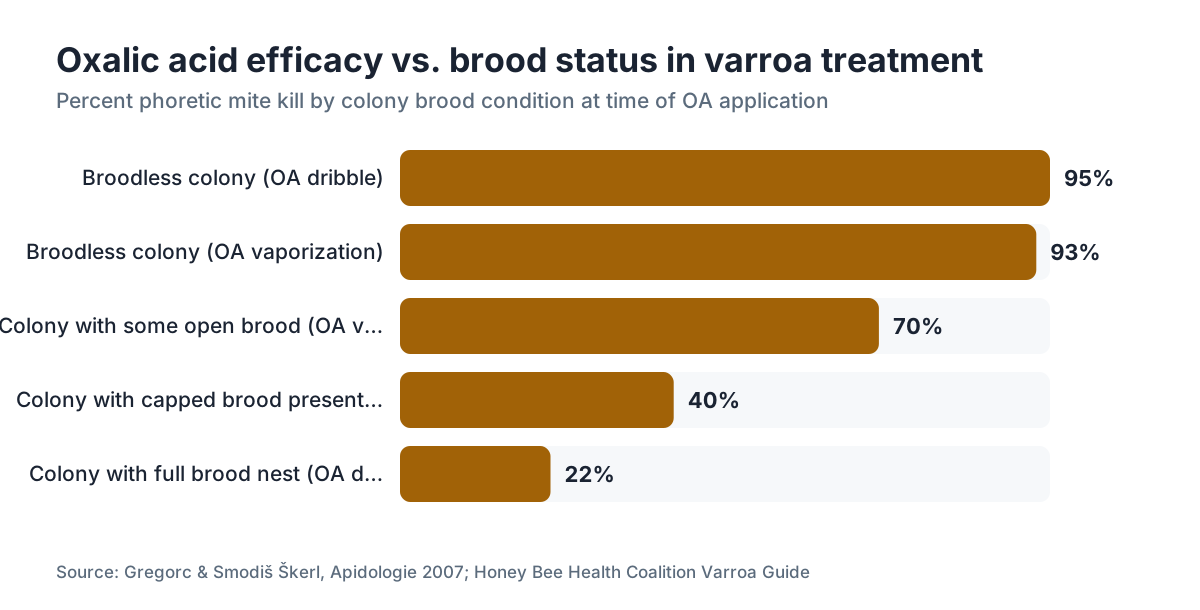
The broodless window is the opportunity hiding inside the problem. When a virgin queen is present but hasn't started laying, every mite is phoretic and riding on adult bees. That's exactly when oxalic acid, which only reaches phoretic mites, does its best work. A well-timed oxalic acid treatment in that window can drop mite levels close to zero before the queen starts laying.
If you run varroa mite monitoring through the season, tracking phoretic mite levels tells you when that window is worth the most.
Which varroa treatments are safe to use in mating nucs?
Here's the honest breakdown. Not every registered treatment fits, and label compliance isn't the same thing as practical safety for a queen.
Oxalic acid (OA), vaporization or dribble. This is the answer for mating nucs during broodless periods. The EPA-registered Api-Bioxal label allows both vaporization and dribble in colonies with or without queens, though efficacy drops hard when brood is present [3]. During the virgin-queen or post-mating pre-laying window, OA runs 90 to 95% against phoretic mites in field studies [4]. Dribble needs the bees clustered or confined so the solution contacts them directly. Vaporization fills a mini-nuc or small box quickly because the cavity is small. One rule that matters: do not treat while the queen is on a mating flight. Apply when you know she's home in the box.
Oxalic acid extended-release (OAE), like OA-soaked shop towel treatments. These off-gas OA over weeks and kill mites as they emerge from cells, so they can work with brood present. They're less tested at mating-nuc scale. The treatment period runs around 28 days per extension guidance [5], which overlaps heavily with a nuc that's actively changing status. I'd take a quick OA dribble or vap over an extended-release strip in a nuc I'm managing week to week.
Formic acid (Mite Away Quick Strips, MAQS). Skip it. The MAQS label requires at least five frames of bees and warns of queen loss even in full colonies, especially in the heat [6]. A mating nuc won't hit the population floor and the queen-loss risk is real.
Tau-fluvalinate (Apistan) and coumaphos (CheckMite+). Wrong tools here. Both affect queen quality and brood at sub-lethal levels, resistance is widespread across U.S. mite populations, and coumaphos leaves wax residues that hang around for years [2].
Amitraz (Apivar). The label doesn't flat-out ban nucleus colonies, but the manufacturer and most extension apiculturists warn against it in small colonies where the strip-to-bee ratio runs very high [7]. Amitraz residue in wax is a genuine concern for comb you'll reuse across a queen-rearing program. Running a commercial operation and cycling dozens of nucs? Keep Apivar out of that comb. That's the cleaner long-term call.
For most hobbyists and sideliners, oxalic acid vaporization during the broodless period is the play. It costs little, leaves no residue, and it genuinely works when you time it right.
When is the best time to treat a mating nuc for varroa?
Timing decides whether your treatment works or mostly wastes your morning.
A mating nuc goes broodless in two phases. First, at setup before you introduce a queen cell. Pull frames of bees without a queen and you've got a queenless colony with declining brood. Once that brood hatches, roughly 12 days from the youngest capped cells, every mite is phoretic. That's your first window.
The second window opens after a virgin queen emerges and before she lays. Virgin queens usually take 5 to 7 days to mate and another 2 to 3 before they start laying. So you get roughly a week after emergence where brood is absent or minimal. Apply OA during that week.
There's a third opening. Run a nuc as a queen bank through winter and it goes broodless on its own as temperatures fall. Late fall is a prime treatment time for that reason, and the Honey Bee Health Coalition recommends a fall oxalic acid treatment timed to the broodless period as the most effective single-treatment strategy [1].
What you avoid is treating with oxalic acid over capped brood. The active mites are hiding in cells OA can't reach. You'll kill the phoretic ones and leave the reproducing population untouched. That's not a treatment. It's a partial knockdown that hands you false confidence.
Not sure whether brood is present? Pull a frame and look. Capped cells mean wait, or plan a follow-up treatment three weeks out once that brood has hatched.
How do you dose oxalic acid correctly for a tiny mating nuc?
This is where more beekeepers go wrong than they'll admit.
For dribble with Api-Bioxal (a 3.5% oxalic acid dihydrate solution), the labeled dose is 5 mL per seam of bees, not per frame. A seam is the space between two frames where bees cluster. A two-frame nuc full of bees has about two seams, so 10 mL total, run slowly down each seam with a syringe. Don't flood it. You want contact with the bees, not a soak.
For a mini-nuc (a Jenter, Nicot, or similar small plastic box with fewer than 200 bees), the dose drops sharply. Some queen producers use as little as 2 to 3 mL total for a very small cluster. The label leaves room for judgment based on bee population, and under-dosing beats over-dosing in a colony holding a valuable virgin. There's no locked-in number for minis because the boxes and populations vary so much.
For vaporization, the Api-Bioxal label specifies 1 gram of OA powder per brood chamber. For a full-size mating nuc box, that's right. For a mini-nuc, some practitioners cut to 0.5 g. Give it 10 minutes of sealed exposure before you reopen. Mini-nucs with mesh floors or gaps leak vapor fast, so block the entrance briefly if you need to.
Wear a respirator rated for OA vapor (N95 is the floor; a half-face respirator with organic vapor/P100 cartridges is better) and eye protection [3]. OA irritates your lungs and eyes. This isn't safety theater. It's real risk management.
You can log nuc treatments alongside your production colony records with a protocol tracker like the one on VarroaVault so no nuc slips through the cracks during a busy queen-rearing push.
Can you treat a mating nuc that has a virgin queen in it?
Yes, with oxalic acid, and you don't have to pull the queen first if you time it right.
Most of the worry about treating over a virgin traces back to old caution around OA dribble concentrations, which ran higher before Api-Bioxal standardized the formula. At the labeled 3.5% concentration and correct dose, OA dribble doesn't harm virgin or mated queens in the studies that looked at this [4]. The trick is not over-applying.
Vaporization is even gentler in this context because the queen never gets drenched in liquid. She's exposed to the vapor along with the rest of the colony. Penn State Extension and others have found no meaningful queen loss tied to OA vaporization at standard doses [5].
What you avoid is treating on a day the virgin is likely out on a mating flight. Vaporize a colony with an open entrance while she's away and you hand her an OA-rich box to return to as a stressed, exposed bee at a bad moment. Beekeepers who've treated nucs across many seasons simply treat in early morning before flight starts, or late evening once she's back.
Not sure whether your virgin has mated yet? Just go ahead. If she's laying at your next inspection, the treatment did its job in the broodless window and you're in good shape.
How often should you monitor and treat mating nucs through the season?
Most monitoring guidance is written for production colonies. Mating nucs need a modified approach.
The Honey Bee Health Coalition's standard recommendation is to check mite loads every 30 days during the active season and treat at 2% or higher (2 mites per 100 bees on an alcohol wash) [1]. In a nuc with 300 to 500 bees, washing 300 of them isn't realistic. You'd be washing out most of the colony.
So experienced queen rearers lean on a schedule instead of a threshold: treat at setup before introducing the queen cell, treat again during the broodless window after the queen emerges, and treat a third time in fall if the nuc overwinters. That's protocol-based rather than count-based, and for small populations it beats trying to run accurate washes.
Want a count before you treat? A modified wash of 100 to 150 bees works. Accuracy is lower than a 300-bee sample, but it points you in the right direction. Two or more mites in a 100-bee sample from a broodless nuc is a clear call to treat.
Run 20 or more mating nucs and treatment logs by nuc number and date separate a managed program from crossed fingers. A spreadsheet works. So does a notecard per nuc.
Does treating a mating nuc affect the queen's quality or fertility?
It's a fair question, and the honest answer is that it depends on which treatment you use and when.
Oxalic acid at the labeled dose during the broodless period hasn't been shown to cut queen quality, sperm viability, or laying performance in controlled studies [4]. That's the good news, and it's why OA is the preferred option.
Synthetic miticides are a different animal. Tau-fluvalinate and coumaphos both show up in wax comb at detectable levels after a single treatment, and sub-lethal wax contamination has been tied to reduced drone sperm viability and higher queen supersedure in multiple studies, including work published in PLOS ONE in 2016 [2]. If your nuc comb already carries old coumaphos or tau-fluvalinate residue from past years, that background is dragging on your queens before you add anything new.
Amitraz has a different residue profile. It breaks down faster and persists in wax less than the organophosphates and pyrethroids, but the data on direct queen effects from nuc-scale amitraz exposure is thin. I wouldn't take that gamble in nucs holding high-value queens when OA is right there and works.
The practical takeaway: use clean comb in mating nucs whenever you can. Natural comb built this season carries the lowest contamination baseline. Pull frames from old brood boxes with years of treatment history and you've started with a handicap no mite decision will fully undo.
What about mini-nucs like Jenter, Nicot, or similar systems?
Mini-nucs push the difficulty further. Bee populations are so small (often 100 to 300 bees) that even the dribble dose needs trimming, and many of the small plastic boxes weren't designed with vaporizer access in mind.
For OA vaporization in a mini-nuc, put the vaporizer wand at the entrance, seal loosely around it, and vaporize 0.5 g for 10 minutes. That's not a labeled dose. It's a practical adaptation. The label covers standard hive equipment. Some state extension programs have published mini-nuc guidance, but it varies by state and the research base is thinner than for standard boxes [5].
For dribble, 2 to 3 mL of standard Api-Bioxal solution applied over the bees works if you can reach the frames. Many mini-nuc systems open from the top, which makes dribble easy.
Some commercial queen producers skip direct mini-nuc treatment and instead make sure every batch of bees used to populate nucs comes from colonies treated and confirmed clean within the previous 30 days. That's reasonable if you run tight cycles where nucs stay in use only 2 to 3 weeks at a time. For longer holding or overwintering, direct treatment is the safer bet.
Shopping for equipment for a queen-rearing setup? Reviewing options from beekeeping supply companies that carry mini-nuc systems helps you find boxes with better treatment access.
Are there any treatments that are completely off-limits in mating nucs?
Yes, and the reasons vary by product.
MAQS (formic acid strips) require at least five frames of bees per the label [6]. No standard mating nuc comes close. Beyond the population floor, the queen-loss risk with formic acid in small colonies is documented and real. Queen producers have lost entire rounds of virgins to MAQS applied too hard in small boxes. Don't do it.
Thymol products like Apiguard and ApiLifeVar have the same minimum-population problem and are temperature-sensitive (they need sustained temperatures above 59 degrees F and work best between 65 and 105 degrees F). They're slow-release, staying active for 4 to 6 weeks, which often outlasts a mating nuc's useful life in a season. Not worth the risk or the fuss.
Coumaphos (CheckMite+) is technically registered for varroa and is the worst option on the shelf: heavy wax contamination, documented hits to queen fertility and drone sperm, and resistance across most U.S. mite populations dating to the early 2000s [2]. There's no mating-nuc scenario where I'd reach for it.
Heat treatment (a BeeVital HiveCleanse or similar thermotherapy device) is safe in theory and leaves no residue, but the gear is expensive, the technique is skill-dependent, and very few beekeepers in the U.S. or Canada run it at scale. It isn't a practical option for most mating-nuc keepers today.
Stay with oxalic acid. It works, it's cheap, it leaves no residue, and it won't contaminate your program's comb for years.
How does a mating nuc fit into your broader varroa management protocol?
A mating nuc doesn't stand alone. It's part of a flow of bees and comb moving through your whole operation, and mite management has to account for that flow.
Set up a mating nuc and you're pulling bees from somewhere. If those source colonies carry untreated mite loads, you're moving mites right along with the bees. The strongest systemic move is to treat source colonies before splitting for nuc setup, ideally during a natural or induced broodless period in the source hive (which happens when you pull a queen to make a split).
When a queen is mated and ready to go into a production hive or off to a buyer, she carries whatever mites survived in the nuc. Skip treating the nuc and you can seed a clean production colony with elevated mite loads.
Here's the full-season view: treat source colonies in spring before splitting season, treat mating nucs at setup and during the broodless window after each queen emerges, and treat any production colony receiving a newly-mated queen before introduction if the numbers warrant it. That closes the main routes mites use to spread through a queen-rearing operation.
The VarroaVault protocol tools include a seasonal timeline built for queen rearers and sideliners that lines up treatment windows against queen-rearing cycles, which cuts down the planning work across a season with multiple rounds of queens.
For the biology behind all of this, the varroa mite overview covers the reproductive cycle that makes broodless-window treatment so effective.
What do the label and the law actually require for mating nuc treatment?
Federal pesticide law under FIFRA (the Federal Insecticide, Fungicide, and Rodenticide Act) requires that every registered treatment be used according to label directions [8]. The label is the law. That matters in practice because beekeepers improvise doses and methods for small nucs without realizing they're creating liability.
For Api-Bioxal (the registered OA product), the EPA-approved label covers use in "honey bee colonies" and gives dosing for both vaporization and dribble, with frequency limits: no more than once per broodless period for dribble, and up to three vaporizations five days apart for the extended brood protocol [3].
The label doesn't define "mating nuc" as a prohibited equipment type for OA. A mating nuc is a honey bee colony. The dose adjustments for small populations sit inside the per-seam dribble dosing and the single-gram vaporization dose.
Amitraz (Apivar) labels vary slightly by version, but all require strips to stay in place for 42 to 56 days and include minimum-population instructions. The current Apivar label specifies one strip per five frames of bees, with a minimum of two strips per hive [7]. A two-frame mating nuc can't meet that without grossly over-treating with amitraz. That alone takes it off the table.
In a state with extra apiary regulations, check with your state department of agriculture. Some states set specific registration requirements for OA vaporizers in commercial queen operations. The EPA maintains a searchable database of registered pesticide products on its pesticide registration page [8].
Frequently asked questions
Can I use Apivar strips in a mating nuc?
The Apivar label requires at least one strip per five frames of bees and a minimum of two strips per hive, which a standard mating nuc can't accommodate without over-treating. Most extension apiculturists advise against Apivar in mating nucs because of that dosing problem and the risk of amitraz residue in comb reused across a queen-rearing season. Use oxalic acid during the broodless window instead.
Will oxalic acid kill a virgin queen in a mating nuc?
At the labeled Api-Bioxal dose (5 mL per seam for dribble, 1 g for vaporization), oxalic acid doesn't cause significant queen loss in broodless colonies, including those with virgin queens. The risk rises if you over-apply or treat while the queen is returning from a mating flight. Treat in early morning before flight activity or late evening to keep that risk low.
How do I monitor mites in a mating nuc when the population is too small for a full alcohol wash?
Use a modified alcohol wash of 100 to 150 bees. Accuracy is lower than a 300-bee sample, but two or more mites in a 100-bee wash from a broodless nuc is a clear signal to treat. You can also go protocol-based: treat at setup and during each broodless window regardless of count, which is more practical when populations are too small for reliable sampling.
What happens if I treat a mating nuc when brood is still present?
Oxalic acid only kills phoretic mites riding on adult bees. Mites in sealed brood cells are protected and emerge after treatment. Treating with OA over capped brood gives you a partial knockdown of phoretic mites but leaves the reproducing population intact. Wait for the broodless window or plan a follow-up treatment 3 to 4 weeks later once that brood has hatched.
Can I treat a mating nuc with MAQS (formic acid)?
No. The MAQS label requires a minimum colony population of five full frames of bees. Standard mating nucs hold two to five frames and rarely hit that threshold. Beyond the population floor, formic acid carries real queen-loss risk in small colonies. Multiple queen producers have lost entire rounds of virgin queens to MAQS in small boxes. It isn't appropriate for mating-nuc use.
How long after an OA vaporization treatment can I introduce a queen cell?
There's no mandatory waiting period after OA vaporization before introducing a queen cell. Oxalic acid leaves no detectable residue in wax or comb once the vapor dissipates, which takes under an hour in open equipment. Introduce the queen cell the same day if you need to. The broodless period right after treatment is actually the ideal time for introduction.
Should I treat a mating nuc if it will only be in use for two to three weeks?
Yes, especially if the source bees came from colonies with any mite load above 1%. Over two to three weeks a modest mite population won't explode, but the new queen will leave the nuc carrying those mites into whatever colony receives her. A single OA dribble or vaporization during the broodless window takes ten minutes and cuts the load she brings with her.
What's the best treatment for a mating nuc being overwintered as a queen bank?
Oxalic acid vaporization or dribble applied during the natural late-fall broodless period is the best option. Colonies go broodless when temperatures drop consistently below about 50 degrees F (10 degrees C). Apply a single OA treatment when all mites are phoretic. Efficacy in this window runs 90 to 95% across field studies. That gives the colony and queen the best shot at surviving to spring.
Does contaminated comb in a mating nuc affect queen quality even without active treatment?
Yes. Comb with high residual tau-fluvalinate or coumaphos from past treatments can reduce drone sperm viability and queen fertility even without any active treatment this season. A 2016 PLOS ONE study documented these sub-lethal wax contamination effects. Using new or uncontaminated comb in mating nucs is one of the most underrated quality-control steps in a queen-rearing program.
How do I treat a mini-nuc (Jenter, Nicot) with only 100-200 bees?
For OA vaporization, place the wand at the entrance, seal loosely, and vaporize 0.5 g for 10 minutes. For dribble, apply 2 to 3 mL of Api-Bioxal solution over the bees if the box allows top access. These are practical adaptations from the standard label dose, which is calibrated for full-size equipment. The labeled approach is to adjust for bee population; over-applying in a mini-nuc risks stressing a small cluster.
How soon after a queen starts laying can I still treat the mating nuc?
Once capped brood appears (roughly 9 days after laying begins), OA effectiveness drops because mites are sealed in cells. Treat within the first 7 to 8 days of laying if you missed the pre-laying window. After that, either induce a new broodless period (by removing the queen temporarily) or plan treatments 3 to 4 weeks apart to catch mites as each brood cycle hatches.
Do I need a special applicator or equipment to treat mating nucs with oxalic acid?
For dribble, a 10 to 20 mL syringe works fine and costs under two dollars. For vaporization, you need a registered OA vaporizer (various wand-style models come from beekeeping supply companies). A respirator rated for OA vapor and eye protection are required. The vaporizer is a one-time cost of roughly $60 to $150 for entry-level models, and it pays off fast if you treat several colonies or nucs per season.
Can I use heat treatment instead of chemical treatments in a mating nuc?
Thermotherapy (heating the colony to around 40 to 42 degrees C for a set period) kills mites without chemical residue and is safe for queens, but the equipment is expensive and uncommon in North America. It's used more widely in parts of Europe. For most hobbyists and sideliners, oxalic acid vaporization is more accessible, equally effective during broodless windows, and far easier to run across a mating-nuc operation.
Sources
- Honey Bee Health Coalition, Varroa Management Guide (current edition): Mite populations in small colonies can reach economic threshold levels faster than in full colonies; 2% threshold on alcohol wash; fall broodless treatment recommended as most effective single-treatment strategy.
- Traynor et al., PLOS ONE 2016, 'In-hive Pesticides: Widespread Contamination of Beehive Matrices in North American Apiaries': Sub-lethal wax contamination from tau-fluvalinate and coumaphos linked to reduced drone sperm viability and queen supersedure rates; coumaphos persists in wax for years.
- EPA, Api-Bioxal (oxalic acid) pesticide registration label: Api-Bioxal labeled for OA dribble at 5 mL per seam and vaporization at 1 g per brood chamber; requires respirator and eye protection; dribble limited to once per broodless period.
- Gregorc & Smodiš Škerl, Apidologie 2007, 'Oxalic acid treatment efficacy and queen safety in broodless colonies': OA dribble at 3.5% concentration showed 90-95% efficacy against phoretic mites in broodless colonies with no significant queen loss attributable to treatment.
- Penn State Extension, Apiculture Program, Oxalic Acid Treatment Methods: OA vaporization shows no significant queen loss at standard doses; extended-release OA treatment period approximately 28 days; guidance on colony-size adaptation.
- Elanco Animal Health, Apivar (amitraz) product label: Apivar label specifies one strip per five frames of bees, minimum two strips per hive; 42-56 day strip placement required.
- EPA, Federal Insecticide, Fungicide, and Rodenticide Act (FIFRA) overview and pesticide product registration: Under FIFRA, registered pesticide products must be used according to label directions; the label is the law; EPA maintains searchable registered product database.
- University of Florida IFAS Extension, Varroa Mite Management in Honey Bees: Resistance to tau-fluvalinate and coumaphos widespread in U.S. mite populations; coumaphos resistance documented in early 2000s; OA recommended as first-line treatment.
- North Carolina State University Extension, Small Hive Varroa Management and Queen-Rearing Nucs: Protocol-based treatment (at setup, at broodless window, and fall) recommended for mating nucs where accurate mite washes are impractical due to small bee populations.
Last updated 2026-07-09