Treating package bees for varroa on arrival: what actually works
TL;DR
- Package bees shipped from southern apiaries usually arrive with low but real varroa loads, often 0.5 to 2 mites per 100 bees.
- Most packages don't need immediate treatment, but testing on arrival and treating before mites pass 2 per 100 during the broodless window gives you the cleanest colony start.
- Oxalic acid dribble or vaporization is the best tool for a broodless package.
Do package bees actually have varroa when they arrive?
Yes. Almost every commercial package shipped in North America comes with some varroa, even when the producer treats before packaging. Source colonies usually sit in California, Hawaii, Georgia, Florida, or Texas, and Varroa destructor lives in all of those regions year-round [1]. The mites riding along are all phoretic at this point, because a package has no capped brood. That turns out to be a big advantage for treatment.
Monitoring data puts most package mite loads at roughly 0.5 to 2 mites per 100 adult bees at installation. You'll occasionally see a package closer to 3 to 4 per 100 from an operation that didn't treat or treated late [2]. That sounds low. It is. Here's the trap: you're starting a colony from scratch, so a mite population that doubles every month on a growing brood nest can run away by midsummer before you notice. Getting the count near zero at the start buys you real time.
Hold one piece of biology in your head. Without brood, every mite is riding on an adult bee, and there is nowhere for it to hide. That broodless window, from the day you shake the package until the first capped worker brood appears (roughly 9 to 12 days after the queen begins laying), is the best treatment window you'll ever get with that colony.
Should you treat on arrival or wait and monitor first?
It depends on what your monitoring tells you. And most beekeepers skip the monitoring entirely and just guess.
The Honey Bee Health Coalition's Varroa management guide recommends treating when mite levels reach or pass 2 mites per 100 adult bees during the broodless period in spring [3]. If your package lands below that, you're not yet at the emergency threshold. If it lands above 2 per 100, treat that day.
Here's what I actually do. Run a quick alcohol wash or sugar roll on about 300 bees the moment you install. It takes ten minutes. If the count is under 1 per 100 and you trust your producer's treatment records, wait until the first brood is capped and then decide. If it's 2 or above, treat the same day with oxalic acid. The test costs almost nothing. Guessing wrong costs you a dead colony by August.
One thing worth knowing. Sugar rolls undercount mite levels compared to alcohol washes by about 25 to 35 percent, according to comparison work from Penn State Extension [4]. If a sugar roll shows 1.5 mites per 100, the real number is probably closer to 2. Factor that in before you decide.
What is the best varroa treatment for a newly installed package?
Oxalic acid is the clear first choice for a package or any broodless colony. It's the most effective treatment for phoretic mites, it leaves no residue that touches honey you'll harvest that first year, and the EPA approves it for use on broodless colonies [5].
You have two OA methods.
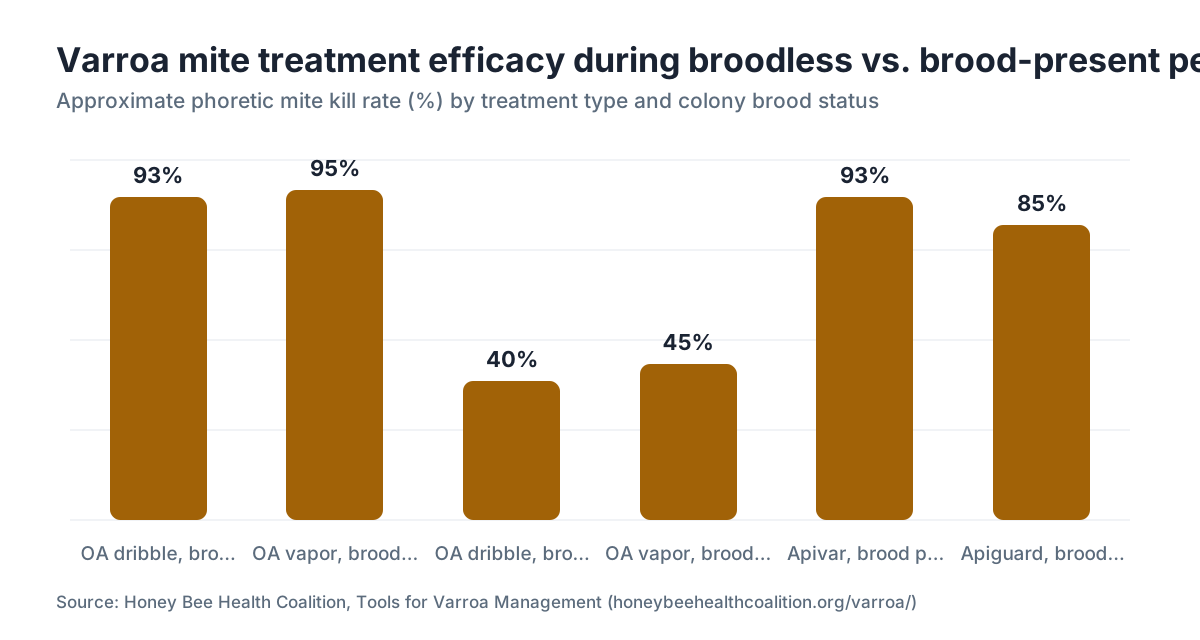
Dribble (trickle) method: Mix a 3.2% oxalic acid solution (the labeled recipe is 35g OA dihydrate per liter of 1:1 sugar syrup) and dribble 5ml per seam of bees, up to 50ml total per hive. This works well for packages because the bees cluster tightly and you can see exactly where they are. One treatment during the broodless window usually kills 90 to 95% of phoretic mites [5].
Vaporization (sublimation) method: A vaporizer, like the ones sold with the Api-Bioxal label, pushes OA vapor through the entrance. It's faster per hive if you have more than one or two packages, slightly better at reaching mites in gaps, and the data shows it matches or edges out dribble. A decent vaporizer runs $150 to $300, worth it if you run more than four or five colonies [6].
Neither method touches mites under capped brood, which is why timing during the broodless window matters so much. Once brood is capped, OA kills roughly 30 to 50% of the colony's mites, because the rest are sealed away. To reach a population with capped brood you need extended treatments like Apivar or Apiguard.
Amitraz (Apivar) and thymol products (Apiguard, Api Life VAR) work well once the colony has capped brood. For the first two-week broodless window, OA is the right tool. See our overview of varroa mite treatment options for a full comparison once your colony is established.
What varroa treatments are NOT appropriate for package bees?
A few things to skip.
Formic acid strips (MAQS, Formic Pro) are labeled for colonies with capped brood present, but the temperature and concentration requirements make them risky for a small spring cluster. High formic concentrations can kill queens, and package queens already carry transport stress. MAQS runs between about 50°F and 85°F, but the bigger problem is that a package without a full brood nest doesn't get the full benefit. Wait until the colony is established.
Apivar (amitraz strips) needs 6 to 8 weeks of bee contact to work, and it leaves residue in wax. Putting Apivar in a package hive on brand-new foundation means you're contaminating comb before the colony has any benefit from it. The label expects brood to be present for full efficacy. Skip it for now.
Apistan (fluvalinate) and CheckMite+ (coumaphos) both have documented resistance and persistent wax contamination problems. I wouldn't use either one, package or not [7].
Any product not registered with the EPA for honey bee colonies is illegal to apply and can hurt your bees and your honey. The EPA keeps a current list of registered pesticide products [5].
How do you do a varroa mite wash on a package before installing it?
Testing before you install is fast and hands you real numbers to decide with. Here's the alcohol wash, step by step.
Shake or scoop roughly 300 adult bees (about half a cup) from the package into a jar with a mesh lid. You want workers, not the queen, so don't sample the cluster nearest the queen cage. Cover the bees with 70% isopropyl alcohol, cap it, and shake for 60 seconds. Pour the liquid through a second fine mesh into a white tray. Count the mites. Divide by the number of bees (300 bees weigh about 30 grams, so weight is the easy estimate) and multiply by 100. That's your mites per 100 bees [11].
A count of 1 or below is good. A count of 2 or above means treat at or before installation. A count of 3 or above means treat immediately and consider calling your supplier, because that points to poor source-colony management.
The alcohol wash kills the sample bees, which some people resist on a 3-pound package. If that bothers you, a sugar roll gives a rough read without killing bees, but remember the 25 to 35% undercount. For a definitive arrival read, the wash is worth the 300 bees.
For the gear to run this test and your treatments, check beekeeping supply companies that carry approved OA vaporizers and testing jars.
Does it matter where your package came from?
It does, more than most beekeepers realize. Producers vary a lot in how consistently they test and treat source colonies before packaging [2]. Some run a pre-shipment OA treatment, which genuinely lowers loads in the shipped package. Others treat on a calendar that may not match the actual mite levels in any given colony.
Hawaii-sourced packages have historically arrived cleaner, because the production season and genetics there differ from mainland operations. That still varies by producer and year. California packages, which dominate the early spring market for northern beekeepers, run from very clean to badly infested depending on the operation.
Ask your supplier three questions. Do you test source colonies before packaging? What method, alcohol wash or sticky board? Did you treat before shipping, and with what? A supplier who answers those specifically is doing it right. Vague reassurances that their bees are "healthy" tell you nothing you can act on.
Package pricing ran roughly $130 to $200 for a 3-pound package with a mated queen across 2024 and 2025, depending on region, genetics, and shipping [8]. Spending an extra $10 on OA supplies to protect that investment is not a hard call.
What is the mite treatment threshold for newly installed packages?
The Honey Bee Health Coalition sets the spring broodless-period threshold at 2 mites per 100 bees [3]. For a package specifically, where the entire mite population is phoretic and OA is near 100% effective, treating at 1 per 100, or even prophylactically, makes sense to a lot of experienced beekeepers even below the published number.
The reasoning is simple. You're starting from zero brood frames, you have a limited mite population, and OA has almost no downside during the broodless window. A colony started at 0.1 mites per 100 in April is likely to stay under 2 per 100 through late June with no further treatment, which gives you room to establish the colony before your first summer check. A colony started at 2 per 100 in April can hit 5 to 6 per 100 by July if you don't treat again, especially with varroa immigration from nearby collapsing colonies [1].
The Coalition's Varroa management guide, the closest thing beekeeping has to a consensus document, states that "during broodless periods, a single oxalic acid treatment can reduce mite populations by 90% or more." [3] That's the benchmark.
For how these numbers translate into mite population growth over a season, the varroa mite overview covers the biology in detail.
How do you apply oxalic acid to a package hive step by step?
Say you're doing an OA dribble, the lowest-barrier method. Here's the actual process.
First, confirm your package is broodless. If more than 12 days have passed since installation and the queen has been laying, you may already have capped brood. Check before you treat, because efficacy drops sharply once brood is capped.
Get Api-Bioxal, the only EPA-registered OA product for honey bees in the US [5]. Don't use pool-supply oxalic acid. The label matters legally and for dosing accuracy. Mix per the label: 35g Api-Bioxal per liter of 1:1 sugar syrup (by weight), which gives the 3.2% OA concentration. The syrup should be warm enough to dissolve the OA completely.
Fill a 5ml syringe or the small dribble applicator sold with Api-Bioxal. With the package installed or with bees still in the cage, dribble 5ml directly onto the cluster in each seam, moving side to side. Don't dump it all in one spot. The dose is 5ml per seam, maximum 50ml per colony. A just-installed package typically has 6 to 8 seams of bees.
Wear nitrile gloves and eye protection. OA is an irritant and the label requires it. Don't treat below 40°F or above 85°F.
If you're vaporizing, follow your vaporizer's instructions, but the Api-Bioxal label calls for 1g of OA per brood box, vaporized at the entrance for roughly 2 to 3 minutes with the entrance sealed. One treatment during the broodless window is usually enough [5].
Record the date, the method, and the mite count before treatment, then run a follow-up wash 3 to 5 days later to confirm the kill. Most beekeepers skip the follow-up and then wonder why their count is high in July.
When should you do a second varroa treatment after installing a package?
The second window depends on how fast your colony builds and what your monitoring shows.
After the first broodless OA treatment, the next check should land around 6 to 8 weeks after installation, once you have a substantial laying population and capped brood. By then, the few mites that survived under capped brood during the first treatment have reproduced, and some are phoretic again. An alcohol wash at that point gives you a realistic midsummer picture.
If mite levels are at or above 2 per 100 by late May or June, treat. Apivar (amitraz strips) is the most reliable workhorse at this stage. The label calls for two strips per brood box for 6 to 8 weeks, with a 50°F minimum temperature [9]. Thymol products (Apiguard above 60°F, ideally 65°F or higher) are an alternative if you prefer soft chemicals.
If you're below 2 per 100 in late May, check again in late July. August is the window that decides your winter, because those bees are the ones that will overwinter. A mite load above 2 to 3 per 100 in August is tied to high winter loss [12].
The Varroa management tools at VarroaVault can track these monitoring dates and set treatment reminders across your season, so you don't miss the windows that matter.
Does feeding a new package affect varroa treatment timing?
Feeding 1:1 sugar syrup to a new package pushes comb building and queen acceptance, and most beekeepers start feeding at installation. Feeding doesn't change OA timing or efficacy directly, but here's one thing to know. Don't dribble OA at the same moment you're feeding syrup through an open or frame feeder, because the syrup dilutes the OA if the bees are wet with it. Dribble OA when bees are in their dry cluster, then add the feeder.
There's no evidence that feeding pollen substitute to a new package causes problems with OA. Protein supplement can actually help the colony shake off transport stress and get eggs developing faster, which is good overall. The reason to feed early is comb and queen acceptance, not mite control.
You can find discussion of early package nutrition and supplemental feeding in beekeeping communities focused on new colony establishment, including on beehive pollen nutrition topics.
What varroa records should you keep for a package installation?
Good records at installation make every later treatment decision easier. The minimum worth keeping:
- Installation date
- Package source (producer, state of origin)
- Mite count on arrival (method used, result per 100 bees)
- Treatment applied (product, dose, method, date)
- Follow-up mite count date and result
- Queen acceptance date
- First capped brood observed
This sounds like a lot. It's about five minutes of notes per hive. The value shows up at midsummer, when you're trying to figure out whether the mites you're seeing are leftover arrival mites, drift from neighbors, or a treatment failure. Without a baseline count, you're guessing again.
Several free worksheets exist. The Honey Bee Health Coalition's downloadable colony log is one of the cleaner ones [3]. Some beekeepers use phone notes or a dedicated app. The format matters less than doing it every time.
Are package bees from Hawaii or certified mite-resistant breeders already safe from varroa?
No, not in any absolute sense. This misconception is worth killing directly.
Hawaiian packages get marketed as low-mite because Hawaiian operations can manage mite levels more easily in that climate. That can be true, but individual packages still arrive with mites, and the spread between producers is wide.
Mite-resistant stock (VSH bees, Hygienic bees, Russian bees, Ankle-biter lines) suppresses mite reproduction but doesn't erase mites. The USDA ARS bee breeding lab in Baton Rouge, which developed VSH (Varroa Sensitive Hygiene) bees, is clear that VSH colonies still need monitoring and may need treatment, especially in the first season before the trait's effect on mite reproduction fully shows up in the population [10]. The trait works by bees uncapping and pulling mites from brood cells, which takes a critical mass of VSH bees to run well. A fresh package with VSH genetics isn't expressing that suppression yet.
Treating a VSH or other resistant-stock package during the broodless window costs you essentially nothing and clears the mites that arrived. It doesn't undermine the genetics. Skipping monitoring on the assumption that your stock is "resistant" is exactly how people end up with 5% mite loads by August.
Frequently asked questions
Can I treat a package for varroa before I install it?
Yes, and it's worth considering. With a vaporizer, you can seal the package cage and vaporize OA through the screen before shaking bees into the hive. Some beekeepers do this right at pickup. It's most practical with a cage-style vaporizer. The dribble method can also go through the screen before installation, though it's messier. Either way, the broodless window drives the high efficacy, not the exact timing relative to installation.
How many mites per 100 bees is dangerous for a new package?
The Honey Bee Health Coalition's spring threshold is 2 mites per 100 bees. For a new package with no capped brood and a small adult population, even 1 to 2 per 100 warrants treatment, because that population grows quickly once brood is established. A load above 3 per 100 at installation is a clear sign the source operation had a mite problem, and immediate treatment is needed.
Does installing a package without treating cause problems if my area has low varroa pressure?
Varroa pressure varies by region, but no area of North America, outside isolated island populations, reliably keeps colonies under threshold without management. "Low pressure" usually means nearby colonies haven't crashed yet. Package bees arrive with mites regardless of local pressure, and without treatment or monitoring at installation, you're relying on luck. Test on arrival and decide from data, not assumptions about your area.
Will oxalic acid harm my new queen?
At labeled doses, OA dribble and vaporization don't harm queens in the research literature, and the EPA-registered Api-Bioxal label covers use with the queen present. Beekeepers treating tens of thousands of packages and nucs with OA at installation report no elevated queen loss tied to treatment. The real queen risk comes from excessive doses or disturbing the cluster in cold weather, not from OA itself.
How long after installing a package does the broodless window last?
A new queen usually starts laying within 3 to 5 days of release, assuming she's accepted. First worker brood is capped about 9 days after the egg is laid, so roughly 12 to 14 days after installation you may have sealed brood. In practice, the safe window with near-100% OA efficacy is the first 10 to 12 days after installation. Treat within that window and you're hitting essentially all phoretic mites.
Can I use Apivar strips on a newly installed package?
The label technically allows it, but it's not the best choice for a broodless package. Apivar needs 6 to 8 weeks of bee contact to work, and the amitraz it releases accumulates in new wax. OA during the broodless window is cleaner, faster, and more effective for this specific situation. Save Apivar for the established colony if mites climb again after the broodless OA treatment.
What if I can't get Api-Bioxal in time for my package installation?
Api-Bioxal is the only EPA-registered OA product for honey bees in the US, and using unregistered oxalic acid violates federal pesticide law (FIFRA). Many beekeepers order Api-Bioxal alongside their packages to have it on hand. If you genuinely can't get it in time and your count is below 1 per 100, monitoring and treating with Apivar once brood is established is a reasonable fallback. Don't use pool-supply oxalic acid.
Should I treat all packages, or only ones with high mite counts?
Testing first is the right call, but if you can't test, treating all packages prophylactically with OA during the broodless window is low-risk and broadly recommended by extension apiculturists. The cost is under $5 per hive and the efficacy on phoretic mites is high. The main argument against blanket treatment without testing is that it skips the monitoring data you need to catch a supply problem or track your threshold performance over the season.
Do I need a license or prescription to use oxalic acid on my package bees?
No. Api-Bioxal is an over-the-counter product in the US and needs no veterinary prescription. You do need to follow the EPA label exactly. Some states have extra pesticide rules, so checking your state department of agriculture's apiculture page is worth a few minutes, but in most states OA dribble and vaporization are open to any registered beekeeper.
How do I know if my varroa treatment on the package actually worked?
Run a follow-up alcohol wash 3 to 5 days after treatment. You want a substantial drop from your pre-treatment count. A 90% or greater reduction is typical for OA during a broodless period. If the count barely moved, either the broodless window had already passed (capped brood present), the treatment went in wrong, or you have an unusual situation worth flagging to your state apiarist.
Can package bees spread varroa to my other hives?
Yes, through robbing and drift. A high-mite package installed near established hives can spread mites via robber bees, especially if the package colony is weak in its early weeks. That's another reason to treat and monitor packages: you're protecting your whole apiary, more than the new colony. Keep new packages as strong as you can early on to cut robbing pressure.
Is a sugar roll good enough to test packages for varroa on arrival?
It gives a usable estimate, but it undercounts mites by 25 to 35% compared to an alcohol wash, according to Penn State Extension testing. For an arrival test where you're deciding whether to treat, factor that undercount in. If a sugar roll shows 1.5 mites per 100, the actual count is likely around 2. Alcohol wash is more accurate, so use it when the decision sits close to the threshold.
What temperature is safe to treat a new package with oxalic acid?
The Api-Bioxal label recommends treating between 40°F and 85°F for dribble. A similar range applies for vaporization. Below 40°F, bees cluster too tightly and may not spread the treatment through the cluster. Above 85°F, the treatment can stress bees and vapor can dissipate too fast. Early spring packages in northern states often go in near 40 to 55°F, which is fine for treatment.
Sources
- USDA ARS, Bee Research Laboratory, Beltsville: Varroa destructor is established in all honey bee producing states on the US mainland; phoretic mites are present in package colonies at shipment
- University of Minnesota Bee Lab: Package bee mite loads on arrival range from approximately 0.5 to 2 or more mites per 100 adult bees depending on source colony management
- Honey Bee Health Coalition, Tools for Varroa Management: Spring broodless-period treatment threshold is 2 mites per 100 bees; a single OA treatment during broodless periods can reduce mite populations by 90% or more
- Penn State Extension: Sugar rolls undercount varroa mite loads by approximately 25 to 35% compared to alcohol wash methods
- US EPA, Pesticide Registration (Api-Bioxal label): Api-Bioxal (oxalic acid dihydrate) is the EPA-registered OA product for honey bees; label calls for 3.2% solution dribbled 5ml per bee seam or 1g vaporized per brood box
- NC State Extension: OA vaporization matches or slightly outperforms dribble in phoretic mite kill efficiency; vaporizer equipment costs range from roughly $150 to $300
- University of Florida IFAS Extension (EDIS): Documented resistance to fluvalinate (Apistan) and coumaphos (CheckMite+) in varroa populations reduces efficacy; persistent wax contamination documented for both compounds
- American Bee Journal: 3-pound package bee pricing in 2024 to 2025 ranges from approximately $130 to $200 depending on region, source, and shipping method
- US EPA, Pesticide Registration (Apivar label, EPA Reg. No. 87243-1): Apivar label requires two strips per brood box for 6 to 8 weeks; minimum ambient temperature 50 degrees F for efficacy
- USDA ARS Honey Bee Breeding, Genetics, and Physiology Research Unit, Baton Rouge: VSH colonies still require monitoring and may require treatment; trait requires critical mass of VSH workers to fully suppress mite reproduction
- Oregon State University Extension: Alcohol wash is the standard field monitoring method for varroa; a 300 bee sample is recommended for accuracy
- University of Georgia Extension: High mite loads in August are strongly associated with winter colony loss; a threshold of 2 to 3 mites per 100 bees in August represents a high-risk population
Last updated 2026-07-09