Treating varroa in a flow hive safely: what actually works

TL;DR
- You treat varroa in a Flow Hive the same way you treat any Langstroth: monitor mite loads with an alcohol wash or sugar roll, hit the 2% threshold before mite populations explode, and choose a treatment that matches whether honey supers are on or off.
- The Flow super is not magic protection.
- Varroa does not care what your frames look like.
Does a Flow Hive change how you manage varroa?
No. It needs to be said clearly because a persistent myth floats around beginner forums that Flow Hives somehow reduce varroa pressure or make treatments unnecessary. They don't.
A Flow Hive is a Langstroth hive with a modified super. The brood box beneath that super is standard Langstroth. Varroa destructor lives, reproduces, and spreads exactly as it would in any other colony. Every mite biology fact you read about applies here without exception.
Where the Flow design does create a real complication is in honey harvest. The plastic Flow frames make it tempting to leave supers on year-round, harvest small amounts continuously, and skip the routine of pulling supers off before treatment. That habit, more than anything, is what gets Flow Hive keepers into trouble. You get busy watching honey dribble out of that window, and you forget to pull the super and treat. By late summer your mite count is catastrophic.
So here's the honest framing of this whole article. Flow Hive varroa management is standard varroa management, plus one extra question you have to answer before every treatment. That question: is there harvestable honey in the Flow super right now, and does my chosen treatment require the super to be off?
What mite level means you need to treat a Flow Hive colony?
The Honey Bee Health Coalition's Varroa management guide sets the treatment threshold at 2% infestation (2 mites per 100 bees in an alcohol wash) during the honey production season, and at 2% going into fall [1]. Some extension programs use a more conservative 1% threshold in late summer because mite populations grow exponentially and the winter bees being produced in August and September are the ones that need to survive through March.
You measure this with an alcohol wash. Take about 300 bees (roughly half a cup) from a frame of open brood, not the frame the queen is on, add 70% isopropyl alcohol, shake for 30 seconds, and count mites in the wash versus bees. Divide mites by bees, multiply by 100. That's your percentage [1].
Sugar rolls are less accurate. A 2019 study published in PLOS ONE found that alcohol washes detected significantly more mites than sugar rolls in side-by-side comparisons, with sugar rolls underestimating infestation by roughly 40% on average [2]. If you're making a treatment decision, use alcohol.
At 2% or above during spring through midsummer, treat. At any percentage above 2% in August, treat immediately, because your colony is heading into a death spiral. The Honey Bee Health Coalition puts it plainly: "Untreated colonies with high mite loads in late summer rarely survive winter." [1]
For Flow Hive keepers, the temptation is to delay treatment because honey is in the super. Don't. A dead colony in October produces no honey next year. Check out our varroa mite overview for a refresher on the biology driving that exponential growth.
Which varroa treatments are safe when honey supers are on?
This is the real practical question for Flow Hive keepers, and the answer is short: almost nothing.
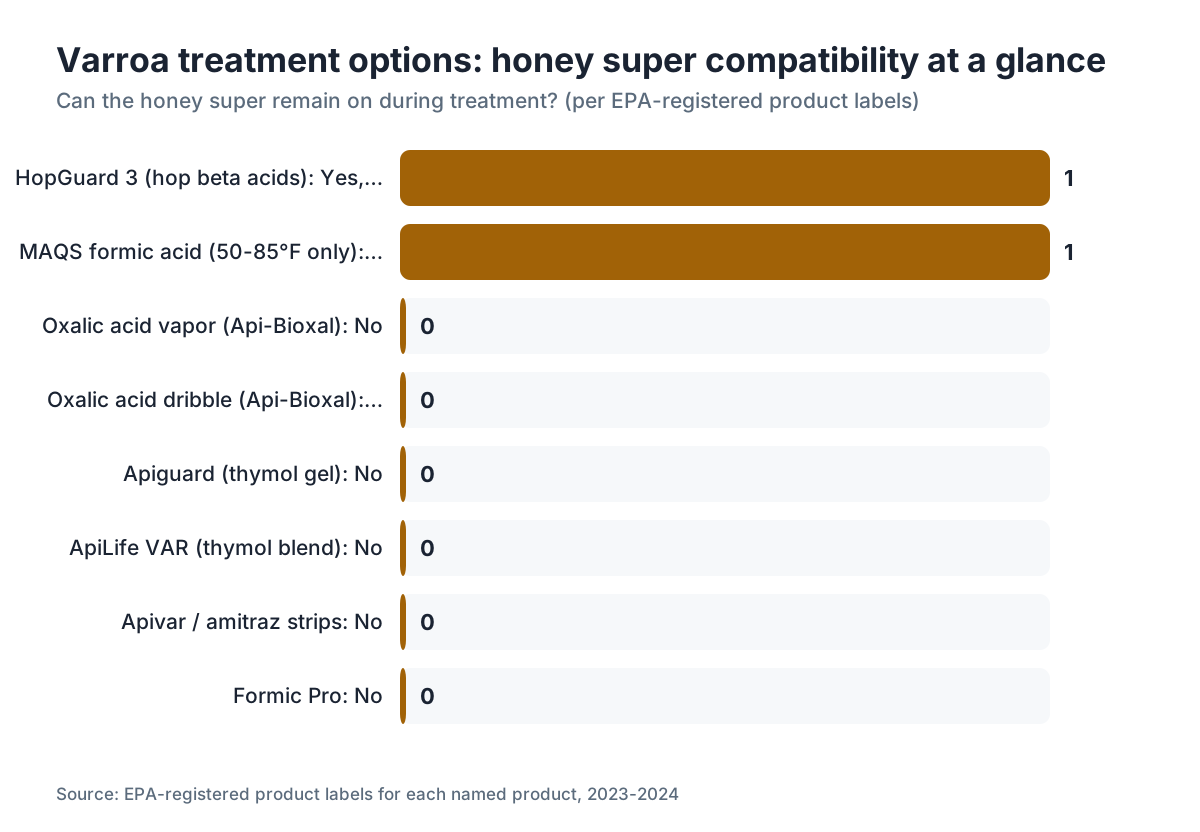
Here is the treatment landscape, organized by label status with honey supers present:
| Treatment | Active ingredient | Honey supers on? | Notes |
|---|---|---|---|
| Oxalic acid dribble (Api-Bioxal) | Oxalic acid | No | Only effective on mite-free colony or broodless period |
| Oxalic acid vapor (Api-Bioxal) | Oxalic acid | No | Not labeled for use with supers on [3] |
| HopGuard 3 | Hop beta acids | Yes (limited) | Label permits use with supers, but only in certain conditions; read label carefully [4] |
| Apiguard | Thymol gel | No | Honey taint risk; label requires removal of honey supers [5] |
| ApiLife VAR | Thymol blend | No | Same restriction as Apiguard [5] |
| Formic Pro / MAQS | Formic acid | Yes (MAQS only under specific conditions) | MAQS label allows use with honey supers on but requires temperatures between 50°F and 85°F; Formic Pro label is more restrictive [6] |
| Amitraz strips (Apivar) | Amitraz | No | Strict prohibition; residues accumulate in wax [7] |
| Apivar (generic) | Amitraz | No | Same prohibition |
The practical upshot for most Flow Hive keepers: if you have honey in the super, HopGuard 3 is your most defensible option for treating now without pulling the super, but its efficacy record is weaker than oxalic acid or formic acid. MAQS (formic acid) is labeled for use with supers on but has a narrow temperature window and can cause queen losses at higher temperatures.
The better protocol is to pull the Flow super, treat properly, and replace the super after the treatment period ends. With oxalic acid vapor during a natural or induced broodless period, that can be as quick as three applications over three weeks [3].
Before you treat anything, read the current product label. EPA product labels are legal documents. The label governs, not forum advice, not YouTube videos, not this article.
How do you use oxalic acid safely in a Flow Hive?
Oxalic acid is the most effective treatment available for broodless colonies, and it's the one most hobbyist beekeepers should reach for in late fall or during a planned broodless period.
Api-Bioxal is the only EPA-registered oxalic acid product approved for use in the United States [3]. The label requires that honey supers intended for human consumption be removed before treatment. This is non-negotiable on the label.
For a Flow Hive, the process looks like this. Pull the Flow super off. Store it somewhere bees can't rob it out. Apply oxalic acid according to label directions, either by dribble (only effective without capped brood present) or by vaporization (more effective across a range of brood states, but still more efficient during broodless periods). The EPA-approved dribble dose is 50 mL of 3.2% solution per 10 frames of bees [3]. Vaporization uses 2.17 grams of Api-Bioxal per brood box [3].
Wait out the treatment period. For vaporization during a broodless period, three treatments spaced five days apart generally collapses the mite population by over 90% [3]. Once the treatment period ends and enough time has passed per label requirements, you can put the Flow super back.
Safety matters here. Oxalic acid vapor is a serious respiratory hazard. Wear a NIOSH-approved respirator rated for acid vapors, not a dust mask. Wear nitrile gloves and eye protection. Do not vaporize in an enclosed space without ventilation. The EPA registration for Api-Bioxal includes specific personal protective equipment requirements that aren't optional [3].
Can you use formic acid treatments in a Flow Hive?
Formic acid penetrates capped brood cells, which makes it the only organic acid treatment that kills mites reproducing inside cells. That's a significant advantage over oxalic acid for colonies with heavy brood.
Mite Away Quick Strips (MAQS) are labeled for use with honey supers on, which is why they appear on the list above. But the label has strict temperature requirements: ambient temperatures must be between 50°F and 85°F (10°C to 29°C) during treatment [6]. Above 85°F, formic acid volatilization accelerates to the point where it can kill queens. In a hot August when your Flow super is full of honey and you desperately need to treat, it might also be 90°F in the shade. That's outside the MAQS label window.
Formic Pro has a different label than MAQS and is more restrictive about supers. Check the current Formic Pro label specifically; don't assume MAQS rules apply.
If temperatures are in range and you're using MAQS, the Flow super can stay on, but you should not harvest that honey during treatment. Wait until the strip treatment is complete (7 days for MAQS) before harvesting. The formic acid volatilizes and leaves no residue in honey at label-compliant doses, which is why the label allows it, but giving it a few days after removal before harvest is sensible practice.
The queen loss risk with MAQS is real. Reported queen loss rates in some studies run between 5% and 15% depending on temperature and colony conditions [6]. Go in knowing that.
What about amitraz strips (Apivar) in a Flow Hive?
Apivar works well against varroa and is widely used. The active ingredient, amitraz, is a synthetic acaricide with strong efficacy. But the label prohibits use when honey supers are on, full stop [7].
More importantly for Flow Hive keepers who use plastic frames: amitraz accumulates in beeswax. The Flow frames have some wax coating applied by bees, and standard research on Langstroth frames shows amitraz residues persist in wax long after treatment ends. A study from Penn State found that amitraz residues in comb wax can remain detectable for multiple years [7].
This doesn't mean Apivar is dangerous if used correctly according to label directions, with supers off, and with supers kept off for the full 42-56 day treatment period. It means you cannot shortcut the protocol because you want to harvest from your Flow super sooner. Remove the super, treat for the full label duration, replace the super afterward.
Apivar should not be your first-line treatment in spring or midsummer if honey production is ongoing. It belongs in fall or winter management when the colony is not producing surplus honey.
Should you ever pull the Flow super off just to treat varroa?
Yes. Regularly. This is the core habit that separates Flow Hive keepers with healthy colonies from those who lose colonies over winter.
The pull-and-treat protocol is this: in late summer, typically late July through August in most of the US, pull the Flow super, treat with the most appropriate product for your conditions (usually oxalic acid vapor or formic acid), complete the treatment period, and replace the super if there's still a nectar flow happening. In many climates, the late-summer treatment lands right at the end of the major flow anyway, so you're not losing much harvestable production.
The Honey Bee Health Coalition's management guide recommends treating in late summer or early fall as the single most consequential treatment of the year, because it protects the winter bees [1]. If you miss this window, the mite-damaged, virus-ridden bees that will form your winter cluster are already being raised.
Pulling the Flow super for treatment is not a failure of the system. It's just beekeeping. The Flow design makes harvesting easy, not mite management optional. Those are different things.
How do you protect Flow frames during treatment?
When you pull the Flow super to treat, you need to store it somewhere bees can't access. A garage, shed, or basement works fine. The plastic Flow frames don't require special conditions; they won't melt at room temperature and don't need to be kept perfectly level unless there's liquid honey in them.
If the frames have substantial honey in them when you pull the super, you have a few options. Harvest the honey first through the Flow tap, which empties most of the cells. Leave some capped honey in place and store the super wrapped in a trash bag to keep pests out. Or put the super in a chest freezer for 48 hours to kill any small hive beetle larvae or wax moth eggs before storage.
Don't store a honey-loaded Flow super in a place where robber bees can get to it. Robbing can turn chaotic fast and will spread varroa mites from your colony to neighbors and vice versa.
When you return the super after treatment, bees will clean and refurbish the cells quickly. The gap in production from a properly timed treatment is small, usually two to four weeks. That's a reasonable trade for a colony that survives to next spring.
What's the right varroa treatment schedule for a Flow Hive through the year?
A seasonal protocol for most temperate US climates looks like this:
Spring (March to May): Monitor monthly with alcohol wash. If mite load is above 2% before the main flow, treat with oxalic acid vapor (pull the super if it has honey, which in early spring it probably doesn't) or formic acid if temperatures permit. Many colonies emerge from winter with low mite loads if fall treatment went well, so spring treatment isn't always necessary.
Early summer (May to July): Monitor every 2-4 weeks during peak brood production because mite populations build fastest now. If you hit 2%, treat. If you're running the Flow super and honey is going in, formic acid (MAQS within temperature range) or HopGuard 3 are your labeled options. Otherwise pull the super and use the most effective product available.
Late summer (late July to August): This is the most critical window. Pull the Flow super. Treat regardless of whether your mite count is at 2%, if it's approaching 1.5% and you haven't treated since spring, treat now. Oxalic acid vapor over three to five treatments, or Formic Pro, depending on your conditions. This is the treatment that saves your winter cluster.
Fall (September to October): Monitor after late-summer treatment. If mites rebound above 2% (they can, especially with drone brood still present), treat again. Apivar is a reasonable fall choice with supers off.
Winter (November to February): If your colony goes broodless, a single oxalic acid dribble or vaporization during the broodless period is highly effective and cheap. It won't hurt to do this even if you treated in fall. The mites have nowhere to hide.
VarroaVault's free protocol builder can help you map this schedule to your specific region and colony count if you want a tool to track treatment windows and thresholds.
For sourcing treatments and equipment, check the options listed at beekeeping supply companies to find registered products available in your area.
Are there any varroa treatment mistakes specific to Flow Hive beekeepers?
A few patterns come up repeatedly.
Leaving the super on through fall because "there's still honey in there" is the most common. The Flow design makes it psychologically hard to pull a super with honey in it. But late-summer treatment trumps late-season honey. Always.
Using thymol products (Apiguard, ApiLife VAR) when the Flow super is on. Both product labels explicitly require honey super removal, and thymol can taint honey with a medicinal flavor that makes it unpalatable and unsellable [5]. The plastic Flow frames may hold thymol odor longer than wooden frames simply because they don't breathe the same way. There's no published data specifically on thymol retention in Flow-style plastic frames, but the general principle holds: follow the label.
Sampling the wrong bees. Some Flow Hive keepers take bees from the super frames for their alcohol wash, not from brood nest frames. Bees in the super have low mite loads compared to nurse bees in the brood nest. Always sample from a frame of open brood in the lower box.
Assuming the Flow design provides some varroa resistance. It doesn't. There is no published peer-reviewed evidence that Flow Hive design reduces varroa infestation rates compared to standard Langstroth equipment.
Skipping the sticky board or mite wash entirely because the colony "looks healthy." A colony can lose 30% of its winter bees to varroa-transmitted deformed wing virus before you notice any clinical signs above the entrance. The virus wrecks fat body reserves in winter bees and shortens their lifespan from six months to roughly six weeks [1]. Monitor. Count. Treat on numbers, not looks.
Is there anything a Flow Hive does better that helps with varroa management?
Honestly, one thing: the window.
The Flow Hive's rear inspection window and the ability to see brood nest activity without fully opening the hive is a real convenience for regular monitoring checks. You won't count mites through a window, but you can quickly see if the cluster is strong, if the queen is laying well, and if anything looks obviously wrong. More frequent low-friction inspection tends to mean more frequent mite monitoring in practice, at least for some keepers.
The ease of pulling honey without disrupting the brood nest is also genuinely useful when timing your treatments. You can harvest most of the honey in the Flow super in an hour before pulling it for treatment, which reduces what you're sacrificing and makes the pull less psychologically difficult.
That's about it. The rest of varroa management in a Flow Hive is identical to a standard Langstroth hive. Same products, same thresholds, same seasonal windows, same consequences for ignoring it.
Where can you find reliable information on registered varroa treatments?
The Honey Bee Health Coalition's Varroa management guide is the best single free resource available. It's updated periodically by a working group of researchers, extension specialists, and industry representatives, and it covers monitoring methods, thresholds, and treatment options with citations [1]. Download it from the HBHC website directly.
EPA product labels are the legal authority on what a treatment product can and cannot be used for. The EPA's pesticide product label system lets you search for current registered labels by product name [3]. Always read the label you have in your hand because labels change when EPA grants label amendments.
University extension programs are the next best source. Penn State's Maarec program, University of Minnesota Extension, and NC State's Apiculture program all publish freely accessible varroa management guides written by researchers who work directly with bees [7][8].
The Bee Informed Partnership publishes annual colony loss data and management surveys that give you a realistic picture of what treatments beekeepers actually use and how colony outcomes correlate with management choices [9].
VarroaVault offers free downloadable mite-tracking logs and threshold calculators built around the HBHC thresholds if you want a practical tool to stay organized across multiple hives.
For any equipment you need, from vaporizer wands to alcohol wash kits, the beekeeping supplies market has grown considerably. Shop around before you buy.
Frequently asked questions
Can I treat varroa without removing the Flow super?
It depends entirely on the treatment. HopGuard 3 and MAQS (formic acid) are labeled for use with honey supers on under specific conditions. Oxalic acid, thymol products (Apiguard, ApiLife VAR), and amitraz strips (Apivar) all require super removal per their EPA labels. When in doubt, remove the super. The honey you lose from a two-to-four-week treatment window is far less costly than a dead colony.
Does the plastic in Flow frames affect which treatments I can use?
No published peer-reviewed data addresses this specifically for Flow frames. General guidance is that thymol-based products can cause flavor tainting in honey and may linger in plastic more than wood, though this is not confirmed for Flow frames specifically. Oxalic acid and formic acid do not interact with polypropylene in ways that registered product labels flag as a concern. Follow label directions and your particular situation will be covered.
How often should I do an alcohol wash on a Flow Hive?
Monthly during spring and summer, every two to three weeks during peak mite-building periods (May through August), and at least once in late fall before winter cluster forms. The Honey Bee Health Coalition recommends testing before and after each treatment to confirm efficacy. A colony that looks good at 0.5% in June can be at 4% by August if you stop monitoring.
What mite count is too high to save a colony?
There is no hard cutoff above which a colony is unsaveable, but colonies above 5% infestation in late summer face long odds going into winter without aggressive treatment. Even at very high mite loads, an oxalic acid vaporization series during a broodless period can crash the mite population. Act fast rather than writing the colony off. Queens are expensive. Packages are expensive. Treating at 6% is cheaper than replacing the colony.
Can I use oxalic acid dribble in a Flow Hive with brood present?
You can apply it, but it will have very poor efficacy. Oxalic acid dribble only kills phoretic mites (mites on adult bees). Mites inside capped brood cells are completely protected from the dribble. The only conditions where dribble works well are true broodless periods, usually midwinter in cold climates or after an artificial broodless period is created by caging the queen.
Will varroa treatments harm the Flow frame mechanisms?
Oxalic acid vapor and formic acid treatments are applied to the brood box with the Flow super removed, so the frames aren't directly exposed. Thymol gels placed in the brood box also don't contact Flow frames when the super is off. There are no reports in available literature of standard varroa treatments damaging Flow frame mechanisms, but since frames are removed during treatment, direct exposure is not an issue.
How do I know if my Flow Hive colony died from varroa?
Common signs of a varroa-related winter loss include a small, dead cluster with plenty of honey remaining, adult bees with shriveled or missing wings (deformed wing virus), crawling or trembling bees near the entrance in fall, and a sharp population crash in September or October. A retrospective alcohol wash on dead bees from the bottom board can sometimes still show mite shells. High mite loads in August are the strongest predictor.
Is it safe to eat honey from a Flow Hive that was treated with oxalic acid?
Yes, if the treatment was done according to the Api-Bioxal label, meaning the honey super was removed before treatment and replaced only after the treatment period ended. Oxalic acid occurs naturally in honey at low concentrations. At label-compliant application rates, Api-Bioxal does not leave residues in honey above naturally occurring background levels, per the EPA registration data underlying the Api-Bioxal label.
What's the difference between treating a single Flow Hive and treating a yard of hives?
Biology is identical. Logistics differ. In a yard of multiple colonies, you need to monitor each hive individually because mite loads vary enormously colony to colony. You also face reinfestation pressure: a heavily infested colony nearby will drift and rob, spreading mites to your treated hives. Treating all colonies in a yard simultaneously gives better collective results than staggered individual treatments.
Can I use drone brood removal to reduce varroa in a Flow Hive?
Drone brood trapping does reduce mite loads and can be a useful supplemental strategy, but it's not a standalone treatment for high mite counts. Varroa preferentially infests drone cells at about eight times the rate of worker cells. Removing capped drone frames every 21 days can reduce mite populations by 30-40% depending on conditions, but this works alongside chemical or organic treatments, not instead of them.
Does the Flow Hive company provide varroa management guidance?
Flow Hive's website includes some general beginner beekeeping guidance. For varroa management specifically, the most reliable sources are the Honey Bee Health Coalition's Varroa management guide, your state's cooperative extension apiculture program, and EPA-registered product labels. Flow's own guidance is a starting point, not a substitute for current research-based protocols from these sources.
What temperature is too cold to treat varroa in a Flow Hive?
It depends on the treatment. Formic acid (MAQS) requires ambient temperatures above 50°F to volatilize effectively. Oxalic acid vaporization works at lower temperatures and is commonly used down to around 40°F, though bee cluster size and configuration matter. Oxalic acid dribble works at any temperature where you can safely open the colony without chilling the brood or cluster. Check each product label for its specific temperature requirements.
How long after treating varroa can I harvest honey from a Flow Hive?
This depends entirely on which treatment you used. For oxalic acid (Api-Bioxal), the label requires that honey supers be absent during treatment; once you replace the super after treatment ends, honey produced afterward is fine to harvest. For MAQS, wait until the strips are fully removed before harvesting. For Apivar (amitraz), supers must be off for the full treatment period (42-56 days) before any honey contact. Always follow the current label.
Sources
- Honey Bee Health Coalition, Varroa Management Guide: Treatment threshold of 2% mite infestation during production season and going into fall; late-summer treatment is the most consequential of the year for winter survival
- PLOS ONE, alcohol wash vs sugar roll accuracy study: Alcohol washes detect significantly more mites than sugar rolls; sugar rolls underestimate infestation by roughly 40% on average
- EPA, Api-Bioxal (oxalic acid) product registration and label: Api-Bioxal is the only EPA-registered oxalic acid product for US use; label requires honey super removal; dribble dose is 50 mL of 3.2% solution per 10 frames; vaporization dose is 2.17 g per brood box
- HopGuard 3 EPA-registered label (BetaTec Hop Products): HopGuard 3 label permits use with honey supers on under specific conditions
- Vita (Europe) Ltd, Apiguard product label; ApiLife VAR label: Thymol-based products Apiguard and ApiLife VAR require removal of honey supers before treatment; honey taint risk from thymol is documented on labels
- NOD Apiary Products, MAQS (Mite Away Quick Strips) EPA-registered label: MAQS is labeled for use with honey supers on; ambient temperature must be between 50°F and 85°F; queen loss rates reported between 5% and 15% in some conditions
- Penn State Extension / Maarec, Apivar (amitraz) use guidelines and wax residue research: Apivar label prohibits use with honey supers on; amitraz residues in comb wax can remain detectable for multiple years after treatment
- University of Minnesota Extension, Varroa mite management: Seasonal varroa management protocols for temperate US climates including monitoring frequency and treatment timing
- Bee Informed Partnership, Annual Colony Loss Survey: Annual US colony loss data and management practice correlations informing treatment timing recommendations
- NC State Extension Apiculture, Varroa management resources: University-based varroa treatment protocols and monitoring guidance for eastern US climates
Last updated 2026-07-09