Treating varroa in a double deep hive setup
TL;DR
- Double deep hives hold more bees, more brood, and more places for varroa to hide, which makes treatment harder than a single deep.
- Oxalic acid vapor works well through both boxes.
- Apivar strips and formic acid pads need careful placement in each box.
- Treat when an alcohol wash shows 2% mites or higher in summer, and treat urgently at 3%.
Why does a double deep hive make varroa treatment harder?
More space means more brood, and more brood means more mites hiding in capped cells where no treatment can touch them. A healthy double deep in mid-summer holds 14 to 18 frames of brood across both boxes. That is a lot of cells. Varroa reproduces inside those capped cells, so the bigger the brood nest, the bigger the reservoir of mites any treatment has to outlast or reach.
Bee population is the other problem. More bees dilute a vapor treatment. Formic acid, oxalic acid vapor, and thymol all work by reaching bees and open brood through the air inside the hive. A double deep with a heavy cluster is harder to saturate than a nuc or a single deep, especially early in the season when bees pack both boxes tight.
Then there is the monitoring math. Pull an alcohol wash from only the top box and you might miss a mite population concentrated in the bottom box where the queen has been laying longest. More on sampling below.
What mite level triggers treatment in a double deep?
The threshold does not change with hive configuration. The Honey Bee Health Coalition recommends treating at 2% mites (2 per 100 bees) or higher from spring through late summer, and acting urgently at 3% or more [1]. Some extension programs set the summer action threshold at 3%. The gap usually comes down to local conditions and when in the season you sample.
What does change in a double deep is where you sample. Pull your 300-bee alcohol wash from the box the queen is laying in now, because nurse bees on brood frames carry the highest mite loads. Sample the same box out of habit and you will miss a mite explosion in the other one. Rotate your sampling point, or pull 150 bees from each box and combine them into one wash.
The Coalition's Varroa management guide is the clearest single document on thresholds, monitoring frequency, and treatment timing. Read it once a year as a calibration check [1].
Before you plan a treatment, the varroa mite overview covers the reproductive cycle that makes threshold timing matter so much.
How do you monitor varroa accurately in a two-box setup?
Alcohol wash is the gold standard. Sticky boards tell you mites are falling but not how many mites per bee, so they track a trend but do not settle a treatment decision [1]. Sugar rolls are gentler, but they undercount by 30 to 40% against alcohol washes in side-by-side tests, and most researchers have dropped them for threshold work.
Here is the field protocol for a double deep:
- Find the brood nest. In most double deeps the queen and the bulk of open brood sit in the bottom box in spring, then spread into both boxes by summer.
- Shake or brush about 150 bees from a brood frame in the bottom box into a jar. Add 150 from a brood frame in the top box.
- Add 70% isopropyl alcohol, shake for 60 seconds, strain, and count mites against the total bee count.
- Calculate: mites divided by bees, times 100, equals percent infestation.
Sample every two weeks during the active season. That pace catches a rising infestation before it crosses 3% and starts wrecking brood.
University of Minnesota Extension names alcohol wash the most reliable field method and publishes a free counting-cup guide [2].
Does oxalic acid vaporization work in a double deep?
Yes, and it is the most practical choice for double deeps when the colony is broodless or close to it. Oxalic acid vapor fills both boxes without you opening the hive, so you never move supers, split boxes, or guess which box holds more bees.
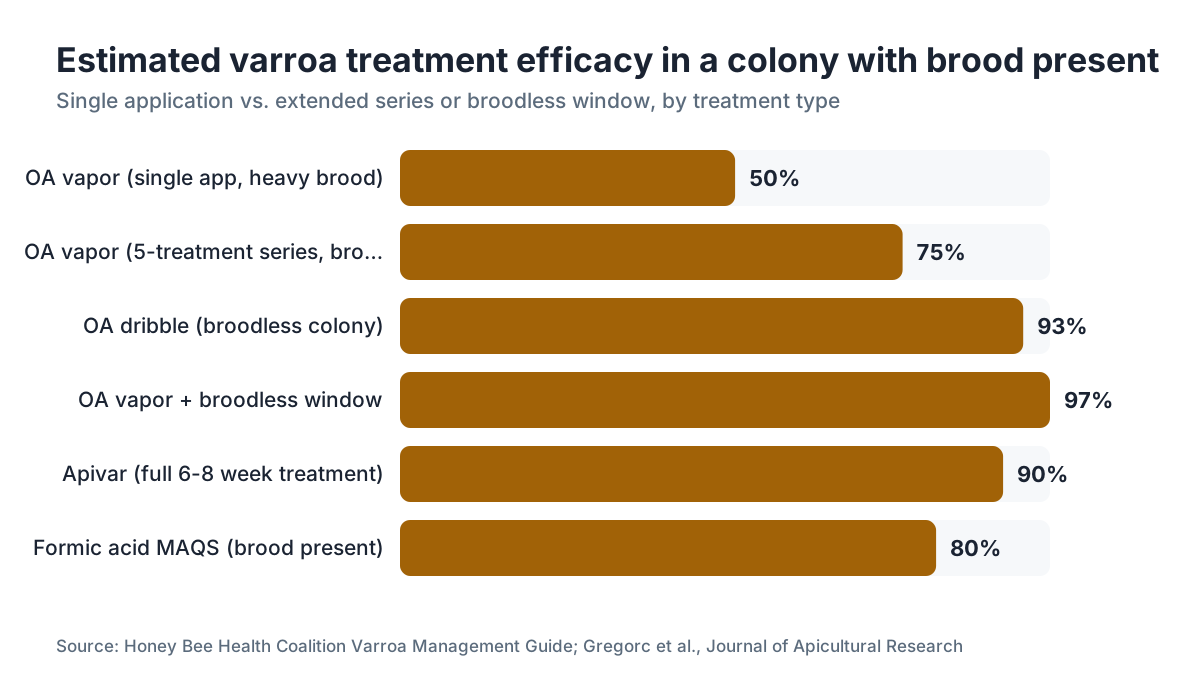
The EPA-registered label for oxalic acid (sold as Api-Bioxal in the United States) allows up to five vaporizations at seven-day intervals when brood is present, or a single application when the colony is broodless [3]. Broodless conditions (after a queen removal, a split, or a tight winter cluster) give the highest efficacy from a single vaporization, because every adult bee is reachable and no capped cells shelter mites.
For double deeps with brood, run the extended series: up to five treatments, one a week. Trials on extended OA vapor with brood present show 60 to 90% efficacy depending on how much capped brood sits in the hive at the start [4]. More brood, more treatments to catch mites as they emerge.
Seal every crack and entrance during vaporization, including any gap between boxes from warping. The vapor has to stay inside long enough to work. Ten to fifteen minutes with entrances closed is the standard label guidance.
The dose does not change for two boxes. The Api-Bioxal label calls for 2.0 grams per brood box [3]. With two brood boxes, many beekeepers split the dose or do two sequential vaporizations from the bottom entrance. Read the current label for your specific vaporizer.
Can you use Apivar (amitraz strips) in a double deep?
Yes. Apivar is one of the most reliable treatments made, and it works fine in double deeps, but placement decides everything. The label requires two strips per brood box, so a double deep gets four strips total [5]. Two in the bottom box, spaced apart in the brood area. Two in the top box, same pattern.
The strips have to touch bees, not hang in empty comb. Bees pick up amitraz by walking across the impregnated plastic and spread it through the colony by grooming. If your top box is thinly populated early in the season, bees may skip the strips up there and efficacy drops. Check at two weeks and slide strips toward the cluster if you need to.
Apivar runs a 6 to 8 week treatment period [5]. Do not pull strips early. Amitraz resistance is documented in some varroa populations, and short treatments speed it up. The full contact time is what the label is built on.
Honey supers come off during Apivar. That is not unique to double deeps, but it drives your calendar. Plan Apivar for spring before the main flow, or fall after you pull supers. Late summer, after the flow but before winter prep, is the single most important treatment window for colony survival [1].
Does formic acid (MAQS or Formic Pro) work across two boxes?
Formic acid vapor is one of the few treatments that gets inside capped brood and kills mites in the cell. That makes it worth using in a heavily brooded double deep. Mite-Away Quick Strips (MAQS) and Formic Pro are the two EPA-registered formic acid products in the US [6].
MAQS calls for two pads on the top bars of the bottom brood box in a single-deep setup. In a double deep, the vapor has to climb through both boxes, and the evidence that it does so evenly is thinner than for a single-box colony. The label does not spell out separate placement for the second box, but research suggests top-box efficacy runs lower than the bottom box when pads sit on the bottom box's top bars [7].
Practical options: put the pads on the top bars of the top box, not the bottom, if the queen and the bulk of capped brood sit up top during summer. Or split the pads, one on the top bars of each box. The label allows some flexibility here. Confirm against the current label before you apply.
The temperature limits are strict. MAQS should not go on when temperatures will top 92 degrees Fahrenheit (33 Celsius) during treatment [6]. Formic Pro has a slightly wider window. In a double deep during an August heat wave, that is a real constraint. In a hot climate, oxalic acid or Apivar is the safer late-summer pick.
Formic acid has one clear edge in a double deep: you can run it with honey supers in place, which neither Apivar nor ApiLife Var can claim [6].
What about thymol-based treatments (ApiLife Var, Apiguard)?
Thymol products release vapor inside the hive. Apiguard is a gel; ApiLife Var is a wafer. Both need warmth to volatilize, roughly 60 to 105 degrees Fahrenheit, with the sweet spot around 65 to 85 [8].
In a double deep, thymol vapor spreads less predictably than oxalic acid. It concentrates in the box holding the product. Put the tray or wafer on the top bars of the bottom box and the top box may get shortchanged. If your brood nest spans both boxes, that leaves the top-box mites partly untreated.
One adjustment works well: place the thymol product on the top bars of the top box, under the inner cover. Heat and vapor rise, so the product moves toward the cover, and the bees in the top box get the strongest exposure first. Several UK beekeeping groups recommend this placement and it makes mechanical sense, though direct efficacy data for double deeps specifically is limited.
Apiguard needs two sequential 2-week applications. ApiLife Var needs three applications at 7 to 10 day intervals [8]. Neither works below 60 degrees, which shrinks the seasonal window in northern states.
For the supplies that keep a treatment program running, the beekeeping supplies page covers what to have on hand.
Does treatment timing change for double deeps in fall?
Fall timing is the most consequential treatment call you make all year. The bees raised in August and September are the winter bees, the long-lived fat-body bees that carry the colony to spring. Parasitize them heavily as larvae and pupae and they emerge with short lifespans and weak immune function. The colony goes into winter already damaged.
For a double deep, fall urgency matches any other setup, but the bigger brood nest means mite loads can be high by early August even if July looked fine. Mite populations roughly double every four to five weeks under active brood rearing [1]. A double deep making honey through July has been making mites at the same clip.
Aim to finish treatment by the first week of September across most of the northern US. That gives treated bees time to emerge and pupate mite-free and reach the fat-body condition that gets them through winter. Treat in October if you missed September, but do not skip it and count on the cold to do the job. Varroa slows in winter, it does not stop, and a high mite load in November kills colonies by March.
VarroaVault's free monitoring schedule tool sets sample dates and treatment windows by region and hive count, which helps when you are running several double deeps on different timelines.
A broodless-window treatment in November or December (oxalic acid vapor or dribble on a tight, broodless cluster) is a smart add-on to the late-summer treatment, not a replacement for it.
What is the oxalic acid dribble method and does it work in double deeps?
Oxalic acid dribble is a 3.5% sucrose solution with oxalic acid, drizzled between frames onto the bees. The EPA label for Api-Bioxal allows dribble only when the colony is broodless [3]. In a double deep, dribble has a practical catch: you open both boxes, find the cluster, and apply solution to each seam of bees.
In winter the cluster is a tight ball, and it often spans both boxes or sits at the junction. You pour through both boxes, which takes more solution and more disruption on a cold day. The dose is 5 mL per seam of bees, not per box [3]. Do not overdose chasing the second box. Follow the label dose by seam count.
Dribble efficacy in broodless winter colonies runs above 90% when applied correctly [4]. The only real limit is the broodless requirement. Once brood is present, dribble does poorly, because it cannot reach mites inside capped cells.
If your double deep carries a late brood nest into October or November (common in southern states), you may not hit a broodless window until December or later. In that case, formic acid or a full oxalic vaporization series in fall fits better.
How does the two-box setup affect split-and-treat strategies?
Making a broodless window on purpose is one of the strongest mite controls you have. Remove or cage the queen for 24 days, long enough for all capped brood to emerge. During that window a single oxalic acid treatment hits close to 100% of mites, because none are hiding in capped cells [1].
In a double deep, queen removal is straightforward. Cage the queen, mark the date, and treat with OA vapor on day 21 to 24. The extra space makes finding her slightly harder, so mark her if you can. An unmarked queen in two full boxes is a genuine search.
Some beekeepers pull the double deep into two singles for the split-and-treat window. That has real advantages: you can confirm no brood remains in each box, and you can treat each box with a precise dose. Recombine after treatment and reintroduce the queen. More labor, cleanest treatment window you can get.
The Honey Bee Health Coalition guide states that brood interruption combined with oxalic acid achieves the highest single-application efficacy of any current approach [1].
Treatment comparison for double deep hives
Here is a side-by-side of the main options, specifically as they apply to a double deep:
| Treatment | Brood penetration | Double-deep adjustment needed | Supers allowed | Temp window |
|---|---|---|---|---|
| Oxalic acid vapor (Api-Bioxal) | No (adults only unless extended series) | None (vapor fills both boxes) | No | Above 10°F |
| Oxalic acid dribble (Api-Bioxal) | No | Apply to all bee seams in both boxes | No | Broodless only |
| Apivar (amitraz strips) | No | 4 strips total (2 per box) | No | 50-86°F |
| MAQS / Formic Pro | Yes | Consider placing pads in top box or splitting | Yes (with limits) | 50-92°F |
| Apiguard / ApiLife Var | No | Place product in top box for better distribution | No | 60-105°F |
All of these are EPA-registered for use in the United States. The homemade and unregistered options (essential oil mixtures, home-diluted OA solutions that miss label specs) do not have the same efficacy data or legal standing, and using an unregistered pesticide on honey bees is a federal violation under FIFRA [9].
For where to buy registered treatments and gear, beekeeping supply companies lists vetted retailers.
What mistakes do beekeepers commonly make treating double deeps?
The biggest one is under-treating the second box. It happens with strips, with thymol wafers, with formic acid pads. The beekeeper puts product in the box holding most of the bees right now, and the other box gets partial coverage. Check both boxes when you place any contact or volatile treatment.
The second mistake is skipping the fall treatment because summer counts looked fine. Double deeps peak in mite production in late July and August, after spring and early summer honey drives brood rearing hard. A 1.5% count in June can become a 4% count by August. Sample every two weeks, not once a season.
Third: forgetting that efficacy craters with brood present. Apply one OA vapor treatment to a full double deep in August and expect an 80% kill, and you will be disappointed. With heavy brood, a single vapor treatment may kill 40 to 60% of mites [4]. Plan the full five-treatment series or use a brood-penetrating product.
Fourth: misreading the alcohol wash because the sample came from the wrong frames. Always sample nurse bees off brood frames. Bees from honey frames or the entrance carry far lower mite loads and will make the colony look healthier than it is [11].
Frequently asked questions
Do I need more treatment product in a double deep than a single deep?
For strip treatments like Apivar, yes: the label calls for 2 strips per brood box, so a double deep needs 4 strips total. For oxalic acid vapor, the dose is per brood box per vaporization (2g per box on the Api-Bioxal label), so you may need more total product. For oxalic acid dribble, dosing is by seams of bees, not box count, so it depends on cluster size.
Can I treat just the bottom box and skip the top box?
Not if both boxes hold brood and bees. Treating one box leaves a large mite reservoir in the other. Even with volatile treatments like formic acid, where vapor travels upward, top-box coverage measures lower than the bottom box when product sits below. Plan every treatment to cover both boxes, through product placement, dosing, or confirming vapor distribution.
How do I know which box my queen is in before treatment?
Look for eggs and very young larvae (less than 3 days old), always within a day or two of where the queen has been. Or mark her with a paint pen the first time you see her in spring. In a double deep, queens tend to sit in the bottom box in early spring and may move up as the colony expands through summer. Confirm before placing contact treatments.
When is the best time of year to treat a double deep for varroa?
Late summer is the most important window: finish by early September in most northern states to protect the winter bees raised in August and September. A second treatment in November or December during a broodless period (oxalic acid) adds meaningful protection. Spring treatment before the main flow can head off the summer mite explosion, but it does not replace fall treatment.
Can oxalic acid vapor reach bees in both boxes without opening the hive?
Yes. OA vapor introduced from the bottom entrance spreads through the hive by bee activity and air movement. Both boxes get exposed without opening the hive, which is a main reason OA vapor is the most practical option for double deeps. Seal any gap between boxes where you see daylight, and close the top entrance during the treatment period.
Is oxalic acid dribble safe to use in a double deep in winter?
Yes, but you have to reach the bees in both boxes. When the winter cluster sits at the junction, you apply dribble to the seams you can access. Follow the Api-Bioxal label dose of 5 mL per seam of bees. Do not overdose trying to reach every bee; overdose is toxic to bees. Application is only allowed when the colony is broodless.
How often should I sample for varroa mites in a double deep?
Every two weeks during active brood rearing (roughly April through September in most of the US). Monthly sampling in fall and winter is enough when brood is minimal. Use alcohol wash, and rotate sampling between boxes so you get a representative read of both brood areas. The Honey Bee Health Coalition recommends the 2% threshold for a summer treatment decision.
Will MAQS or Formic Pro reach capped brood in both boxes of a double deep?
Formic acid vapor does penetrate capped brood and kills reproductive mites inside cells, which is its main advantage. How evenly it spreads across two full boxes is less studied. Placing pads on the top bars of the top box rather than the bottom tends to give the upper cluster better exposure, since vapor moves toward the cover and top entrance. Check the current label for placement guidance.
What mite count on an alcohol wash should make me treat immediately?
Treat at 2% or higher from spring through late summer, per the Honey Bee Health Coalition's Varroa management guide. At 3% or more, treatment is urgent and brood damage is likely already happening. Do not wait for the next sample date if you get 3% or higher. The colony's winter bees are being compromised right now.
Can I use a sugar roll instead of an alcohol wash in a double deep?
Sugar rolls are gentle on bees but undercount mites against alcohol washes, often by 30 to 40% in controlled comparisons. That margin changes treatment decisions. Use sugar roll results to decide whether to treat and you are likely working from an undercount. Most extension programs now recommend alcohol wash for threshold calls. The bees lost in a proper wash are a small cost against losing a colony.
Do I need to combine my double deep into one box before treating with oxalic acid?
No. Oxalic acid vapor works fine in a two-box setup with no reconfiguration. The vapor fills the hive space through both boxes. Dribble application means opening both boxes to reach the bees, but you do not have to consolidate. Apivar strips just get placed in both boxes. The only reason to consolidate is a broodless-window treatment, where a single box makes finding the cluster easier.
How do I prevent varroa resistance to Apivar in my double deep colonies?
Rotate your chemical class each year. Do not use amitraz (Apivar) every treatment cycle. Alternate with oxalic acid or formic acid in at least one annual treatment. Always run the full Apivar period (6 to 8 weeks), because partial treatments remove only the most sensitive mites and leave resistant survivors to breed. Test with a mite wash before and after treatment to confirm the strips are working.
Should I remove one deep box before treating to simplify the process?
Only for a real reason, like making a split or inducing a broodless window. Pulling a box mid-season just to simplify treatment is usually more disruptive than the treatment itself, and can stress the colony or leave brood frames without enough bees to hold temperature. With oxalic acid vapor or a full Apivar strip count, treating a double deep as-is is straightforward.
Sources
- Honey Bee Health Coalition, Varroa management guide (current edition): Recommended treatment threshold is 2% mites per alcohol wash in summer; brood interruption combined with oxalic acid achieves the highest single-application efficacy; mite populations roughly double every 4-5 weeks under active brood rearing
- University of Minnesota Extension, Bee Lab, monitoring varroa mites: Alcohol wash is the most reliable field monitoring method; sugar rolls consistently undercount mites compared to alcohol washes
- EPA, Api-Bioxal (oxalic acid) product label, Registration 86243-3: Api-Bioxal label allows up to five vaporizations at 7-day intervals when brood is present, or one application when broodless; dose is 2g per brood box for vaporization; dribble dose is 5 mL per seam of bees; dribble is only approved when colony is broodless
- Gregorc A. et al., Efficacy of oxalic acid in late autumn varroa treatments, Journal of Apicultural Research: OA dribble efficacy in broodless colonies exceeds 90%; OA vapor in colonies with heavy brood may show efficacy of 40-60% in a single application; extended OA vapor series shows 60-90% efficacy depending on brood level
- EPA, Apivar (amitraz) product label: Apivar label requires 2 strips per brood box and a 6-to-8-week treatment period; honey supers must be removed during treatment
- EPA, Mite-Away Quick Strips (formic acid) product label: MAQS can be used with honey supers in place; application should not occur when temperatures exceed 92 degrees Fahrenheit; formic acid penetrates capped brood and kills reproductive mites inside cells
- Underwood R. et al., Distribution of formic acid vapors in multi-story colonies, American Bee Journal: Formic acid vapor concentration in the top box is lower than in the bottom box when pads are placed on the bottom box top bars in two-story colonies
- EPA, Apiguard (thymol) and ApiLife Var product labels: Apiguard requires two 2-week sequential applications; ApiLife Var requires three applications at 7-to-10-day intervals; optimal temperature range for thymol products is 60 to 105 degrees Fahrenheit
- EPA, Federal Insecticide, Fungicide, and Rodenticide Act (FIFRA) overview: Using an unregistered pesticide on managed honey bee colonies is a federal violation under FIFRA
- Pennsylvania State University Extension, Varroa mite management: Late summer (August-September) is the most critical treatment window for protecting winter bees; fall mite counts above 2% correlate with high winter colony mortality
- North Carolina State University Extension, Bee Health, varroa monitoring and treatment: Sampling nurse bees from brood frames is required for accurate mite load assessment; bees from non-brood areas carry significantly lower mite loads and produce underestimates
Last updated 2026-07-09