Treating multiple hives simultaneously: the complete logistics guide
TL;DR
- Treating multiple hives simultaneously saves time and stops mites from bouncing between colonies, but it takes planning up front.
- Standardize your mite counts first.
- Group hives by brood status and temperature window.
- Batch your supplies.
- Log every application.
- Miss one hive and the whole yard rebounds within weeks.
Why does treating all your hives at the same time matter?
Varroa mites don't respect property lines or hive numbers. If you treat six of your eight hives this week and get to the last two next weekend, the untreated colonies bleed mites into the yard through drifting and robbing the whole time. The Honey Bee Health Coalition's Varroa Management Guide points to mite dispersal between colonies in the same apiary as one of the most underappreciated drivers of treatment failure [1]. One hot colony reinfests your treated hives fast.
This isn't theoretical. Work tracking miticide applications across multicolony apiaries shows that a single untreated colony can raise mite loads in neighboring hives within two to three weeks [1]. The reinfestation math works against you unless you treat synchronously.
Synchronous treatment also buys you a single temperature window, a single supply order, and a single post-treatment mite wash. That's less labor, not more, even though standing in front of twenty hives in a row sounds daunting the first time.
Here's the practical rule: commit to treating every colony in an apiary on the same day, or inside the same 48-hour window. If a hive is queenless or can't take the primary treatment, note it in writing and handle it separately that same week.
How do you assess mite levels across many hives before you start?
Before you touch a treatment bottle, you need a mite count on every single hive. Not a guess. Not a glance at the bottom board. An alcohol wash or sugar roll on roughly 300 bees (about half a cup) from the brood nest of each colony [2].
For a large operation, that sampling step is a logistics job by itself. A practical approach:
- Number your hives permanently with paint or numbered tags. Temporary tape blows off and causes real recording errors.
- Work with a partner: one person opens the hive and collects the sample, the other records the hive number and runs the wash. You can move through ten hives in under an hour this way.
- Use the same jar and wire mesh setup for every hive, rinsed between samples with clean water. Cross-contamination between samples gives you false counts.
- Record raw mite count AND bee count so you can calculate percent infestation (mites per 100 bees). The Honey Bee Health Coalition recommends an action threshold of 2 percent for most of the United States during brood rearing, and 2 to 3 percent in late summer before winter bees are raised [1].
A wash result of 5 percent or higher means that colony has a severe infestation and may need a faster-acting treatment than a neighbor sitting at 1.5 percent. Knowing this before you order supplies keeps you from applying the wrong product category across a mixed yard.
For varroa mite biology background, that article covers why mite reproduction in sealed brood means your wash results lag actual population growth by about ten days.
How do you group hives by treatment type and what criteria matter?
Not every hive in your yard can take the same treatment on the same day. The two biggest dividing lines are brood status and ambient temperature.
Brood status. Oxalic acid dribble and oxalic acid sublimation are both labeled for broodless colonies. Sublimation has extended labeling in the U.S. for use in colonies with brood (up to three treatments, seven days apart), but efficacy drops hard when brood is present because mites hiding in sealed cells never get exposed [3]. Amitraz strips (Apivar) and formic acid products (Mite Away Quick Strips, Formic Pro) work regardless of brood. Sort your hives into two groups: broodless or low-brood, and full brood.
Temperature. Formic acid products carry hard temperature ceilings on their labels. MAQS is labeled for 10°C to 29.5°C (50°F to 85°F); go over the top limit and you risk queen loss and dead brood [4]. Oxalic acid sublimation works across a wider range. Amitraz strips lose efficacy below about 10°C (50°F) [5]. Check the full 7-day forecast for your apiary, more than the day-of temperature.
Honey supers. If honey meant for people is on the hive, many treatments are off the table. Apivar (amitraz) cannot go on while supers are on [5]. Oxalic acid products have varying super restrictions by formulation and state; read the current EPA-approved label [3].
Once you've sorted by these criteria, you'll usually land on two or three treatment groups. Write them down. A 20-hive yard might look like this: Group A (12 hives with brood, temperature in range, no supers) gets Formic Pro; Group B (5 hives that are queenless or just requeened and broodless) gets oxalic acid sublimation; Group C (3 hives with supers still on) gets supers pulled first, then joins Group A or B the following week.
What supplies do you need and how do you calculate quantities?
Underordering is the most common logistics error. You open your 15th hive and find two Formic Pro strips left for eight more hives. The schedule collapses, you scramble for a partial order, and half the yard sits exposed for an extra week.
Calculate quantities before you order, not the day before you treat.
| Treatment | Typical dose per hive | Notes on ordering buffer |
|---|---|---|
| Formic Pro | 1 or 2 strips per colony depending on mite load | Buy 10-15% extra; strips can't be resealed and have a shelf life |
| MAQS | 2 sachets per colony | Same single-use constraint |
| Apivar (amitraz) | 2 strips per colony | Strips reusable within the labeled treatment period |
| Oxalic acid (Api-Bioxal dribble) | ~5 mL per seam of bees | Weigh out or measure carefully; a single 35g packet treats roughly 35 applications |
| Oxalic acid (sublimation) | 1g per box (brood chamber) | Buy a calibrated scale accurate to 0.1g [3] |
For a 20-plus hive treatment day, plan your equipment list around this:
- Enough protective gear for everyone helping (you can find options at beekeeping supply companies)
- A dedicated treatment log sheet or app for recording application time, product lot number, and hive ID
- Your mite washing kit for pre- and post-treatment samples
- A cooler if temperature-sensitive products need it during transport
- A battery pack or generator if you're running an oxalic acid vaporizer at a remote yard
One note on beekeeping supplies: buy from a supplier who stocks full-season quantities. Partial backorders during peak treatment windows (late July through September in the northern U.S.) are common and will stall your entire protocol.
How do you actually work through 20 or more hives in a single day?
The answer is a route and a rhythm.
Map your hives in the order you'll work them. If hives sit in rows, don't zigzag. Work left to right down each row and mark your spot with a colored flag if you step away. On a 20-hive day, losing track of which hives you've treated is a real hazard, especially when hives look alike.
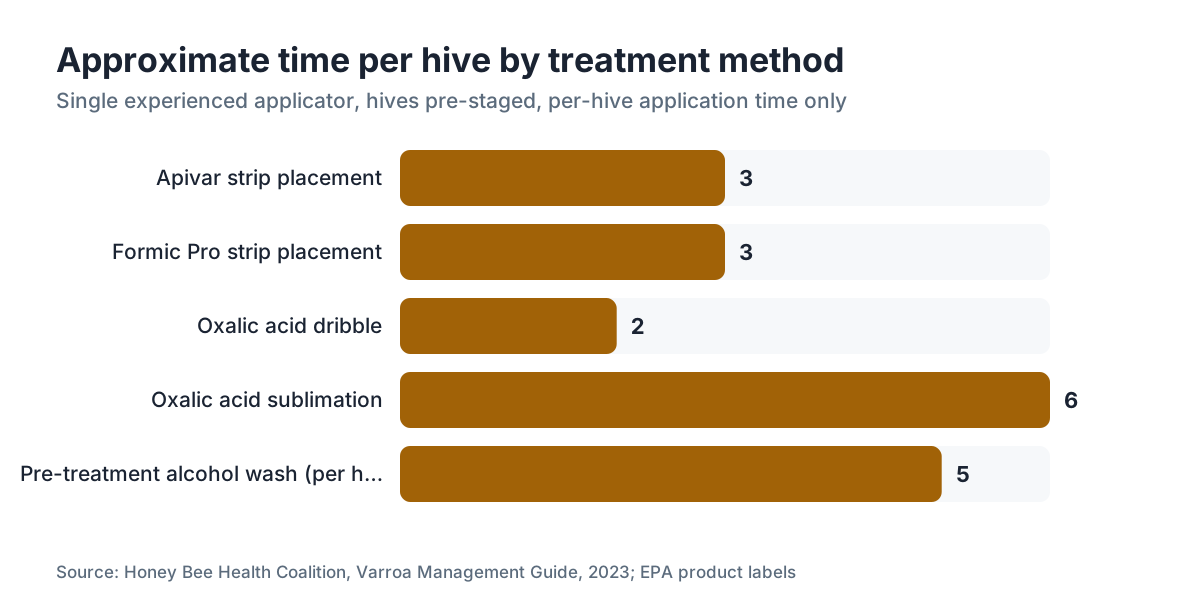
For strip treatments (Apivar, Formic Pro), one person can treat a hive in under three minutes once you find the groove: crack the cover, pull the inner cover, place strips between two frames in the brood nest, replace the cover, write the hive number on your log. Two people working together can treat 20 hives comfortably in two hours, including a few minutes of troubleshooting per hive.
For oxalic acid sublimation, the clock runs longer. You seal the entrance, heat the vaporizer, wait the prescribed time (typically four minutes after the acid has vaporized completely), then move to the next hive [3]. A single vaporizer setup might take five to seven minutes per hive. On 20 hives, that's two hours minimum, and you should rotate to a second vaporizer to keep the element on the first one from overheating. Plenty of beekeepers with 15 or more hives keep two vaporizers for exactly this reason.
For dribble oxalic acid on broodless colonies, a syringe with measured volume makes it quick. Five mL per seam of bees, one pass down each seam between frames from the top. A 10-colony broodless group takes about 30 minutes.
Log the start and end time for the whole session. Some products require you to remove strips after a set number of days (Apivar: 6-8 weeks [5]; Formic Pro: remove after 20 days if two strips used [4]). That removal date is counted from the application date, so accurate records matter.
How do you keep accurate treatment records across a large apiary?
Paper logs work fine. A waterproof field notebook with one row per hive per treatment event is the floor. Columns should cover hive ID, date, product name, lot number, dose, applicator initials, and pre-treatment mite wash result. Add a column for removal date if the product needs one.
Digital options are better for large operations. A simple spreadsheet shared between everyone working the yard solves the problem of one person's notebook riding in a truck while another person treats hives. Purpose-built hive management apps exist too, and VarroaVault's free protocol tools include a treatment tracker that flags overdue removals and generates a per-hive history.
The EPA requires that certain product records be kept for a set period. Apivar's label, for example, is a federally enforceable document, and applying it out of compliance (wrong dose, supers on, and so on) is a legal problem, not only an efficacy one [5]. Good records protect you if a honey buyer, inspector, or insurance claim ever asks about your treatment history.
State apiary inspectors in many states can and do request treatment records during routine inspections. Check your state's department of agriculture requirements; many states with mandatory registration programs publish record-keeping guidance [6].
One number to keep: the Honey Bee Health Coalition recommends confirming treatment efficacy with a mite wash 42 to 72 days after treatment completion for most products, then comparing against your pre-treatment baseline [1].
What do you do when some hives can't be treated with the main group?
This happens on almost every multi-hive treatment day. A hive is queenless. One is in a flow with supers. One has a newly mated queen you don't want to stress. You have a few options.
For hives pulled out of the main treatment, set a hard date within the same week to handle them individually. Write it on your log the day of the main treatment. Don't say 'I'll get to it.' Set the actual date.
For a queenless hive, oxalic acid dribble or sublimation is usually the right call because there's no brood for mites to hide in. That's the one situation where a broodless treatment hits maximum effectiveness. Treat it within two to three days of your main group.
For a hive with supers on, your fastest path is usually to pull the supers, treat, then put them back after the minimum pre-harvest interval on the label. Formic Pro, for example, carries labeling that allows honey supers on during treatment under specific conditions, but you must read the current label for your state and product version [4].
A hive with a brand-new queen from a split or purchase deserves a mite wash before you decide whether to treat. Many newly started splits carry low mite loads. If the wash comes back under 1 percent, monitor and treat at the next round rather than stressing the new queen with formic acid.
How do temperature and weather affect a multi-hive treatment day?
Temperature is probably the most commonly ignored variable in multi-hive treatment logistics, and it causes some of the most predictable failures.
Formic acid products (Formic Pro, MAQS) carry label temperature windows that are not suggestions. Above 29.5°C (85°F), queen mortality climbs. The Mite Away Quick Strips label states: 'Do not treat when outdoor temperatures exceed 85°F (29.5°C) for 5 or more consecutive days following application' [4]. Across most of the continental U.S., that pins formic acid use to spring and early fall.
Oxalic acid sublimation is less temperature-sensitive but still has a practical floor. Cold slows the bees, which is actually fine for sublimation (they cluster and all get exposed), but extreme cold can drag out your vaporizer's heating time and drain battery performance.
Amitraz strips (Apivar) lose efficacy below about 50°F (10°C) because the active ingredient volatilizes more slowly in the cold [5]. For late fall treatments in northern states, that's a real concern.
On treatment day, check the weather for the full label exposure period, more than that morning. A week-long heat wave starting on day three of a formic acid treatment matters. If conditions are borderline, oxalic acid sublimation or amitraz are often the safer picks for a large yard where you can't easily abort mid-treatment.
Rain complicates the logistics too. Wet hives during oxalic acid dribble dilute your dosing. Formic acid strips lose punch in high humidity because the vapor dissipates faster. Aim for dry conditions for at least 48 hours after application.
How do you manage multiple apiaries in different locations on the same treatment cycle?
Beekeepers with hives at multiple sites face a scheduling problem single-yard beekeepers don't: you can't be in two places at once, so 'same day' treatment across sites needs either multiple people or a rolling two-day window.
The reinfestation logic that makes same-day treatment matter within a yard doesn't apply between separate apiaries with no foraging overlap. Two yards two miles apart can be treated on consecutive days with no mite-sharing problem. The concern kicks in when apiaries sit within about two miles of each other, roughly the outer edge of a honeybee's foraging range.
For remote sites, pack a complete treatment kit for each location. Don't try to shuttle half-used products between sites mid-day. One kit per site prevents cross-contamination and keeps your lot-number records clean.
If a helper treats Site B while you work Site A, brief them hard on the protocol beforehand. The most common multi-site error is one person applying the wrong strip count to a hive, or using a product outside its labeled temperature window because they didn't check the forecast for that specific location.
VarroaVault's free varroa mite protocol tools include a multi-yard scheduling template that accounts for site-specific weather windows and tracks lot numbers across locations, worth pulling up when you're coordinating more than two sites.
What is the timeline from assessment to post-treatment mite check?
A clean multi-hive treatment cycle has five phases, and knowing how long each takes helps you plan backward from your target window (usually late summer, before winter bee production starts in late August or September in the northern U.S.).
Phase 1: Pre-treatment mite washes. 1-2 days for a 20-hive yard, depending on crew size.
Phase 2: Supply ordering and arrival. 3-10 days depending on supplier. Order early. Backordering during peak treatment season in July and August is a real problem.
Phase 3: Treatment application. 1 treatment day for most products. Oxalic acid sublimation with extended brood treatment runs three applications over three weeks.
Phase 4: Active treatment period. Apivar: 6-8 weeks on the hive [5]. Formic Pro: up to 20 days for the two-strip dose [4]. Oxalic acid dribble on a broodless colony: one-time treatment, no removal needed.
Phase 5: Post-treatment mite wash. Run washes on every hive 42-72 days after treatment ends to confirm efficacy [1]. If results still sit at or above threshold, investigate resistance, reapplication timing, or whether the hive was inadequately treated.
Total elapsed time from first wash to efficacy confirmation runs roughly 10 to 12 weeks for strip treatments. Plan your treatment window with enough calendar margin to finish this cycle before your local first hard frost.
| Phase | Minimum time | Notes |
|---|---|---|
| Pre-treatment washes | 1-2 days | More hives, more days |
| Supply delivery | 3-10 days | Order early in season |
| Application day | 1 day | Sublimation extended: 3 weeks |
| Active treatment | 6-8 weeks (strips) | Shorter for acids |
| Post-treatment wash | 1 day | 42-72 days after treatment ends |
| Total cycle | ~10-12 weeks | Plan backward from frost date |
What do you do if you find treatment resistance in part of your yard?
Amitraz resistance in varroa is documented in the U.S. and spreading. A 2022 paper in Pest Management Science confirmed amitraz-resistant varroa populations in multiple U.S. states [7]. If your post-treatment mite washes show loads that didn't drop much after a complete Apivar treatment, resistance is a real possibility.
The practical response for a multi-hive yard:
- First rule out applicator error. Were strips placed correctly in the brood nest? Were they on for the full labeled period? Were temperatures adequate? These explain most 'resistance' complaints before you reach actual genetic resistance.
- If application was correct, switch product classes entirely for the next round. Amitraz is a formamidine; oxalic acid and formic acid are organic acids. Rotating between chemical classes, not between brand names, is the standard resistance management recommendation [1].
- Submit mite samples to a diagnostic lab if you want confirmation of resistance. The USDA Bee Research Laboratory and several university labs run bioassays. Contact your state apiarist for referrals [8].
- Keep treating. Resistance in part of the mite population doesn't mean the product is useless; it means you need to rotate and stop leaning on one chemistry. This is the same logic used in agricultural pest management, and it's well established in the varroa literature [1].
For your multi-hive records, flag any hive that showed anomalous post-treatment counts and track it separately the following season.
Are there any legal or label requirements specific to multi-hive operations?
The short answer: the label is federal law whether you have two hives or two hundred. The Federal Insecticide, Fungicide, and Rodenticide Act (FIFRA) governs all pesticide use in the U.S., and EPA-registered miticides like Apivar, MAQS, Formic Pro, and Api-Bioxal fall under it [9]. Using them in a way inconsistent with the label is a federal violation.
Key label points that trip up multi-hive operations:
- Strip counts per colony. Apivar requires two strips per colony regardless of colony size [5]. Don't split a pair of strips across two weak hives to save money.
- Honey super restrictions. These vary by product and state. Read the label you have in hand, not a summary from a forum.
- Maximum annual applications. Oxalic acid (Api-Bioxal) sublimation is labeled for up to three treatments per year in colonies with brood [3]. Going past that is off-label use.
- Re-entry intervals. Formic acid products require you to stay out of the hive during the exposure period. The MAQS label states a 14-day minimum before routine inspections [4].
Some states require commercial beekeepers (and in some cases sideliners) to register their apiaries and report pesticide use. The National Association of State Departments of Agriculture maintains contact information for state apiary programs [6]. Checking in once a year is worth your time.
For a broader look at sourcing compliant equipment and treatments, the beekeeping supply companies article covers what to look for from reputable suppliers.
Frequently asked questions
Can I treat all my hives on the same day even if some are stronger than others?
Yes, and you should. Mite load, not colony strength, decides whether a hive needs treatment. Stronger hives might get a slightly higher dose of some products (for example, two Apivar strips are standard regardless of strength), but the timing should be synchronized across the yard. A strong untreated hive can reinfest your weaker treated colonies within two to three weeks through robbing and drift.
How many hives can one person realistically treat in a single day?
With strip treatments (Apivar, Formic Pro), one experienced beekeeper working alone can treat 15 to 25 hives in a half day once supplies are staged and a route is mapped. Oxalic acid sublimation is slower, around 5 to 7 minutes per hive, so 20 hives is a realistic solo daily limit. Working with one partner roughly doubles throughput for any method.
Do I need to treat hives that tested below the action threshold?
The standard guidance from the Honey Bee Health Coalition puts the treatment action threshold at 2 percent (2 mites per 100 bees) during the brood-rearing season. Hives below that don't require immediate treatment, but monitor them every 2 to 4 weeks. In late summer, even a 1.5 percent reading in August warrants serious thought given how fast mite populations climb before winter bee production.
What's the best way to track strip removal dates across many hives?
Write the removal date directly on each strip in permanent marker before you insert it, so you don't lean only on a notebook. Then back that up with a dated log entry for each hive. Apivar strips need removal after 6 to 8 weeks; Formic Pro two-strip applications after 20 days. Missing removal deadlines can affect honey contamination risk and product efficacy for later treatments.
Can different hives in the same yard receive different treatments at the same time?
Yes, if their circumstances warrant it. A broodless hive might get oxalic acid sublimation the same day your brooded hives get Apivar. The goal is synchronous treatment, not identical treatment. Keep product types clearly labeled on your log so you know what to remove and when, and don't mix up strips between product types during application.
How do you prevent cross-contamination when doing alcohol washes on many hives?
Rinse your sample jar and mesh lid with clean water between every hive. Don't pour leftover alcohol from one wash back into your stock bottle. Use separate labeled containers for each sample if you're processing washes in bulk back at home. A single contaminated sample on a high-mite hive can inflate the count on the next hive and lead you to treat a colony that doesn't need it.
What's the risk of treating too early in the season with multiple hives?
Treating in spring before mite populations have built can give you a clean false start but won't protect you through the high-mite-buildup period of late summer. The bigger risk is burning through your product supply and treatment window before the critical August-September stretch when mite pressure on winter bees peaks. Most extension programs recommend a mite wash before any treatment decision, regardless of the time of year.
Should I treat newly acquired or package hives at the same time as my established colonies?
Wash them first. Packages sometimes arrive with very low mite loads, and treating unnecessarily stresses a colony that's already working to establish. If the wash shows under 1 percent and you're mid-season, monitor the new colony monthly and treat when it hits threshold or before your late-summer main treatment round, whichever comes first.
How do I handle a hive that's in the middle of a split or has a virgin queen on treatment day?
Formic acid products risk killing virgin and newly mated queens. If you have a queen-cell or virgin-queen hive on treatment day, skip the formic acid for that colony. Use oxalic acid dribble or sublimation instead, or delay the colony's treatment by a week until she's confirmed mated and laying. Log the deviation and the reason.
What post-treatment mite level confirms the treatment worked?
The Honey Bee Health Coalition recommends a post-treatment wash 42 to 72 days after treatment ends. A successful outcome is a mite count well below the 2 percent action threshold, ideally under 1 percent heading into fall. If a hive still sits at or above 2 percent after a completed strip treatment, that warrants investigation into application error, resistance, or reinfestation from a neighboring apiary.
Do I need different equipment for treating hives in remote or off-site apiaries?
Pack a complete, self-contained kit for each site: treatments, applicator tools, a mite wash kit, your log sheet, and protective gear. Don't count on running back to your truck or a shared supply. For oxalic acid sublimation at remote sites, bring a fully charged battery and confirm power output before you leave home. A dead vaporizer mid-session on a 15-hive yard is a real problem.
How often should a sideliner beekeeper treat varroa per year?
Most university extension programs and the Honey Bee Health Coalition recommend a minimum of two treatment decisions per year, based on mite wash results: one in late spring or early summer and one in late summer before winter bee production. A 'treatment decision' may end in no treatment if mite levels sit below threshold, but the wash and evaluation still have to happen. High-pressure regions or a history of colony loss may warrant three wash-and-decide cycles.
Is there a way to reduce the labor of treating many hives without cutting corners on coverage?
Standardizing on one product type for your main yard cuts prep time a lot. Staging all your supplies the night before, mapping your treatment route, and working with a partner cuts single-day treatment time roughly in half. Some larger operations use extended-release oxalic acid glycerine towels, though those products are in a fluid regulatory status; confirm current EPA registration before using any product you haven't used before.
Sources
- Honey Bee Health Coalition, Varroa Management Guide (2023): Mite dispersal between colonies drives treatment failure; action threshold is 2% during brood-rearing season; post-treatment wash recommended 42-72 days after treatment completion; rotate product classes for resistance management
- Penn State Extension, Varroa Mite Sampling: Alcohol wash on approximately 300 bees from the brood nest is the recommended sampling method
- EPA, Api-Bioxal (oxalic acid) product label registration: Api-Bioxal sublimation labeled for up to three treatments per year in colonies with brood; 1g per box dosing guidance; calibrated scale required
- EPA, Mite Away Quick Strips (MAQS) / Formic Pro product label: Do not treat when outdoor temperatures exceed 85°F (29.5°C) for 5 or more consecutive days following application; minimum 14-day re-entry for MAQS; two-strip Formic Pro application removal after 20 days
- EPA, Apivar (amitraz) product label: Two strips required per colony; cannot be used while honey supers are on; reduced efficacy below approximately 10°C (50°F); strips to be removed after 6-8 weeks
- National Association of State Departments of Agriculture, State Apiary Programs: State apiary programs maintain registration and record-keeping requirements for beekeepers
- Pest Management Science, 'Widespread detection of amitraz-resistant varroa in U.S. honey bee populations' (2022): Amitraz-resistant varroa populations confirmed in multiple U.S. states as of 2022
- USDA Agricultural Research Service, Bee Research Laboratory: USDA Bee Research Laboratory conducts varroa resistance bioassays and diagnostic services
- EPA, Federal Insecticide, Fungicide, and Rodenticide Act (FIFRA) overview: FIFRA governs all pesticide use in the U.S.; using a registered miticide inconsistent with its label is a federal violation
- University of Minnesota Extension, Varroa Mite Management: Late summer treatment timing guidance; importance of treating before winter bee production begins in August-September in northern U.S.
- UC Davis Department of Entomology, Honey Bee Research: Colony reinfestation dynamics through robbing and drift within apiaries
Last updated 2026-07-09