What happens when you underdose varroa treatments
TL;DR
- Underdosing varroa treatments leaves enough mites alive to rebound fast, selects for treatment-resistant mite populations, and often triggers a worse infestation than skipping treatment entirely.
- Colonies carrying post-treatment loads above 2-3% can collapse within weeks.
- Correct dose, correct temperature, and correct duration are all required for any treatment to work.
What does 'underdosing' actually mean in varroa treatment?
Underdosing means the mites in your colony got less active compound than the label requires to kill a lethal share of them. It sounds like a clean pharmaceutical idea. In practice it's messier. You can underdose in four ways: using less product than the label specifies, applying at the wrong temperature so the compound volatilizes too fast or too slow, cutting the treatment period short, or treating a colony whose size doesn't match the dose (say, one Apivar strip in a four-box hive).
The label is the law. The EPA registers each varroa treatment at specific application rates, exposure durations, and temperature windows [1]. Deviate from any of those, and you're doing more than getting a reduced effect. You're getting a different outcome. Low-dose amitraz, for example, can suppress mite reproduction without killing adults, which is exactly the selection pressure that breeds resistant populations.
For the biology behind what you're treating, the varroa mite overview covers the mite's life cycle, because knowing where the mite is vulnerable in that cycle is the whole reason dosing precision matters.
Why doesn't a partial dose just kill fewer mites?
This is the question that trips people up. Intuitively, if a full dose kills 95% of mites, half a dose should kill maybe 50%. That's not how it works.
Varroa populations are not genetically identical. Any colony holds natural variation in mite sensitivity to a given compound. A correct dose kills the sensitive mites and enough of the moderately-resistant ones to drive the population below a threshold it can't recover from fast enough to cause harm. A sub-lethal dose kills only the most sensitive mites and leaves the moderately-resistant and fully resistant ones alive to reproduce. Those survivors pass their resistance traits to offspring. Repeat that selection each generation, and the population shifts harder toward resistance [2].
The Honey Bee Health Coalition's Varroa Management Guide puts it plainly: treatments applied outside label parameters "may result in ineffective mite control and could contribute to the development of resistance" [3]. That's the careful institutional phrasing. The blunt version: hobbyist misapplication is one of the main engines of resistance spread.
Then there's the population math. Varroa reproduce inside capped brood cells. A healthy summer colony can hold 80,000 or more bees, and the mite population can double roughly every 28 days [3]. If your partial dose leaves a 4% load instead of dropping it to 1%, you're not a little behind. You're months behind, because the mites compound.
How fast do mite populations rebound after a failed treatment?
Fast. Uncomfortably fast.
A colony entering peak summer at 3% infestation, left untreated, can reach damaging levels within 4 to 6 weeks [3]. If your treatment dropped the load from 5% to 3% instead of below 2%, you bought yourself a few weeks of false security while the population resets. Beekeepers who underdose in August and check mite loads in October are often genuinely shocked at what they find.
Reinfestation makes it worse. If your treatment fails, mites don't just reproduce in place. They hitchhike in on drifting and robbing bees from infested hives within roughly a 1 to 2 mile radius [4]. A successful treatment that drops your load to 0.5% can be partly reversed within weeks by reinfestation. A failed treatment that leaves you at 3% turns your colony into a mite source for the neighborhood.
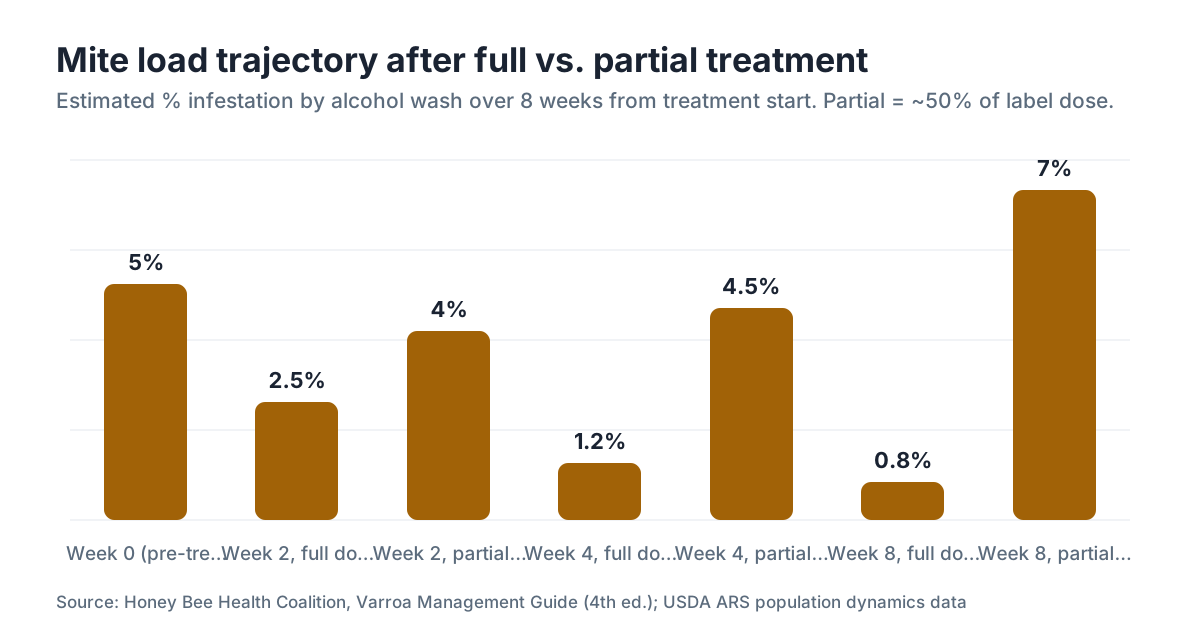
The chart below shows a rough mite load trajectory drawn from population dynamics data in the USDA and peer-reviewed modeling work [4][5].
Here's the takeaway: there's no such thing as a treatment that "kind of worked." You either got below threshold or you didn't, and the biology punishes the latter.
What are the direct consequences for colony health?
High mite loads hurt bees two ways. First, direct parasitism: Varroa destructor feeds on the fat bodies of developing and adult bees, causing physical damage and shortening their lives [6]. Second, and worse at the colony level, mites vector a suite of viruses, especially Deformed Wing Virus (DWV). Bees emerging from heavily infested cells often can't fly, can't thermoregulate, and forage poorly.
A colony that enters winter above 2-3% mite load is unlikely to survive. The Honey Bee Health Coalition recommends treating in late summer specifically to protect the long-lived winter bees that carry the colony through to spring [3]. Those bees are produced in August and September. If your August treatment failed or was underdosed, the bees raised during and after that window develop in cells under heavy mite pressure. They emerge damaged. They don't live as long. They can't keep the cluster warm. The colony starves or freezes before February.
A study in PLOS ONE found that DWV titer in bees correlates strongly with Varroa infestation level, and that colonies with high viral loads entering winter had significantly reduced survival [6]. The mites are the vector. Underdosing keeps that vector population at levels where virus transmission stays high.
This is why underdosing is arguably worse than not treating at all. Skip treatment, and you know the colony is at risk, so you monitor closely. Apply a partial dose and believe you've treated, and you may not recheck until it's too late.
Which treatments are most sensitive to underdosing errors?
Every registered varroa treatment can be underdosed. The mechanisms and consequences differ.
| Treatment | Active ingredient | Common underdosing error | Consequence |
|---|---|---|---|
| Apivar strips | Amitraz | Too few strips for hive size; removing too early | Sub-lethal amitraz exposure, resistance risk |
| MAQS / Formic Pro | Formic acid | Low ambient temperature, short exposure | Mites in capped brood survive; queen loss risk misdiagnosed |
| Oxalic acid dribble | Oxalic acid | Treating during brood-right season | Mites in capped cells untouched; 90%+ of population survives [7] |
| OA vaporization | Oxalic acid | Too few treatments, wrong frequency | Mite load reduced temporarily but rebounds from emerging brood |
| ApiLife Var / Thymovar | Thymol | Temps below 59°F or above 105°F | Volatilization too slow or too fast; ineffective exposure |
Oxalic acid is the clearest case where timing matters as much as dose. The dribble or trickle method works well, but only on adult bees, not on mites inside capped cells [7]. Applied to a colony with normal brood, roughly 80-90% of the mite population sits in capped cells and stays untouched. That's not underdosing in the chemical sense. It's a correct dose at the wrong life stage. The result is identical: most mites survive.
Formic acid is exquisitely sensitive to temperature. Both MAQS and Formic Pro have labeled temperature windows, and applying below them means the acid doesn't volatilize at a therapeutic rate [1]. Beekeepers who treat in cool fall weather and see poor results often blame the product when the real culprit is ambient temperature.
Does underdosing cause varroa resistance, and how quickly?
Yes. This is probably the most consequential long-term effect of widespread underdosing, because resistance doesn't stay in your apiary.
Amitraz resistance in Varroa destructor has been documented in the United States, Europe, and South America. A 2018 study in Scientific Reports found significant variation in mite susceptibility to amitraz across U.S. apiaries, with some populations showing tolerance many times higher than susceptible ones [2]. The authors noted that misuse, including underdosing and extended continuous use, likely drove the variation they observed.
The mechanism is plain genetics. Amitraz acts on octopamine receptors in the mite. Mites with mutations at those receptors are less affected. Sub-lethal exposure doesn't kill those mites, but it does kill their sensitive competitors. Repeat that across multiple generations and multiple beekeepers in a region, and the resistance allele frequency climbs across the local mite population.
Oxalic acid resistance has not been documented at meaningful levels in field populations, which is one reason it's a lower-resistance-risk option. But the research isn't closed, and "no documented resistance yet" is not "resistance-proof." Pyrethroid-based treatments (fluvalinate, coumaphos) already carry widespread documented resistance, which is why many extension services now recommend rotating to non-pyrethroid options [8].
The practical point: your underdosing mistake doesn't just hurt your colony. It can seed resistance in the mite population that spreads to your neighbors via bee movement, and those resistant mites get harder for everyone to treat.
How do you know if your treatment actually worked?
You check mite loads before and after. There's no other way.
A pre-treatment wash tells you where you're starting. The standard summer treatment threshold is 2% (2 mites per 100 bees) by alcohol wash or sugar roll, though the Honey Bee Health Coalition's guide shows thresholds shift slightly by season [3]. Recheck 2 to 3 weeks after treatment ends. If the load is still above 2% in summer or above 1% in fall, the treatment didn't do enough, whether from underdosing, resistance, or application error.
Alcohol wash beats a sugar roll. Sugar rolls are gentler but consistently undercount, sometimes by 30-50% compared to alcohol wash [3]. If sugar rolls are your only monitoring method, add a correction factor or switch to alcohol wash for efficacy checks.
Sticky boards are the weakest tool for judging treatment. They give you a mite fall rate, but reading that number requires knowing your colony size and never gives you infestation percentage. Use them as a rough signal, not a pass/fail test.
Free protocol tools at VarroaVault help you schedule monitoring around your treatment windows so you don't skip the post-treatment check, which is the step most hobbyists drop.
What's the right way to dose varroa treatments to avoid these problems?
Start with the label, in full. Every registered varroa treatment carries an EPA-approved label specifying the number of strips, pads, or grams per colony, the temperature range, and the duration [1]. Efficacy trials set those numbers, not arbitrary caution. Treating a two-story hive with a single Apivar strip to stretch supplies is not a cost-saving move. It's underdosing.
A few things matter more than most beekeepers realize.
Hive size drives strip-based treatments. Apivar's label calls for 2 strips per colony for most configurations, but for colonies with more than 10 frames of bees, check the label for additional strips. The amitraz spreads by physical contact as bees move across the brood nest, so coverage has to reach the whole nest.
Temperature windows are hard limits. Formic acid products (MAQS, Formic Pro) require ambient temperatures between 50°F and 85°F (10-29°C) [1]. Thymol products want 60-105°F. Check the forecast for the entire treatment duration, more than application day.
Don't pull treatments early. Cutting an Apivar treatment from the labeled 6-8 weeks to 3-4 weeks because a mite wash looks good means the mites emerging from brood cells during those final weeks never get exposed. You need the full duration to catch the full mite cycle.
For sourcing reliable products, use reputable beekeeping supply companies that stock treatments and can confirm you're getting labeled, in-date, properly stored stock.
Can you 'rescue' a colony after a failed underdosed treatment?
Sometimes. It depends on how fast you catch it and the time of year.
Underdose in July and catch the failure by mid-August, and you still have time to apply a full correct treatment before the winter bee population is wrecked. Do an alcohol wash right away, confirm the load is still above threshold, pick a different treatment class from what you just used (in case resistance has already been selected), and follow the label exactly.
October with a load above 3% is harder territory. Oxalic acid vaporization on a broodless or near-broodless colony can still knock loads down quickly. If the colony still has a significant brood nest in October (possible, depending on climate), you need either extended OA vapor treatments on a weekly schedule or a fast-acting chemical option. Cornell University's extension recommends oxalic acid vapor as a rescue for fall-infested colonies, especially broodless or near-broodless hives [11].
Some colonies are too far gone. Sacbrood, heavy DWV symptoms, a collapsing adult population, and drone-layer signs together usually mean the colony has passed the tipping point. At that stage the priority is keeping those mites out of your healthy colonies through robbing. Close down the entrance, combine if you can, or pull the hive from the apiary.
How does underdosing affect nearby colonies and the wider beekeeping community?
This is the part beekeeping communities don't always talk about honestly.
A failed treatment creates a high-mite reservoir colony. Robbing bees from neighboring hives enter it and leave carrying mites. A single robbing event can move hundreds of mites from a collapsing hive to a healthy one [4]. USDA work estimates that mite movement between apiaries within 1 to 2 miles is a major driver of re-infestation after successful treatment [4].
Resistance is the other externality. Keep exposing your apiary's mites to sub-lethal amitraz through repeated underdosing, and the resistant mites you select for spread into the local population. A beekeeper five miles away who treats correctly may find their treatments working less well over time because of resistance that started in apiaries running sloppy protocols.
This is why the Honey Bee Health Coalition, Penn State Extension, and others push community-level mite management [3][8]. Coordinated timing, monitoring, and correct dosing across a neighborhood beats any single beekeeper doing everything right while their neighbors do everything wrong. It's a strong argument for joining a local club and for being honest with other beekeepers when your treatments fail.
For how bee biology and colony communication make mite spread so efficient, the varroa mite overview explains drift and robbing in detail.
What do extension services and the EPA say about treatment compliance?
The EPA's position is unambiguous: varroa treatments are registered pesticides, and using them contrary to label directions is a violation of federal law (FIFRA, 7 U.S.C. § 136j) [9]. The label is a legal document, not a suggestion. That covers the wrong rate, the wrong temperature, and the wrong duration.
The EPA doesn't inspect individual beekeepers' hives. But the legal framework matters because it defines responsible use, and because some state departments of agriculture do run inspections where pesticide misuse can be cited.
Penn State Extension, one of the most cited sources on varroa management in the northeastern U.S., holds that all miticides must be used strictly according to their labels for safety and efficacy, and specifically flags using fewer strips than directed as a common error [8]. The University of Minnesota Bee Lab likewise stresses that thresholds and treatment timing are not conservative guesses but come from colony population modeling that accounts for mite reproduction rates [10].
The Honey Bee Health Coalition's Varroa Management Guide, now in its fourth edition and free online, is the most complete public resource on treatment protocols. It covers every registered U.S. treatment with dosing tables, temperature requirements, durations, and resistance notes [3]. If you haven't read it, read it first.
Frequently asked questions
What happens if I use only one Apivar strip instead of two?
Using one Apivar strip in a standard colony exposes roughly half the bees to amitraz contact, which cuts efficacy sharply. Mites in the part of the brood nest with less strip contact get sub-lethal exposure, the exact condition that promotes resistance selection. The Apivar label calls for two strips per colony. Using one is both a dosing error and a FIFRA label violation.
Can I reuse varroa treatment strips from a previous season to save money?
No. Apivar strips lose potency once opened, and reusing strips from a prior season means the amitraz concentration is unknown and almost certainly below therapeutic levels. That's an underdosing error even if you use the right number of strips. It's also inconsistent with label use requirements. Fresh strips from the current season are the only way to know you're applying a labeled dose.
Does applying oxalic acid to a colony with brood count as underdosing?
Not in the strict sense, but the effective dose reaching mites is far lower than in a broodless colony. Mites inside capped cells are physically inaccessible to oxalic acid no matter how much you apply. In a brood-right colony, 80-90% of mites sit in capped cells and survive any single OA application. Multiple timed treatments or scheduled vaporization are needed to address that population.
How do I know if my varroa treatment failed because of underdosing vs. resistance?
You can't know for certain without lab testing, but timing and application notes help. If you followed the label correctly and still have high mite loads, resistance is more likely. If you applied at low temperatures, cut the treatment short, or used fewer strips than directed, rule out your own protocol errors first. Sending mites to the USDA Bee Research Lab for bioassay testing is the definitive route, though it's not practical for most hobbyists.
Is it okay to treat at a slightly lower temperature than the label says to save time?
No. Temperature windows on formic acid and thymol products are tied to volatilization rates. Below the labeled minimum, those compounds don't vaporize fast enough to reach therapeutic concentrations in the hive air. You'll use up your product, stress the colony, and likely fail to kill a meaningful share of mites. Waiting for the right temperature window is not optional.
What mite level should I expect after a successful treatment?
A well-executed treatment should bring your load below 2% by alcohol wash in summer, and ideally below 1% going into fall. If a post-treatment wash 2 to 3 weeks after treatment ends still shows you above those thresholds, the treatment didn't work. Recheck your protocol, consider switching treatment classes, and retreat. Don't wait another month to see if it improves on its own.
Can underdosing varroa treatments harm my bees directly?
The bigger risk is the mites that survive, not the compound itself. That said, some treatments carry direct bee toxicity at high doses, and improper use causes issues. Formic acid applied in high heat can kill queens. Amitraz at very high concentrations is toxic to adult bees. Following the label protects both efficacy and bee safety. Underdosing is dangerous for different reasons than overdosing, but both are problems.
Does varroa resistance to amitraz mean I should stop using Apivar?
Not necessarily, but monitor for efficacy and rotate treatments. If you apply Apivar correctly and still see high mite loads post-treatment, resistance may be a factor. Switching to oxalic acid or formic acid in rotation is the standard recommendation. The Honey Bee Health Coalition's Varroa Management Guide has a resistance management section covering rotation strategies. Continuous use of the same compound every cycle is how resistance spreads fastest.
How often should I monitor mite levels to catch underdosing failures early?
At minimum, test before treatment and 2 to 3 weeks after treatment ends. A fuller schedule is monthly from April through October in temperate climates. The Honey Bee Health Coalition and most university extension services recommend at least 4 to 6 monitoring events per year. Alcohol wash is the most accurate method. Testing once a year means you'll miss a failed treatment until the colony is already in trouble.
Are there varroa treatments that are harder to underdose accidentally?
Oxalic acid vaporization on a broodless colony is relatively forgiving, because a single correct application reaches all adult bees. The main errors are treating during a heavy brood period (making OA largely ineffective, not underdosed per se) or running too few sessions. Strip-based treatments like Apivar demand attention to hive size and strip count. No treatment is foolproof, but broodless-season OA vaporization has the shortest list of ways to mess it up.
What's the legal situation if I use a varroa treatment off-label?
Under FIFRA (the Federal Insecticide, Fungicide, and Rodenticide Act), using a registered pesticide contrary to its label directions is a federal violation. For individual hobbyist beekeepers, enforcement is rare, but the standard exists. More practically, off-label use voids any basis for complaint if the product doesn't work, and it feeds the resistance and efficacy problems that make varroa management harder for everyone.
Should I treat a new package of bees at full label dose?
Yes, but timing matters more than dose modification. New packages usually have low mite loads, but that changes fast. Treat when monitoring shows you're approaching the 2% threshold, not before, to avoid unnecessary chemical exposure. When you do treat, use the labeled dose. Some beekeepers cut strip count for very small packages, but that's an underdosing error. Use the full label rate and monitor the result.
How do mites spread from my underdosed colony to my neighbors' hives?
Robbing and natural drift are the main routes. A heavily infested colony often weakens and becomes easier to rob. Robber bees from healthy colonies enter, take honey, and leave carrying mites on their bodies. A heavily infested colony can export hundreds of mites a day during robbing events. Research estimates colonies within a mile or two regularly exchange mites this way, which is why individual underdosing has community-wide consequences.
Sources
- EPA Pesticide Registration: Registered Varroa Treatment Labels: EPA-registered varroa treatments must be used according to labeled application rates, temperature ranges, and treatment durations under FIFRA
- Scientific Reports (2018): 'Acaricide resistance in Varroa destructor': Significant variation in mite susceptibility to amitraz was found across U.S. apiaries, with some populations showing tolerance many times higher than susceptible populations
- Honey Bee Health Coalition, Varroa Management Guide (4th ed.): Treatments applied outside label parameters 'may result in ineffective mite control and could contribute to the development of resistance'; summer treatment threshold is 2% mite infestation by alcohol wash; Varroa populations can double roughly every 28 days
- USDA Agricultural Research Service: Varroa mite research: Mite movement between apiaries within 1-2 miles via robbing and drift is a major driver of re-infestation after successful treatment
- Rosenkranz et al., Apidologie (2010): 'Biology and control of Varroa destructor': Varroa population dynamics modeling showing mite population doubling time and infestation trajectory under different treatment scenarios
- PLOS ONE: 'Deformed wing virus and colony mortality in honey bees': DWV titer in bees correlates strongly with Varroa infestation level; colonies with high viral loads entering winter had significantly reduced survival rates
- University of Minnesota Bee Lab: Oxalic acid treatment guidelines: Oxalic acid dribble method is effective only on adult bees, not on mites inside capped brood cells; applied to a brood-right colony, roughly 80-90% of mites survive
- Penn State Extension: Varroa mite management: All miticides must be used strictly according to their labels; using fewer strips than directed is a common error
- FIFRA, 7 U.S.C. § 136j (Federal Insecticide, Fungicide, and Rodenticide Act): Using registered pesticides contrary to label directions is a federal violation under FIFRA
- University of Minnesota Extension: Varroa mite thresholds and treatment timing: Treatment thresholds and timing are based on colony population modeling that accounts for mite reproduction rates
- Cornell University College of Agriculture and Life Sciences: Varroa management: Oxalic acid vaporization recommended as a rescue option for fall infested, near-broodless colonies
Last updated 2026-07-09