Mite infestation models for treatment timing: what the math actually tells you
TL;DR
- Varroa infestation models use colony size, mite reproduction rates, and brood cycles to predict when mites will overwhelm a hive.
- Nearly every model agrees: treat when an alcohol wash or sugar roll hits 2% or higher in summer, and don't wait for visible symptoms.
- Act on the curve, not on gut feeling.
- That's what keeps a colony alive through winter.
What is a varroa infestation model and why should you care about it?
A varroa infestation model is a mathematical description of how mite populations grow inside a colony over time. It takes known biology, including how often mites reproduce, how long brood cycles last, and how many bees fill the hive, and projects forward to predict future mite loads. The output is a curve, not a guess.
Timing is the whole reason this matters. Varroa doesn't kill colonies slowly and visibly. It accelerates. A colony that looks fine in June at a 1% mite load can crash by September if nothing changes, because the mite population roughly doubles every few weeks during peak brood season [1]. By the time you spot deformed wing virus or a shrinking cluster, the damage is already done. Models let you act before that tipping point instead of reacting after it.
You don't need to run the math yourself. What you need is to read a threshold recommendation on an extension bulletin or a product label and know exactly what it's telling you. Every "treat at 2%" instruction came from someone who ran the numbers. Understand the logic and you're a sharper beekeeper than the one who follows rules blind. If you're new to the parasite itself, the varroa mite overview covers the biology this modeling rests on.
How does the varroa population actually grow inside a hive?
Varroa destructor reproduces only inside capped brood cells, almost always in worker or drone cells just before capping. A female mite enters a cell, lays eggs on the developing pupa, and her daughters mate with her son inside the cell before emerging with the adult bee. One founding female typically produces one to two reproductive female offspring per brood cycle in worker cells, and up to three in drone cells [2].
The biological rate of increase for varroa in a temperate colony with steady brood runs roughly 2.7 to 3.3 fold per month during peak season, though the real doubling time hinges on the ratio of capped brood to adult bees and how much drone comb is around [1]. Mites prefer drone cells at about 8 to 10 times the rate of worker cells. That's why drone brood removal is a real suppression tool and not theater.
The curve is exponential, not linear. Internalize that one fact and the rest follows. Going from 1% to 2% doesn't double your problem. Because compound growth works against a shrinking late-season bee population, 1% in July often means you're six weeks out from a 10%-plus infestation and a collapsing cluster. The Honey Bee Health Coalition's Varroa management guide names this directly, warning that "mite populations can increase rapidly, especially as the bee population decreases in late summer and fall" [1].
Brood breaks flip the whole picture. When a colony goes broodless, every mite is phoretic, riding adult bees with nowhere to reproduce. This is the window when treatments hit hardest, because mites have no capped cell to hide in. A well-timed oxalic acid treatment during a broodless stretch can reach 95%-plus efficacy, against 60 to 70% in a colony packed with brood [3].
What are the key thresholds that models produce, and where do they come from?
The thresholds you see everywhere come from modeling paired with field validation, not committee guesswork. Here are the ones in common use across North America:
| Season / Situation | Treatment threshold (mites per 100 bees) | Source |
|---|---|---|
| Summer buildup (April-July) | 2% (2 mites per 100) | HBHC Varroa Guide [1] |
| Late summer / fall prep | 2% (some models say act at 1%) | HBHC Varroa Guide [1] |
| Broodless winter cluster | 2% | HBHC Varroa Guide [1] |
| Any time, weak colony | 1% | Seeley & Smith 2015 [4] |
The 2% figure traces back to population modeling that projects forward from a starting mite load and estimates whether the colony survives the coming season. At 2%, most models predict the colony crosses damaging levels (roughly 8 to 10%) within 6 to 8 weeks during summer if left alone [1]. That's the rationale. It isn't that 2% is lethal by itself. It's that 2% in July becomes 10% by September in a colony that's also shedding bees for winter.
Some researchers push for a lower trigger, around 1%, for colonies heading into fall, because the winter cluster carrying the colony to spring is exactly the generation being damaged right now. Others note economic thresholds shift with location, colony size, and goals. A hobbyist keeping one colony alive runs a different calculation than a commercial operation weighing treatment cost against colony value.
The 3% threshold you'll find in older materials is mostly considered outdated now. The Honey Bee Health Coalition moved its guide to the 2% standard on the strength of field data and modeling refinements [1].
Which monitoring method gives you the most accurate mite count for plugging into a model?
You need a number you can trust. The three common methods are alcohol wash, sugar roll, and sticky board counting. They are not equally reliable.
Alcohol wash is the standard. Sample roughly 300 bees (about half a cup) from a brood frame, shake them in 70% isopropyl alcohol or windshield washer fluid, and count the mites that drop. Done right, it's around 97% accurate for detecting mites on adult bees [1]. The Honey Bee Health Coalition names alcohol wash as its most accurate method for quantitative monitoring.
Sugar roll spares the bees but pays for it in accuracy. Published comparisons show sugar roll undercounts mite loads by 25 to 60% against alcohol wash [5]. Sugar-roll a 1.5% and the real number might be 2 to 3%. That's a serious error when you're measuring against a threshold to decide whether to treat.
Sticky boards count mite fall over 24 to 72 hours and give you a drop rate, not a percentage of the bee population. Turning natural drop into an infestation percentage takes a formula with its own error range, and it sits a step further from the modeling inputs. Use it to watch trends, not to make threshold calls.
Where you sample matters as much as how. Pull bees from the frame with the most open brood, because foragers and nurse bees cluster there along with the highest share of phoretic mites. Sample only from the entrance or the outside of the cluster and you undercount every time.
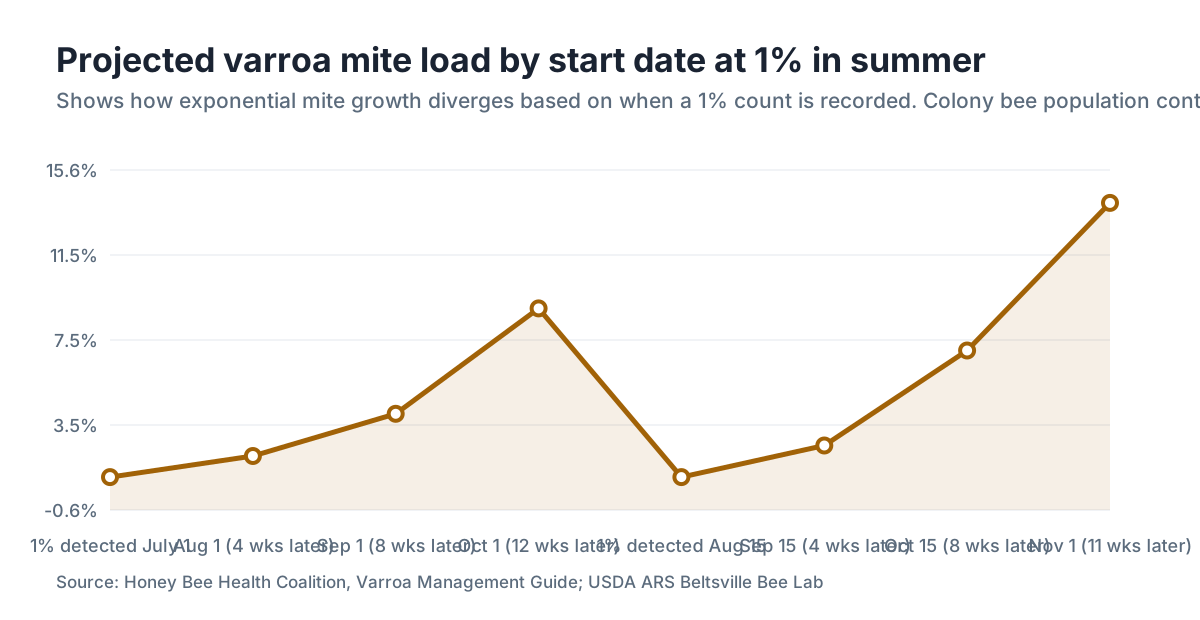
To tie your count to a model, you need three things: your current mite percentage, the date, and a read on whether the colony is building, holding, or contracting. A 2% count in April rides a different trajectory than a 2% count in late August. The chart below this section shows how far those two paths diverge.
How do you read the exponential growth curve to predict when you need to treat?
Here's the practical version of the math. If your mite load doubles roughly every 4 to 6 weeks during brood season (a conservative estimate from published doubling times), you can project forward without a calculator:
- Measure 1% in late June. Wait 6 weeks. Expected load: 2%. You're at threshold by mid-August, heading straight into fall population decline.
- Measure 1% in late August. The bee population is contracting while mites keep breeding. At the same biological doubling time, the percentage climbs faster because the denominator (bees) is shrinking. You could hit 4 to 5% by October.
So the date of your count matters as much as the number. A 1% count in spring with a growing colony buys you time. A 1% count in late summer buys you almost none.
Nobody has a clean universal equation that fits every colony in every climate. The closest thing to a validated tool for hobbyists is the Bee Informed Partnership's survey data paired with the HBHC's modeling guidance, which says to monitor monthly through active season and act at 2% no matter the month [1][12]. Some beekeepers sample every three weeks in summer because the gap between "safe" and "urgent" is that narrow.
Our varroa treatment protocols walk through how to log counts by date and colony so you can see the trajectory bending toward threshold before it crosses.
One more thing. Mite models assume your sample represents the colony. Sample a weak hive with a small cluster and your percentage might read high while the absolute count stays low. Sample a booming colony of 60,000 bees and a 2% count means 1,200 mites. Both say treat, but the urgency differs. The model runs on percentages because percentage predicts viral damage per bee, not raw mite tallies.
What happens when you wait too long? What does colony collapse look like in model terms?
In model terms, collapse hits when the mite reproductive rate outruns the colony's ability to replace damaged bees. It isn't a sudden cliff. It's an acceleration, then a cliff.
Above roughly 8 to 10% mite load, virus vectoring (mostly deformed wing virus) swamps the colony's ability to raise healthy winter bees. The bees emerging in August and September are the ones that have to survive 5 to 6 months to carry the colony through. Mite-parasitized bees live shorter lives with weaker immune function, so even a hard treatment in October leaves you protecting a winter cluster that's already compromised [6].
That's the mite bomb in another form. A colony that dies in October or November from varroa didn't die from the mites directly. It died from the viruses those mites vectored through summer, into bees that are now gone. By the time you see the crash, the cause sits 10 to 12 weeks in the past.
Model projections from the USDA Agricultural Research Service show colonies above 3% in August carry much higher winter mortality regardless of whether treatment follows later in fall [6]. That's the data behind the urgency. Fall treatments do help. They just help far less than an earlier summer treatment would have.
Do broodless periods change the model thresholds you should use?
Yes, and by a lot. During a broodless period, whether natural in winter or forced through a queen cage or a swarm, the whole mite population is phoretic. No mite is protected inside a capped cell. Two things shift: treatment efficacy climbs, and the mite load percentage now reflects 100% of the mites in the colony instead of the slice riding adult bees.
The 2% threshold still applies to a broodless winter cluster. The treatment options change, though. Oxalic acid vaporization or dribble during broodlessness is highly effective and approved for use with no brood present [3]. The EPA-registered Api-Bioxal label calls broodless conditions the best scenario for dribble application, with vaporization labeled for use with or without brood [3].
Colonies heading into winter with brood still going need treatments that reach into the cell, which narrows you to formic acid products and oxalic acid vapor (limited against capped brood). Amitraz strips (Apivar) work over a longer window and don't need broodless conditions, but the 6 to 8 week contact time means timing still counts for fall use.
A brood break forced by caging the queen for 24 days can cut the reproductive mite load ahead of an oxalic acid treatment, creating a near-broodless state that sharply improves outcomes. It's an advanced move but well documented [7].
The model insight: a broodless period isn't only a treatment window, it's a reset point. Knock mites to near-zero during broodlessness and you restart the whole growth curve from a much safer baseline.
How do you build a simple seasonal monitoring and treatment schedule based on model outputs?
You don't need a spreadsheet or special software to act on these models. You need a calendar and consistent sampling.
A practical framework, drawn from HBHC guidance and extension recommendations, looks like this:
Late winter/early spring (February-March): If the colony is broodless or nearly so, run an alcohol wash. A count above 2% during winter broodlessness is grounds for an oxalic acid treatment. Plenty of colonies that look like they "starved" in March actually died from varroa-mediated virus loading carried over from the prior fall.
Spring buildup (April-May): Monthly alcohol washes. The colony is building fast, so mite percentages may hold steady or even dip because bee numbers are growing faster than mite numbers. Don't be fooled. Log the number and the trend.
Pre-summer decision (June): The most important monitoring window of the year. If you're at or near 2% in June, treat now, ahead of the solstice bee population peak. The mites you kill now don't compound through July and August.
Summer (July-August): Monitor every 3 to 4 weeks. Exponential growth is fastest here, and the bees being born become your winter cluster. A 2% count means act. No hesitation.
Fall (September-October): Last chance to protect winter bees. Sample in early September. Above 2%, treat with a product that works in cooler temperatures and with brood present. Apivar strips or formic acid (MAQS/Formic Pro) both fit, with different temperature limits on formic acid.
Winter: Oxalic acid dribble or vaporization during the broodless period if counts warrant, or as a maintenance dose even when counts read low.
For sourcing treatments and monitoring gear, the beekeeping supply companies article covers vendors carrying the full range of registered varroa treatments.
What are the registered treatment options and how do model timing considerations affect which one you choose?
Not every treatment fits every timing window, and the model-based logic differs by product category.
Oxalic acid (Api-Bioxal): EPA-registered [3]. Most effective during broodless periods. Vaporization can run with brood present but at reduced efficacy on capped mites. Dribble is labeled for broodless colonies only. Cost is low. Best in winter broodless conditions or as part of a brood-break plan.
Formic acid (Formic Pro, MAQS): EPA-registered, works with brood present, and it's the only treatment that penetrates capped cells to kill mites on brood [8]. Heavily temperature-dependent: Formic Pro needs 50 to 85 degrees F for application. Treat in September with temperatures dropping and you're racing a weather window. The model earns its keep here. A July count signaling treatment gives you far more temperature room than waiting for fall.
Amitraz (Apivar): EPA-registered strips sit in the brood nest for 6 to 8 weeks [9]. No temperature limits. Works with brood present. Pull the strips at the end of the window to hold down resistance pressure. The long duration means you plan around honey supers, since strips come out before supers go on for harvest.
Thymol (ApiLife Var, Apiguard): Temperature-sensitive, most effective between 59 and 105 degrees F depending on product. Works best in early fall when it's still warm but past honey harvest. EPA-registered [10].
The practical takeaway from a model view: pin your treatment timing first (when does the count cross threshold?), then pick the product that fits that window's temperature and brood conditions. Most treatment failures start with picking the product first and forcing the timing around it. That's backwards.
For a full list of supplies and where to buy, see beekeeping supplies.
What does resistance to treatments do to the model, and should you rotate products?
Resistance changes the reproduction rate the model assumes a treatment will interrupt. If a miticide should cut your mite load by 90% but resistance has dropped its real efficacy to 60%, the post-treatment trajectory is much steeper than you expect, and you can find yourself back above threshold faster than the model predicts.
Amitraz resistance in varroa is documented in commercial apiaries across the United States and Europe, though confirming resistance at hobbyist scale is harder [11]. Oxalic acid resistance isn't confirmed in field populations in current literature, though lab studies raise questions. Formic acid resistance also isn't documented in natural populations.
University extension programs and the HBHC both say to rotate between chemical classes across seasons, not within a single treatment bout [1]. Use Apivar (amitraz) in fall, then reach for oxalic acid or formic acid in spring, not more Apivar. The point is to avoid selecting for resistance across the mite population in your apiary.
Run fewer than 10 colonies and your practical resistance risk is lower, because a smaller mite population is less likely to throw resistant mutants at scale. Build the rotation habit anyway. The treatment toolkit is thin enough that losing one class of chemistry to resistance would hurt the whole beekeeping community.
Are there any free tools or calculators that apply these models for you?
Yes, several good ones, and they're free.
The Honey Bee Health Coalition offers a downloadable varroa management guide with threshold tables and monitoring worksheets [1]. It's the most cited hobbyist resource in North America and the best place to start if you haven't read it.
The Bee Informed Partnership (BIP) at the University of Maryland keeps monitoring data and publishes annual colony loss surveys that give you a real-world baseline for how mite management tracks with winter survival [12]. Their site also carries monitoring guides.
The USDA Beltsville Bee Lab has published mite sampling protocols and threshold validation research that underpins most of the extension guidance you'll find [6].
Our own varroa treatment protocols let you log alcohol wash counts by date and colony, then chart the trajectory against the 2% line so you can catch a worrying curve before it crosses. The goal is to make the model's output actionable without asking the beekeeper to do arithmetic.
One honest caveat: no free calculator replaces understanding the biology. These tools work best for beekeepers who know what they're reading. That's the whole point of this article.
What are the biggest mistakes beekeepers make when applying mite population models?
Sampling too rarely tops the list. A beekeeper who checks once in spring and once in fall has almost no model data. Mite loads can jump from safe to dangerous in 4 to 6 weeks. Monthly sampling through active season is the floor.
Trusting a sugar roll number is next. If you're making a threshold call off a sugar roll, add 30 to 50% to estimate reality. A 1.4% sugar roll might be a 2%-plus actual load.
Waiting for symptoms. Deformed wing virus, crawling bees, bald brood: see any of those and you're weeks too late. Models exist to make you act before symptoms show.
Treating at the wrong time for the product. Formic acid in a heat wave, or oxalic acid dribble on a colony full of brood, are both common errors that cut efficacy and waste money.
Assuming one good treatment means you're done for the year. Mite populations rebuild. A post-treatment count matters as much as the pre-treatment count, both to confirm efficacy and to reset your projection baseline. Treat in August and hit a 90% knockdown, and you still sample again in September to confirm you haven't already climbed back over threshold.
Ignoring the neighbors. Mite drift and robbing mean your well-run colony can be re-infested from someone else's neglected hive. That's especially true in dense beekeeping areas. Nobody has clean data on exact re-infestation rates, but the closest field studies put rebound loads from drift at 20 to 40% of post-treatment mite increases in some apiaries [13].
Frequently asked questions
What is a 2% mite threshold and where does it come from?
A 2% threshold means 2 mites per 100 bees on an alcohol wash. It comes from population modeling showing colonies at 2% in summer will likely cross damaging levels (8 to 10%) within 6 to 8 weeks if untreated, because varroa grows exponentially while fall bee populations decline. The Honey Bee Health Coalition adopted 2% as its standard action threshold based on that modeling and accumulated field data.
How often should I monitor for varroa mites during beekeeping season?
Monthly monitoring is the minimum during active brood season, roughly March through October in temperate North America. Through July and August, when mite growth is fastest and winter bees are being born, every 3 to 4 weeks is better. One spring count and one fall count isn't enough. A colony can climb from 1% to dangerous levels in under 6 weeks at peak season.
Is alcohol wash really more accurate than sugar roll for counting mites?
Yes. Published comparisons show sugar roll undercounts mite loads by 25 to 60% against alcohol wash. The Honey Bee Health Coalition names alcohol wash as its standard for accurate quantitative monitoring. If you'd rather not kill bees, accept that your sugar roll number is likely a big undercount and adjust accordingly, treating at 1% to absorb the error.
When is the best time of year to treat varroa to protect winter bees?
Late July through early August is the most critical window in temperate climates. The bees born in August and September become the winter cluster. If mite loads run above 2% then, those winter bees are parasitized before they even emerge. A treatment that drops mites in late July does far more for winter survival than the same treatment in October, when winter bee production is already winding down.
Can I use oxalic acid to treat varroa when the colony has brood?
Oxalic acid vaporization (Api-Bioxal) is EPA-labeled for use with or without brood, but efficacy on capped brood mites is limited. Dribble is labeled for broodless colonies only. In a colony with a full brood nest, vaporization knocks down phoretic mites while mites in sealed cells go largely untouched. Multiple vapor treatments at 5-day intervals can improve efficacy by catching mites as cells uncap.
What is the difference between phoretic mites and reproductive mites, and why does it matter for treatment?
Phoretic mites ride adult bees outside brood cells. Reproductive mites sit inside capped cells, shielded from most topical treatments. The ratio drives treatment choice: during broodless periods, 100% of mites are phoretic, making oxalic acid extremely effective. With heavy brood, only 10 to 30% of mites may be phoretic at any moment, so treatments must either penetrate cells (formic acid does) or run long enough to catch emerging mites.
How do I calculate a varroa infestation percentage from an alcohol wash?
Count the mites in your sample, divide by the number of bees in the sample, then multiply by 100. For example, 6 mites in a sample of 300 bees equals 2%. Aim for at least 200 to 300 bees from a brood frame for statistical reliability. Samples under 100 bees have wide confidence intervals and can mislead your threshold decision by a full percentage point or more.
What does mite doubling time mean and how does it apply to treatment planning?
Doubling time is how long the mite population takes to double in percentage terms under active brood conditions. Published estimates run roughly 4 to 6 weeks during summer peak, though it shifts with colony size, brood area, and drone comb. Knowing your doubling time lets you project forward: a 1% count in late June with a 6-week doubling time means 2% by early August if untreated, right when you can least afford it.
Should I rotate varroa treatments between seasons, and does it really prevent resistance?
Yes, and the logic holds even with limited hobbyist-scale resistance data. Rotating between chemical classes (oxalic acid, formic acid, amitraz, thymol) reduces selection pressure on any single mode of action. Amitraz resistance is documented in commercial apiaries in the US and Europe. Using the same product every cycle speeds resistance in your local mite population. Rotate across seasons, not within one treatment period.
How do I know if a varroa treatment actually worked?
Count mites before treatment and 3 to 4 weeks after. An effective treatment should cut your mite percentage by at least 90% for oxalic acid during broodless conditions, and 80 to 90% for formic acid and amitraz with brood. A post-treatment count showing under 70% reduction points to reduced efficacy (possible resistance or application error) or re-infestation from nearby colonies. Always do a post-treatment check.
What is mite drift and how much does it affect my mite model projections?
Mite drift is mites spreading between colonies through bee drift and robbing. A treated colony can be re-infested from nearby untreated hives. Field studies put drift at 20 to 40% of post-treatment mite rebounds in some apiaries. Your model projections assume a closed system, but real apiaries aren't closed. If mites keep bouncing back faster than the model predicts, neighboring untreated colonies are a likely cause.
Is there a safe mite level where I don't need to treat at all?
Below 1% in spring and summer, most models say you have a buffer, but that doesn't mean stop monitoring. Thresholds are action triggers, not guarantees. A 0.5% count in July with a fast-growing colony can reach 2% before your next monthly check. Some researchers argue any detectable load should be managed; the 2% threshold is a practical compromise between treatment frequency and colony disruption, not a biological safety line.
How does the varroa model change for a small colony or a nuc?
Percentage thresholds apply at any colony size, but small colonies are more fragile at a given percentage because the total bee population has less buffer. A 2% count in a 5-frame nuc of 10,000 bees means 200 mites and a colony with little resilience. Many experienced beekeepers treat nucs at 1% rather than waiting for 2%, and monitor every 2 to 3 weeks instead of monthly.
Can brood breaks substitute for chemical treatments based on what models show?
Brood breaks, natural or forced by caging the queen for 24-plus days, interrupt mite reproduction and can drop mite loads on their own. Paired with oxalic acid during the broodless window, the result can match chemical treatment. Models show a 24-day brood break followed by oxalic acid vaporization can cut mite loads by over 90%. It's a legitimate strategy, but it takes more labor and tighter timing than strip or vapor treatments alone.
Sources
- Honey Bee Health Coalition, Varroa Management Guide (latest edition): 2% alcohol wash threshold for summer treatment action; mite populations can increase rapidly as bee populations decrease in late summer and fall; recommends alcohol wash as most accurate monitoring method
- Rosenkranz P., Aumeier P., Ziegelmann B., Biology and control of Varroa destructor, Journal of Invertebrate Pathology, 2010: Varroa female mite produces 1-2 reproductive female offspring per worker brood cycle, up to 3 in drone cells; drone cells preferred 8-10x over worker cells
- U.S. EPA, Api-Bioxal (oxalic acid) product registration and label: Oxalic acid labeled for use with and without brood for vaporization; dribble application labeled for broodless colonies; broodless conditions optimal for dribble application
- Seeley T.D., Smith M.L., Crowding honeybee colonies in apiaries can increase their vulnerability to the deadly ectoparasite Varroa destructor, Apidologie, 2015: Treatment threshold of 1% mite load cited for weaker or more vulnerable colonies; colony proximity affects mite re-infestation rates
- Dietemann V. et al., Varroa destructor: research avenues towards sustainable control, Journal of Apicultural Research, 2012: Sugar roll systematically undercounts mite loads by 25-60% compared to alcohol wash in comparative evaluations
- USDA Agricultural Research Service, Beltsville Bee Lab, varroa research publications: Colonies exceeding 3% mite load in August have significantly higher winter mortality rates regardless of whether treatment occurs later in fall
- University of Minnesota Extension, Varroa mite management, Department of Entomology: Induced brood break by caging queen for 24 days creates near-broodless conditions that dramatically improve oxalic acid treatment outcomes
- Formic Pro product EPA label, NOD Apiary Products: Formic acid (Formic Pro) is the only registered treatment that penetrates capped brood cells to kill mites during larval stages; labeled for use with brood present; requires 50-85F temperatures
- Apivar (amitraz) product EPA label, Veto-pharma: Amitraz strips placed in brood nest for 6-8 week contact period; no temperature constraints; remove before adding honey supers for harvest
- Apiguard (thymol) product EPA label, Vita Bee Health: Thymol-based treatments most effective at temperatures between 59-105F depending on product formulation
- Rinkevich F.D., Detection of amitraz resistance and reduced treatment efficacy in Varroa destructor from US apiaries, PLOS ONE, 2020: Amitraz resistance documented in commercial US apiaries; resistance affects model projections by reducing post-treatment efficacy below expected 90% knockdown
- Bee Informed Partnership, University of Maryland, annual colony loss surveys: Annual colony loss data correlates mite management practices with winter survival rates across surveyed US beekeepers
- Frey E., Odemer R., Rosenkranz P., Reinfestation of Varroa-free honey bee colonies, Apidologie, 2011: Drift and robbing behavior can account for 20-40% of post-treatment mite rebounds in some apiary settings
Last updated 2026-07-09