Varroa destructor mite: what it is and what it does to your bees
TL;DR
- Varroa destructor is a parasitic mite that feeds on the fat bodies of honey bees, spreads deadly viruses like Deformed Wing Virus, and kills an untreated colony within one to three years.
- It is the biggest single driver of managed honey bee losses worldwide.
- Every beekeeper running Apis mellifera needs a monitoring schedule and a treatment plan.
What is Varroa destructor and where did it come from?
Varroa destructor is a reddish-brown, crab-shaped external parasite in the family Varroidae. Adult females are about 1.1 mm wide and 1.6 mm long, flat enough to wedge between a bee's abdominal segments and hold on [1]. Males are smaller, pale, and never leave the capped brood cell where they hatch.
The mite came from the eastern honey bee, Apis cerana, in Asia. On that host it has co-evolved long enough that colonies get by: the mite reproduces only in drone brood, hygienic bees remove infested cells before the population explodes, and colony deaths are rare [2]. None of that balance carried over to the western honey bee, Apis mellifera, the species most beekeepers keep.
Varroa jumped to Apis mellifera sometime in the mid-20th century, probably through bee movement in Asia, then rode the beekeeping trade around the planet as colonies and queens shipped between countries. It reached Europe by the 1980s. The United States confirmed it in 1987 [3]. Today it is established on every continent where Apis mellifera lives, except Australia, which holds it back with strict biosecurity. Treat the term varroa mite as a synonym for colony threat and you're framing it correctly.
Two species in the genus parasitize Apis mellifera: Varroa destructor and the close relative Varroa jacobsoni. V. destructor causes nearly all the damage globally and is the one you're fighting in North America and Europe [1].
What does Varroa mite do to a honey bee?
Calling Varroa a "blood-sucking" parasite is wrong, and the correction changes how you understand the damage. A 2019 study by Samuel Ramsey and colleagues at the University of Maryland confirmed that Varroa feeds mainly on the bee's fat body tissue, not hemolymph [4]. The fat body is the bee's liver, immune system, and energy reserve in one organ. It stores vitellogenin (a protein the bee needs for brood rearing and overwintering), breaks down pesticides, and powers the immune response. Eating fat body tissue does more than drain energy. It cripples the bee's ability to fight infection, detoxify chemicals, and raise healthy brood.
The wound is a second problem. Varroa's feeding lesion stays open and lets pathogens into the hemolymph directly. That's why infested bees carry far higher viral loads even after you account for the viruses riding on the mite's body surface.
An adult female rides an adult bee (the phoretic phase), feeds, and waits for a bee to enter a cell about to be capped. When a nurse bee caps a larval cell, the mite slips in first, hides in the brood food, and starts reproducing. Her first egg is unfertilized and becomes a male. Fertilized eggs follow at roughly 30-hour intervals and become females [1]. In a worker cell (capped about 12 days) she usually produces one to two mated daughters. In a drone cell (capped about 14.5 days) she produces two to three. That longer capping window is why drone brood carries mite loads 8 to 10 times higher than worker brood [2].
The bee that emerges from an infested cell is not the bee that would have emerged clean. It weighs less, has smaller fat reserves, a shorter life, worse learning ability, and, if Deformed Wing Virus hit it during development, possibly crumpled or useless wings [5]. Multiply that across a colony over months and the collapse makes sense.
How does Varroa spread viruses through the colony?
Varroa carries at least 18 honey bee viruses, but three do most of the damage: Deformed Wing Virus (DWV), Sacbrood Virus, and Acute Bee Paralysis Virus (ABPV) [5]. DWV is the most studied and the most destructive.
Before Varroa reached a bee population, DWV sat at low levels and did little visible harm. The mite changed everything. When it feeds in a capped cell on a developing pupa, it injects virus straight into the hemolymph and skips the gut defenses entirely. That direct route pushes DWV to replicate at levels millions of times higher than an oral infection [5]. The bee ecloses with stubby, crumpled wings, a bloated abdomen, and a lifespan measured in days instead of weeks.
A 2016 study in Science found that the global spread of Varroa lined up with a sharp narrowing of DWV genetic diversity, selecting for one highly virulent DWV variant that now dominates bee populations worldwide [5]. The mite didn't just carry the virus. It bred the nastiest version of it.
ABPV and Kashmir Bee Virus make adult bees tremble, lose coordination, and die fast. Both show up in late-summer collapses when mite numbers peak. A colony can look healthy in July and be dead by October. The bees aren't vanishing overnight. Every new bee emerging from capped brood is already damaged before her first flight.
Are honeybees exposed to Nosema through Varroa destructor mite?
No. Varroa does not directly transmit Nosema. Nosema apis and Nosema ceranae are microsporidian gut fungi (recently reclassified as fungi rather than protozoa) that infect bees through oral ingestion of spores, usually from contaminated food, water, or comb cleaning [6].
The link between the two isn't zero, though. Varroa weakens the bee's immune system by eating fat body tissue, and a bee with a battered immune system holds Nosema back less well once it's infected. Some field studies find colonies with high Varroa loads also show higher Nosema spore counts, but separating cause from the general stress both parasites cause at once is hard [6]. Think of Varroa as lowering the bee's defenses against everything, Nosema included, rather than carrying Nosema the way it carries DWV.
If a colony shows high Varroa counts plus Nosema symptoms (dysentery, crawling bees, slow spring buildup), treat the Varroa first. Varroa suppression has the cleanest evidence behind it. Nosema ceranae treatment with fumagillin is complicated by the drug's regulatory status in the U.S., where it is not approved for use in honey bees [6].
How fast does a Varroa infestation grow?
Varroa populations grow exponentially, and the math is brutal. Under good conditions for the mite (plenty of brood, a laying queen, warm weather), a mite population can double roughly every four to six weeks [2]. Start spring with 100 mites and by late summer you can be sitting on 3,000 to 5,000 with no intervention.
Most university extension services and the Honey Bee Health Coalition set the treatment threshold at 2 to 3 mites per 100 bees (a 2 to 3 percent infestation rate) during the brood-rearing season [2]. Above 3 percent, colony damage speeds up. Above 5 percent, you're almost certainly seeing shorter bee lifespans and elevated virus loads even if the colony still looks fine from the outside.
The mite-to-bee ratio hides part of the story, because most mites at any moment are inside capped brood, not on adult bees. In a typical infested colony, roughly 70 to 80 percent of the mite population sits in capped cells [2]. An alcohol wash or sugar roll only tells you about the phoretic mites on adults, so scale up what you find to estimate the total. This is why broodless periods, natural or induced, hit so hard: they force every mite into the open where treatments reach it.
Colonies rarely look sick until infestation rates are high. Varroa is genuinely sneaky that way. By the time deformed-wing bees are crawling in front of the hive, you've missed the window to save that colony with one treatment cycle.
What are the signs your colony has Varroa?
The only reliable way to know your mite load is to count. Every visible symptom is a late-stage warning.
Still, know what to look for. Bees with crumpled, shriveled wings crawling on the landing board are the classic sign of heavy DWV driven by Varroa. You might also see a spotty, scattered brood pattern as bees pull out infested pupae (from a distance this can look like European Foulbrood), a late-summer population drop that doesn't match where the colony should be, and a colony that dies over winter despite plenty of honey.
Crack open a capped cell and spot a mite on the white pupa, and you have your answer. Mites are visible to the naked eye, reddish-brown and oval, easy to see against a pale developing bee.
For real counts, three methods hold up: the alcohol wash, the sugar roll, and CO2-based commercial monitors. The alcohol wash is the most accurate of the DIY options. Scoop about 300 adult bees (roughly half a cup) from a frame of capped brood where nurse bees gather, drop them into 70 percent isopropyl alcohol, shake for 60 seconds, and pour through a mesh screen. Count the mites, divide by the number of bees, and you have your infestation rate [2]. The Honey Bee Health Coalition's Varroa Management Guide walks through the protocol with photos.
A sugar roll is gentler on the bees but consistently reads lower than an alcohol wash, so if a sugar roll comes in at 1.5 to 2 percent, lean toward treating.
What treatments are available for Varroa destructor in the U.S.?
Every legal Varroa treatment in the United States requires EPA registration. Some antibiotics for bees also require a veterinary feed directive from a licensed veterinarian under FDA rules, though the miticides below do not. Using unregistered products or ignoring label directions is a legal violation and risks residues in honey [7].
Here is a summary of the main registered options:
| Treatment | Active Ingredient | Brood Penetration | Temp Range | With Honey Supers? |
|---|---|---|---|---|
| Apivar | Amitraz (strips) | Partial | 50-105°F | No |
| Apistan | Fluvalinate (strips) | Partial | 50-85°F | No |
| ApiLifeVar | Thymol blend | No | 59-69°F | No |
| Apiguard | Thymol gel | No | Above 59°F | No |
| Oxalic acid (dribble) | Oxalic acid | No | Above 40°F | Broodless only |
| Oxalic acid (vaporization) | Oxalic acid | No | Any | Broodless preferred |
| Hopguard 3 | Hop beta acids | Partial | Any | Yes (limited) |
| MAQS / Formic Pro | Formic acid | Yes | 50-92°F | Yes (under conditions) |
Formic acid (MAQS and Formic Pro) is the only treatment that reaches through cappings and kills mites inside sealed brood, which makes it the go-to when you can't break the brood cycle [8]. Oxalic acid works extremely well during broodless windows, especially in winter, and is approved for organic production. Amitraz (Apivar) is broadly effective, but resistance has turned up in some U.S. and European mite populations, so rotate your chemistries.
Resistance is real and getting worse. The Honey Bee Health Coalition's Varroa Management Guide notes that leaning on one chemical class over multiple seasons selects for resistant mites, and field failures of fluvalinate (Apistan) are now common enough that many extension services drop it from their first-line lists [2]. Rotate chemical classes, check your post-treatment counts, and if the numbers aren't dropping the way they should, change your approach.
To keep all of this straight, the free tools at VarroaVault build treatment calendars, track colony-level mite counts, and fire threshold alerts, no spreadsheet required.
What is the Varroa mite's life cycle and why does it matter for timing treatments?
The mite's life cycle isn't trivia. It tells you why some treatments work better at certain times of year and why one treatment round almost never finishes the job.
The adult female spends the phoretic phase riding an adult bee, feeding on fat body tissue through the soft membrane between abdominal segments. She's waiting for her reproduction window: a larval cell about to be capped. She reads chemical cues from nurse bees and brood and enters the cell in the hours before capping [1].
Inside the sealed cell, she hides under the brood food and waits for the larva to spin its cocoon. She lays her first egg (a male) about 60 to 70 hours after capping. Female eggs follow at 30-hour intervals. The male mates with his sisters inside the cell before the adult bee ecloses. The mother and her mated daughters leave with the emerging bee. The son dies in the cell. The young mated females start their own phoretic phase right away.
In summer, mites cycle through brood nonstop, with 70 to 80 percent tucked inside capped cells at any moment. Treatments that can't penetrate cappings (oxalic acid dribble or vapor, thymol products) kill only the phoretic fraction, so you either repeat them or aim them at broodless windows to get full value. That's why a broodless period (from queen removal, a swarm, or natural winter broodlessness) followed by oxalic acid is so powerful: the mite has nowhere to hide.
In late fall and winter in temperate climates, the queen slows or stops laying and the brood nest shrinks. Time an oxalic acid treatment to a naturally broodless stretch and you can drop mite loads by 90 to 97 percent in a single application [9].
How does Varroa affect colony survival over time?
An untreated colony in most of North America and Europe won't last. Field studies and modeling agree: a new colony started from a package or nuc with no treatment usually collapses within one to three years, depending on the starting mite load, mite pressure from neighboring colonies, and the season [2].
Collapse isn't one dramatic event. It's damage piling up. Workers emerge with shortened lives. The colony's ability to raise winter bees (long-lived, fat-rich bees that must survive from October to March) breaks down, because the August and September brood, the exact bees meant to become winter bees, develops during peak mite season. Colonies go into winter smaller than they should, with bees running on depleted fat, and they run out of bees before spring.
This is why October counts matter more than most beekeepers think. A colony carrying a 5 percent mite load in October is almost certainly dead by February, not from cold or starvation but because its winter bees were wrecked in August brood cells [2].
Feral Apis mellifera colonies feel it too, and most unmanaged feral populations cycle through collapse and reinfestation. The "survivor" colonies that hang on in tree cavities for years are real, and some research has looked at whether they carry traits like stronger hygienic behavior or reduced mite reproduction. But they're the exception, not a reason to skip treatment in a managed apiary.
Are there Varroa-resistant honey bee populations?
Yes, and the science here is genuinely interesting, even if the payoff for most beekeepers is still limited.
The most studied resistant population is the Gotland Island bees in Sweden, isolated and left unmanaged in the 1990s. After an early crash, survivors showed higher rates of mite infertility (mites that enter cells but fail to reproduce) and some behavioral resistance. Fries and colleagues tracked the population for more than a decade and found it settled at lower mite loads than unselected bees [10].
In the U.S., the USDA-ARS lab in Baton Rouge has selected for Varroa-sensitive hygiene (VSH) bees for decades. VSH bees find and remove mite-infested pupae before the mites finish reproducing, which breaks the mite's cycle. Colonies with strong VSH expression hold lower mite loads with less chemical help [11]. USDA VSH queens sell commercially, though they cost more and aren't always easy to source.
Breeding programs for hygienic behavior more broadly, including the Minnesota Hygienic line and work through the Bee Informed Partnership, look promising. The honest read: genetics is a useful piece of an integrated mite program, not a substitute for monitoring and treatment. No commercially available U.S. bee line today ends the need for mite management.
For how different honey bee species and populations compare in parasite tolerance, the beekeeping species overview covers the differences.
What is the economic and ecological impact of Varroa destructor?
Varroa is bigger than a beekeeping headache. It's an agricultural and ecological problem at scale.
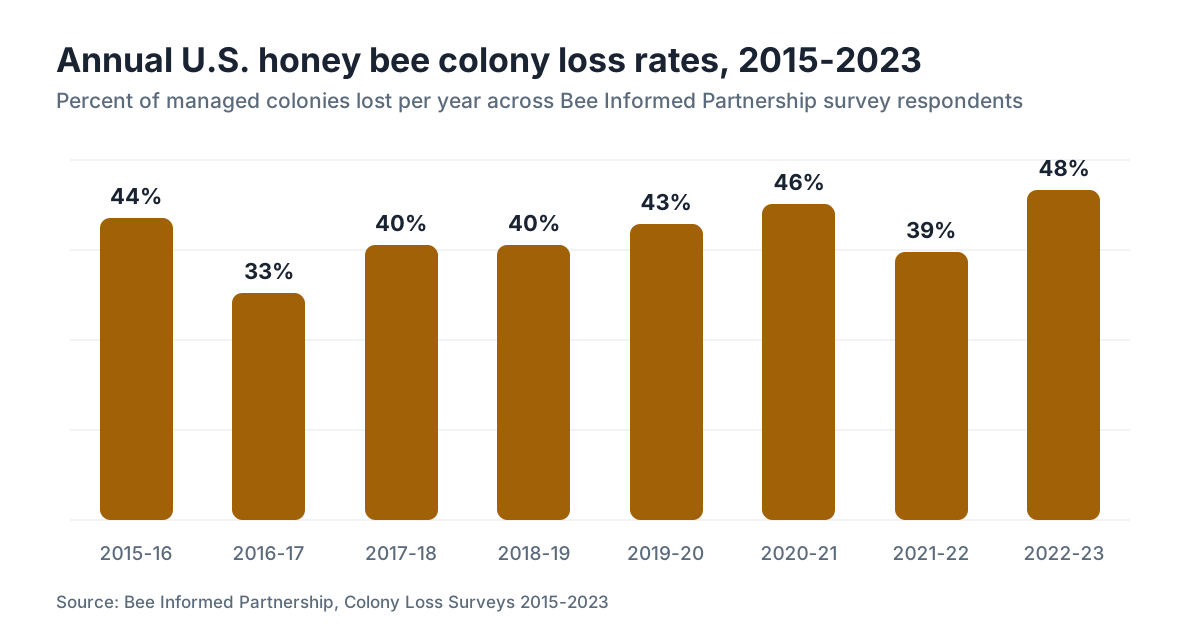
The USDA National Agricultural Statistics Service put U.S. managed honey bee colonies at roughly 2.8 million in 2023, down from about 5 million in the 1940s. Varroa is the leading identified cause of managed colony losses, with annual losses running 30 to 40 percent since systematic tracking started with the Bee Informed Partnership survey in 2006-2007 [12]. The Partnership's 2022-2023 survey reported a total annual loss of 48.2 percent of managed colonies among respondents, the highest in the survey's history [12].
The USDA estimates honey bee pollination is worth about $15 billion a year to U.S. agriculture, covering almonds, blueberries, cherries, cucumbers, and hundreds of other crops that lean on managed pollinators [13]. When Varroa kills colonies, beekeepers rebuild at real cost, roughly $150 to $250 per package and $30 to $60 per treatment cycle, and pollination services get pricier and less dependable.
For wild and feral bees the picture is murkier. Varroa has been documented spilling over into wild bee populations at shared foraging sites, though it can't reproduce on non-Apis species. The indirect hit lands harder: feral Apis mellifera colonies once acted as a reservoir of foragers across farm country, and they're far rarer now, cutting the background pollination that farmers and gardeners used to get for free.
How do you build a practical Varroa management plan?
A working plan has three parts: monitoring on a schedule, threshold-based treatment decisions, and records.
Monitor at least four times a year: early spring before populations expand, midsummer around the solstice, late summer around mid-August (the check that matters most), and late fall before winter bees are locked in. In a high-pressure apiary, or if you've had trouble before, count every four to six weeks through the active season [2].
Treat when you hit the threshold, not when it suits you. The 2 to 3 percent number is a population-level guide. For a weak colony or one you're pushing for winter, treat at 2 percent instead of waiting for 3. Log every count and every treatment. Patterns across seasons tell you far more than any single number.
Match the treatment to the situation. Capped brood present and temperatures cooperating? Formic acid is your best shot because it reaches mites under cappings. Natural or induced broodless window? Oxalic acid vapor is cheap and highly effective. Never treat with honey supers on unless the label explicitly allows it for your method. Read the label. It's the law [7].
The Honey Bee Health Coalition's Varroa Management Guide (free PDF on their site) is the closest thing North American beekeepers have to a consensus protocol. It covers treatment options, timing, and monitoring methods in detail, backed by field trial data [2].
To track counts and build a seasonal schedule off paper, VarroaVault's free protocol tools run on exactly this workflow. You can also source alcohol wash kits and monitoring trays through the beekeeping supply companies that carry them.
Frequently asked questions
What is a Varroa mite in simple terms?
Varroa destructor is a tiny external parasite, about 1.1 mm wide, that lives on honey bees and inside their capped brood cells. It feeds on the bee's fat body tissue, weakens the bee's immune system, and transmits deadly viruses like Deformed Wing Virus. Without treatment, it kills a honey bee colony within one to three years.
What does Varroa mite do to a bee colony?
Varroa shortens worker lifespans, damages the fat body (the bee's immune and energy organ), and injects viruses straight into developing pupae. Colonies show spotty brood, crawling bees with deformed wings, and shrinking populations heading into winter. The damage stacks up: a colony that looks fine in July can collapse by February because its winter bees were compromised in August brood.
Are honeybees exposed to Nosema through Varroa destructor mite?
No, Varroa does not directly transmit Nosema. Nosema spreads orally through contaminated food, water, or comb. But Varroa weakens bee immune function by eating fat body tissue, which leaves bees less able to contain Nosema once exposed. Colonies with high Varroa loads often have worse overall health, Nosema included, though the transmission route is completely different.
How do I know if my hive has Varroa mites?
The only reliable method is a mite count. An alcohol wash of about 300 bees gives you an infestation rate as a percentage. Visible symptoms like crumpled wings or crawling bees show up only at high infestation. By the time you see them, you may have lost the season. Count at least four times a year and treat at 2 to 3 percent.
What is the difference between Varroa destructor and Varroa jacobsoni?
Both species parasitize Apis mellifera, but Varroa destructor causes nearly all managed colony losses worldwide. V. jacobsoni historically stayed on its original host, Apis cerana, across parts of Asia and the Pacific, though it has been documented on Apis mellifera in Papua New Guinea. In North America and Europe, when beekeepers say Varroa, they mean V. destructor.
Can Varroa mites spread between hives?
Yes. Mites spread through drifting bees (bees that wander into the wrong hive), robbing (bees stealing honey from weaker colonies), and swarms. A collapsing infested colony is especially dangerous: neighbors rob it out and carry the mites home fast. That's why managing Varroa in a multi-hive apiary means treating every colony, not only the ones showing symptoms.
How long does Varroa take to kill a colony?
Without treatment, most colonies collapse within one to three years of infestation, depending on the starting mite load and local reinfestation pressure. The timeline shortens if mite numbers start high or neighboring colonies are collapsing (which drives robbing and rapid spread). Colonies going into winter above 3 to 5 percent rarely survive to spring.
Is oxalic acid safe to use on bees with brood present?
Oxalic acid dribble is approved only for broodless colonies in the U.S. Oxalic acid vaporization is labeled for colonies with or without brood, but it works far less well with brood present because the acid can't reach mites inside capped cells. For colonies with brood, formic acid (Formic Pro or MAQS) is the better choice because it penetrates cappings.
What temperature do Varroa treatments need to work?
It depends on the product. Apivar (amitraz strips) works between 50 and 105°F. Thymol products like Apiguard need above 59°F to volatilize. Formic acid (MAQS and Formic Pro) is labeled for 50 to 92°F. Oxalic acid vapor works in cold weather and gets used for winter broodless treatments above 40°F. Always check the current label for your specific formulation.
Can Varroa mites infest other bee species besides honey bees?
Varroa destructor can't reproduce on bumblebees, mason bees, or other non-Apis species, though phoretic adults have been found on them briefly. The mite's reproduction needs the specific brood conditions of Apis colonies. On non-Apis hosts, mites die without reproducing. The damage to wild bee communities is indirect: fewer feral Apis mellifera colonies means less background pollination, not direct infestation.
Why does Varroa prefer drone brood over worker brood?
Drone brood is capped about 14.5 days versus 12 days for worker brood, giving the mite more time to run more reproduction per cell. Mites also enter drone cells preferentially, possibly from different chemical cues or because drones are reared in smaller numbers, cutting competition between mites in one cell. Drone brood typically carries mite loads 8 to 10 times higher than worker brood.
What are Varroa-sensitive hygiene (VSH) bees?
VSH bees are a honey bee line developed at the USDA-ARS lab in Baton Rouge, selected to detect and remove mite-infested pupae before the mites finish reproducing. Colonies with strong VSH expression hold lower mite loads with less chemical help. USDA VSH queens sell commercially but cost more. They work best inside an integrated program, not as a standalone replacement for monitoring and treatment.
How do Varroa mites reproduce inside a bee cell?
A female enters a larval cell just before capping, hides under the brood food, and starts laying eggs about 60 to 70 hours after the cell is sealed. The first egg produces a male; later eggs produce females. The male mates with his sisters inside the cell. The mother and mated daughters exit with the emerging adult bee; the male dies in the cell. In a worker cell, one to two mated daughters typically survive.
What is the Varroa treatment threshold I should use?
Most North American extension services and the Honey Bee Health Coalition recommend treating at 2 to 3 mites per 100 bees (2 to 3 percent) during the active brood-rearing season. Some drop the threshold to 1 percent in August to protect winter bees. After treatment, counts should fall below 1 percent to confirm it worked. If counts stay high after a full course, suspect resistance and switch chemical classes.
Sources
- Anderson & Trueman, Experimental and Applied Acarology, 2000, Varroa jacobsoni is more than one species: Varroa destructor adult female morphology: approximately 1.1 mm wide and 1.6 mm long; taxonomy separating V. destructor from V. jacobsoni
- Honey Bee Health Coalition, Varroa Management Guide: Treatment threshold of 2-3 percent infestation, 70-80 percent of mites in capped brood, population doubling time of 4-6 weeks, monitoring frequency recommendations
- USDA Agricultural Research Service, Varroa mite history and detection in the United States: Varroa destructor confirmed in the United States in 1987; reached Europe by the 1980s
- Ramsey et al., PNAS, 2019, Varroa destructor feeds primarily on honey bee fat bodies: Varroa destructor feeds on fat body tissue, not hemolymph; fat body is primary feeding site confirmed by histology and stable isotope analysis
- Mordecai et al., Science, 2016, Superinfection exclusion and the long-term survival of honey bees in Varroa-infested colonies: Global spread of Varroa selected for a single virulent DWV variant; at least 18 viruses vectored by Varroa including DWV, ABPV, and SBV
- Higes et al., Journal of Invertebrate Pathology, 2007, Nosema ceranae causes honeybee colony collapse: Nosema spreads via oral ingestion of spores; fumagillin regulatory status and Nosema biology overview
- U.S. EPA, Pesticide Registration: All Varroa treatments in the U.S. require EPA registration; product label is a legal document
- U.S. EPA, Pesticide product and label system (Formic Pro / MAQS registration): Formic acid (Formic Pro/MAQS) is the only approved treatment that penetrates capped brood; labeled temperature range 50-92°F
- Gregorc & Planinc, Veterinary Record, 2001, Acaricidal effect of oxalic acid in honeybee colonies: Oxalic acid achieves 90-97 percent mite mortality in broodless colonies in a single treatment
- Fries et al., Apidologie, 2006, Survival of mite infested honey bee colonies in a Nordic climate: Gotland Island bee population stabilized after initial collapse with elevated rates of mite reproductive failure indicating behavioral resistance
- USDA Agricultural Research Service, Honey Bee Breeding, Genetics and Physiology Lab, Baton Rouge: USDA VSH (Varroa-sensitive hygiene) bee line development and commercial availability
- Bee Informed Partnership, Colony Loss Survey 2022-2023: Annual colony losses of 48.2 percent reported for 2022-2023; consistent 30-40 percent annual losses since 2006-2007 survey inception
- USDA Economic Research Service, Honey Bees and Colony Collapse Disorder: Honey bee pollination contributes an estimated $15 billion annually to U.S. agricultural value
Last updated 2026-07-09