Varroa in a swarm: how to treat before hiving
TL;DR
- Swarms carry fewer varroa than the parent colony, but none are mite-free.
- Before you hive a caught swarm, run an alcohol wash or sugar roll for a baseline count.
- At 2 mites per 100 bees or higher, treat right away with oxalic acid dribble or vapor.
- Do it before the colony draws comb and caps brood, because capped cells hide mites from oxalic acid.
Do swarms actually carry varroa mites?
Every swarm from a varroa-infested colony carries mites. The idea that swarms are "clean" is wishful thinking, not science.
Here is why the myth sticks around. A swarm takes only adult bees with it, no brood frames. Varroa reproduces inside capped brood cells, so every mite riding a swarming bee is phoretic, clinging to an adult between reproductive cycles. That broodless stretch cuts the total mite population compared to the parent hive. It does not zero it out. University extension programs report swarms carrying phoretic mites at rates that often run 1 to 3 mites per 100 bees, higher if the parent colony was heavily infested before it swarmed [1][10].
The real issue is timing. A fresh swarm has no capped brood. That is your window, and it is short. Oxalic acid, the most accessible treatment for small operations, works almost entirely on phoretic mites because it cannot penetrate wax cappings [4]. Once your new colony draws comb and the queen starts laying, that window closes fast. A queen can go from her first egg to capped brood in about nine days [7]. Wait two weeks to treat and you have already missed the best shot you will ever get with that colony.
How many mites does a typical swarm have?
There is no single number. The honest answer is it swings with the health of the parent colony and the point in the season the swarm left.
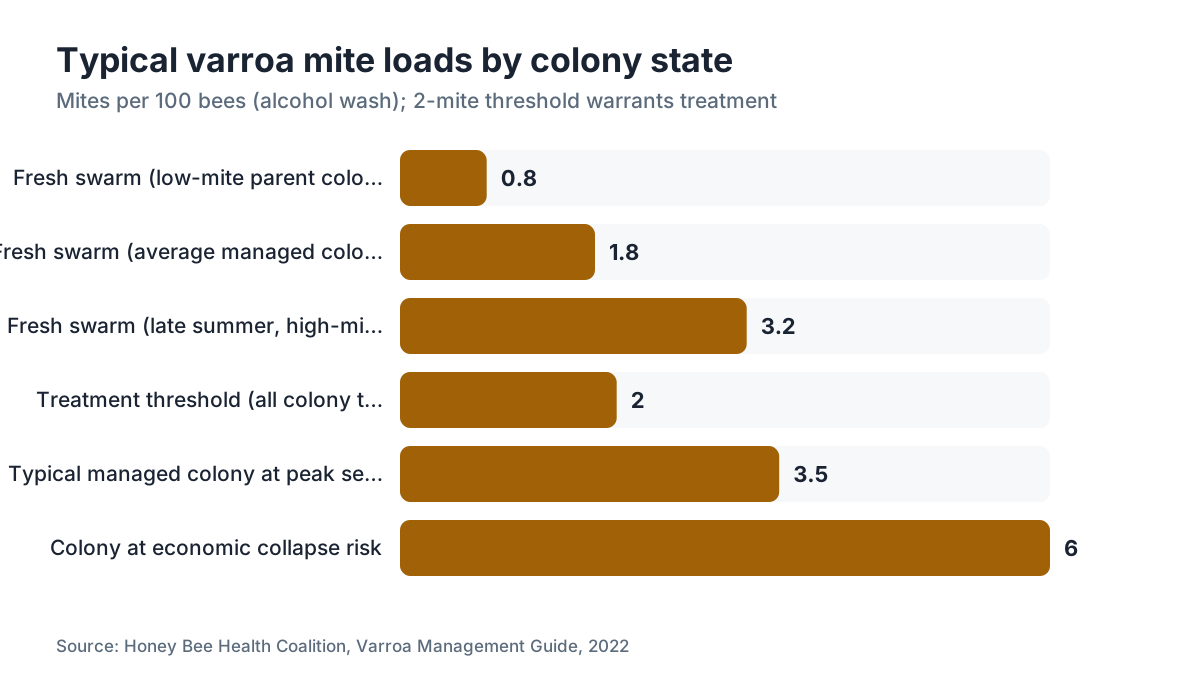
Here is what the data does show. Swarms carry lower mite loads than the colonies they leave, but the gap is smaller than most beekeepers guess. The Honey Bee Health Coalition puts the treatment line at 2 mites per 100 bees on an alcohol wash for most situations [2]. A spring swarm from a low-mite parent may land well under that. A late-summer swarm from a heavily infested colony can hit 3 mites per 100 bees or more.
The chart below shows typical phoretic mite loads at different colony states, including the broodless swarm. Treat these as rough benchmarks, not promises.
One practical takeaway: do not assume a swarm is safe just because it came from your own "treated" hive. Treatments fail. Mite-resistant genetics are not mite-free genetics. Every caught swarm earns a fresh alcohol wash before it goes into a permanent box.
How do you test a swarm's mite load before hiving?
The alcohol wash is the most accurate field method and the one most university extension programs recommend for a real count [3]. The sugar roll is gentler on the bees but undercounts mites by 30 to 40 percent against an alcohol wash, so if you go that route, adjust your result upward in your head [3].
For a fresh swarm sitting in a collection container, run the wash like this:
- Chill the swarm container in the shade or briefly in a cooler. Cold bees move slower and the whole job gets easier.
- Find the queen and set her aside in a small cage if you can. You do not want her in your sample.
- Scoop or shake roughly 300 bees (about half a cup) into a wide-mouth jar. A half-cup runs close to 300 bees, which is the reliable sample size [3].
- Add 70 percent isopropyl alcohol to cover the bees. Put a mesh lid on and shake for 30 to 60 seconds.
- Pour the wash through a second container over a white paper towel or white plastic lid. Count the mites that drop through.
- Divide mite count by bee count and multiply by 100. That is your mites per 100 bees.
A count of 0 to 1 means you are in good shape, though a preventive oxalic treatment still makes sense. A count of 2 or above means treat before hiving. No debate.
If you cannot find the queen and cannot risk losing her in the sample, pull bees from the outer edge of the cluster, away from the dense center where she usually sits. Accept some uncertainty and lean toward treating.
What treatments actually work on a broodless swarm?
Oxalic acid is the right tool. It is the one treatment that works well on a broodless colony, is legally registered for honey bees in the US, and lets you hive the colony quickly [4].
You have two delivery methods.
Oxalic acid dribble (Api-Bioxal or equivalent): Mix the registered Api-Bioxal product at the labeled concentration, 3.5 g oxalic acid dihydrate per 35 mL of 1:1 sugar syrup, and dribble 5 mL per seam of bees [4]. For a swarm in a temporary box, that means dribbling over as many seams of clustered bees as you can see. It is fast and cheap. One application typically hits 90 to 97 percent efficacy on broodless colonies [5].
Oxalic acid vapor (vaporization): Needs a vaporizer unit and a NIOSH-approved OV/P100 respirator. Vapor gets through the cluster better than dribble in cold weather and needs less contact with the bees. The labeled rate with Api-Bioxal is 1 gram per brood box, and the label allows repeat treatments [4]. For a broodless swarm, a single vapor treatment before hiving does the job.
Amitraz strips (Apivar) and formic acid products (MAQS, Formic Pro) are wrong for this stage. Apivar needs 6 to 8 weeks and depends on brood dynamics to matter [8]. MAQS and Formic Pro can hurt open brood and queens in the heat, and a newly hived swarm's queen is already fragile. Stick with oxalic acid.
Look at the available beekeeping supply companies and source your Api-Bioxal and equipment before swarm season starts, not the morning you catch one.
What is the step-by-step process to treat a swarm before hiving?
Here is the sequence I use and would tell any beekeeper to use.
Step 1: Catch and contain. Get the swarm into a temporary container: a nuc box, a cardboard box, a ventilated five-gallon bucket. Make sure the queen is in. Close it up with ventilation and set it in shade.
Step 2: Let the cluster settle. Give them 30 to 60 minutes. Bees cluster tighter once they calm down, which makes the cluster easier to sample and treat.
Step 3: Run an alcohol wash. Follow the method above. Aim for a 300-bee sample. Do not rush the count.
Step 4: Decide. At 0 to 1 mite per 100 bees, treat preventively with oxalic acid dribble and hive. At 2 or above, treat and weigh a second treatment in 5 to 7 days before brood caps form.
Step 5: Treat with oxalic acid. For dribble, apply straight to the cluster in the temporary container before you transfer to the hive. For vapor, seal the container, vaporize through a small gap, and wait the label time. Follow the Api-Bioxal label exactly. Nitrile gloves and eye protection for dribble; a full OV/P100 respirator for vapor [4].
Step 6: Wait. Give the bees 10 to 15 minutes after a dribble treatment before moving them. This lets the acid work and lets the bees start grooming.
Step 7: Hive the swarm. Transfer to your prepared hive body. Give them drawn comb if you have it. It speeds queen acceptance and shortens the time to brood-capping, which is one more reason to move fast.
Step 8: Monitor and retest. Check mite levels again 3 to 4 weeks after hiving, once the colony has run a full brood cycle. That first retest tells you whether your treatment held and whether the colony needs more.
Does treating a swarm with oxalic acid hurt the queen?
This is a fair worry, and worth being straight about. The data on queen safety with oxalic acid dribble is reassuring for broodless colonies, with a few caveats.
For dribble on adult bees: published research and field experience show oxalic acid dribble at the labeled rate does not meaningfully raise queen loss in established, broodless colonies [5]. The acid irritates bees into grooming, it does not linger in the colony, and queens in a healthy cluster are not singled out.
For vaporization: the evidence is similarly favorable in broodless conditions. Work published in the Journal of Apicultural Research found no significant increase in queen loss from oxalic acid vapor in broodless colonies against untreated controls [5]. Queen trouble climbs when colonies have open brood and you vapor-treat several times in quick succession, which is not your fresh swarm.
The bigger risk with a caught swarm is handling stress, not chemistry. Shake the swarm repeatedly, chill them too hard, or make the queen run a gauntlet before she reaches a hive, and you raise the odds of supersedure or loss. Be calm and deliberate. If you caged the queen during sample prep, get her back into the cluster promptly after treatment.
How soon after treating can you hive the swarm?
For oxalic acid dribble, 15 to 30 minutes is enough to let the treatment start working before you move the colony. The Api-Bioxal label sets no mandatory holding period for this scenario [4]. The acid acts on contact, and the bees begin spreading it through the cluster by grooming almost right away.
For oxalic acid vapor, follow the label's ventilation timing. You generally seal the treatment space for about 10 minutes, then let it ventilate before opening and moving the bees. Do not rush it. The vapor needs to dissipate and the bees need a few minutes to clear it from the cluster before you start shaking them around.
There is no honey residue reason to hold off on hiving. The EPA registration for Api-Bioxal requires no honey withdrawal period, and residue studies find oxalic acid in treated colonies stays within the background levels already present in untreated honey [4][5].
Short version: treat in the temporary container, wait 15 to 30 minutes for dribble or the ventilation period for vapor, then hive normally.
What if you catch a swarm and have no oxalic acid on hand?
It happens. Swarms do not schedule themselves. You can still manage the situation without treatment on day one, but you have to move once you get product.
Hive the swarm immediately so you do not lose it. A swarm stuck too long in a temporary container will abscond or die. Get the colony established first.
Order or pick up Api-Bioxal fast. Many beekeeping supply companies carry it, and some farm supply stores stock it. Check whether a local bee club will lend or sell a member a small amount in a pinch.
Treat with oxalic acid dribble the moment you have it, as long as the colony is still broodless. Watch the colony. Inspect at day 5, day 9, and day 12. Once you see capped worker cells, your oxalic acid window is closing fast [7]. You can still dribble or vapor to knock down phoretic mites, but you will need a follow-up after brood emerges to catch the mites that were sealed inside cells.
Got drawn comb? Give it to the new swarm. Queens lay faster on drawn comb, which shortens the broodless window but speeds colony growth. The trade is worth it for viability. Just treat sooner.
You can review the varroa mite management fundamentals to see where this fits in the broader treatment calendar before you make your call.
Should you treat a swarm differently depending on the time of year?
Yes. Season matters for two reasons: temperature changes oxalic acid efficacy and queen vulnerability, and mite pressure in the local bee population shifts through the year.
Spring swarms (April to May in most of the US): parent colonies usually run lower mite loads after winter. Spring swarms tend to come in low, but "tend to" is not "always." Test anyway. Temperatures usually sit where dribble and vapor both work well. These swarms also have the longest runway to build up, so a clean start pays off.
Early summer swarms (June): mite populations in untreated colonies are climbing. A June swarm from an unmanaged feral colony or a neighbor's neglected hive can carry a surprising load. Test, and assume you need to treat.
Late summer swarms (July to August): the highest-risk group. Mite populations peak in late summer across much of North America [2]. A late swarm may have come from a collapsing colony with a load well over threshold. Test right away. Vapor may be the better pick in late-summer heat, since dribble efficacy can slip above 85 to 90 degrees Fahrenheit, though the label sets no temperature restriction [4].
For vaporization specifically, a range of 50 to 90 degrees Fahrenheit is generally cited as optimal for oxalic acid vapor in the field [3].
The other seasonal point: in late summer, every week you delay lets the mite population in your new colony grow while winter bees are being raised. Mite-damaged winter bees are the main driver of winter colony losses [2].
Can a swarm from a mite-resistant colony skip treatment?
Maybe. Test it anyway.
Mite-resistant stock, whether Varroa Sensitive Hygiene (VSH), Minnesota Hygienic, or Saskatraz lines, is bred to suppress mite reproduction, not wipe out mites. These colonies carry fewer mites on average, and a swarm from a well-managed VSH colony might genuinely wash out at 0 mites per 100 bees. If that is your result, you have a reasonable case for skipping a chemical treatment and monitoring closely instead.
The catch is you rarely know the full genetic history of a caught swarm. Feral swarms are wild cards. Even a swarm from your own resistant stock has likely open-mated with drones from other colonies nearby, and those genetics feed into mite sensitivity.
The defensible position: test every swarm regardless of claimed genetics, and treat at or above 2 mites per 100 bees. At 0 to 1 with documented VSH or similar genetics, you can hold off on chemicals and retest in three weeks. That first retest at the four-week mark is non-negotiable here.
What equipment do you need to have ready before swarm season?
If you want to treat before hiving, the supplies have to be on hand before you catch anything. Swarms do not wait for shipping.
Minimum kit to keep ready during swarm season:
- Api-Bioxal (or a generic oxalic acid product with EPA registration for honey bees in your state). Check your state's registration; not every generic is registered in every state [6].
- A wide-mouth mason jar with a mesh screen lid for the alcohol wash.
- 70 percent isopropyl alcohol.
- A white container or paper towel for mite counting.
- Nitrile gloves and safety glasses.
- A small queen cage in case you need to protect the queen during sampling.
- If using vapor: your vaporizer, a NIOSH OV/P100 respirator, and a way to seal the temporary swarm container for treatment.
Source most of this from beekeeping supply companies well before your first swarm call. Having it ready is the difference between treating a swarm properly and hiving it untested because you were caught flat.
For what to look for in a supplier, the free shipping honey bee supply companies roundup covers options that can get you supplies fast if you are short.
How do you record and follow up after treating a swarm?
Treating the swarm before hiving is step one. The follow-up decides whether the colony actually stays healthy.
Your record should include the date you caught the swarm, the initial alcohol wash result (mites per 100 bees), the treatment you used, the treatment date, and the temperature at treatment time. This is not paperwork for its own sake. It is the information you need to time the next test and judge whether a second treatment is warranted.
Your follow-up test schedule:
- Day 21 to 28 after hiving: first retest. By now the colony has run at least one full brood cycle. Mites that were sealed in cells during your initial treatment have emerged and gone phoretic again. This count reflects the colony's true mite load.
- If the day-28 count is above 2 mites per 100 bees: treat again with a product suited to a colony with brood. Oxalic acid drops off in efficacy once there is significant capped brood. Apivar (amitraz strips) or Formic Pro may fit better at this stage, depending on temperature and your situation [2][8].
- Day 42 to 56: second retest if you applied a second treatment. Confirm it worked.
The Honey Bee Health Coalition's Varroa Management Guide, last updated in 2022, walks through this monitoring cycle in detail and is worth bookmarking [2].
Frequently asked questions
Is it safe to eat honey from a hive started with a treated swarm?
Yes. Api-Bioxal (oxalic acid) has no honey withdrawal period under its EPA registration. Oxalic acid occurs naturally in honey, and studies consistently find residues in treated colonies stay within the range already present in untreated honey. The EPA found no food safety concern from oxalic acid treatments used according to label directions.
Can I use Apivar strips on a swarm before hiving?
It is the wrong choice for a pre-hiving treatment. Apivar works over 6 to 8 weeks and depends on bees walking across the strips repeatedly to spread amitraz. A fresh swarm with no brood gets knocked down faster and more completely with a single oxalic acid treatment. Save Apivar for colonies with established brood where oxalic acid alone falls short.
What mite count is too high for a swarm to be worth hiving?
There is no standard cutoff for "not worth it" based on mite count alone. Even a swarm at 4 or 5 mites per 100 bees is salvageable with immediate, effective oxalic acid treatment in the broodless window. The real danger is hiving an untreated high-mite swarm and letting it crash months later, spreading mites to neighboring colonies through drift and robbing.
How long does a swarm stay broodless after hiving?
Once hived, the queen usually starts laying within 24 to 72 hours if drawn comb is available, or up to 5 to 7 days if the colony is drawing comb from scratch. Worker brood is capped around day 9 after the egg is laid. So your true broodless window from hiving day runs roughly 9 to 12 days for oxalic acid to work at full efficacy.
Does a sugar roll work well enough to test a swarm's mite load?
It works, but it undercounts mites by roughly 30 to 40 percent against an alcohol wash, per published university extension comparisons. If a sugar roll gives you 1.5 mites per 100 bees, your real count may be closer to 2 or above. Treat on the adjusted estimate, or just use an alcohol wash for accuracy when the call matters.
Can I treat a swarm with oxalic acid vapor if the temperature is above 90 degrees Fahrenheit?
The Api-Bioxal label sets no hard temperature ceiling for vaporization, but field experience suggests efficacy drops in extreme heat. More practically, running a vaporizer in high heat raises your own exposure risk. Above 90 degrees, dribble is often more practical. Always check the current label for your product, since label language gets updated periodically.
Do feral swarms carry more varroa mites than managed hive swarms?
Often yes, though variability is real. Feral colonies are usually untreated and may have been building mite loads for years. That said, some feral populations carry naturally selected resistance traits that keep loads lower. You cannot tell which you have without an alcohol wash. Test every feral swarm and never assume it is clean.
What if the swarm is very small, fewer than a pound of bees? Should I still treat?
A small swarm is a fragile colony, and oxalic acid dribble at the labeled rate (5 mL per seam) is generally well tolerated even by small clusters. The bigger risk with a small swarm is losing it entirely to a heavy mite load if you skip treatment. Apply carefully to the seams you can see, and weigh whether the colony is big enough to survive and build before you commit a full hive body to it.
How do I find the queen in a swarm before taking a mite sample?
In a settled cluster, the queen usually sits near the center of the mass. Gently pull bees from the outer edge into your sample jar, avoiding the dense core. You can also watch for her on the container walls before the cluster fully forms, since she sometimes walks alone for a short stretch. If you cannot locate her, sample carefully from the periphery and accept some uncertainty.
Can I use homemade oxalic acid instead of Api-Bioxal on a swarm?
In the US, only EPA-registered products like Api-Bioxal are legal for use on honey bee colonies. Using food-grade or lab-grade oxalic acid that is not part of a registered label is an off-label application and a violation of federal pesticide law under FIFRA. The registration exists so the concentration and application method are standardized for safety and efficacy. Use the registered product.
Should I treat a swarm I caught from my own hives differently than one from an unknown source?
The process is the same: test, then treat if at or above threshold. The difference is your confidence in the parent colony's mite history. If your source colony had a clean alcohol wash three weeks before swarming, a low swarm count is more plausible. If the parent colony's history is unknown, treat more conservatively. Do not skip the wash either way.
How many oxalic acid treatments does a swarm need before it is considered protected?
For a truly broodless swarm, one well-run oxalic acid treatment hits 90 to 97 percent efficacy on phoretic mites. That is enough to start the colony healthy. The essential follow-up is a retest at 3 to 4 weeks post-hiving to catch any mites that survived or reproduced once brood started. Most swarms need only one pre-hiving treatment if it lands during the broodless window.
Is a swarm from an Africanized honey bee colony safe to hive?
Africanized honey bees (AHB) bring management challenges well beyond varroa. In areas where AHB is present, catching and hiving an unknown swarm risks introducing highly defensive genetics into your apiary. Understand your regional AHB status before hiving any feral swarm. The separate guide on the africanized honey bee covers identification and risk assessment for beekeepers in affected states.
Sources
- Penn State Extension, Varroa Mite Biology and Management: Swarms carry phoretic mites at rates that commonly run 1 to 3 mites per 100 bees depending on the parent colony's infestation level.
- Honey Bee Health Coalition, Varroa Management Guide (2022): A threshold of 2 mites per 100 bees on an alcohol wash warrants treatment; mite populations peak in late summer across North America; winter colony losses are driven primarily by mite-damaged winter bees.
- University of Minnesota Extension, Varroa Mite Monitoring Methods: Alcohol wash with a 300-bee (half-cup) sample is the most accurate field monitoring method; sugar roll underestimates mite counts by 30 to 40 percent compared to alcohol wash; optimal vapor treatment temperature range is 50 to 90 degrees Fahrenheit.
- EPA, Api-Bioxal Oxalic Acid Product Label (EPA Reg. No. 69610-3): Api-Bioxal is EPA-registered for use on honey bees; labeled dribble concentration is 3.5 g oxalic acid dihydrate per 35 mL of 1:1 sugar syrup applied at 5 mL per seam; vaporization rate is 1 gram per brood box; no honey withdrawal period is required.
- Gregorc, A. et al., Journal of Apicultural Research, Oxalic acid efficacy and queen safety in broodless colonies: Oxalic acid dribble achieves 90 to 97 percent efficacy on phoretic mites in broodless colonies; oxalic acid vapor does not significantly increase queen loss in broodless colonies compared to untreated controls; residue levels in treated colonies remain within naturally occurring background levels found in untreated honey.
- USDA Agricultural Marketing Service, National Organic Program and state pesticide registration guidance: State-level EPA pesticide registration status for oxalic acid generics varies; beekeepers should verify their specific state's registration before use.
- North Carolina State University Extension, Varroa Mite Integrated Pest Management: Swarm colonies transition from broodless to capped brood within approximately 9 to 12 days of hiving when drawn comb is available.
- Virginia Cooperative Extension, Honey Bee Varroa Management: Oxalic acid is most effective on colonies with no capped brood; once significant capped brood is present, alternative treatments such as amitraz strips may be more appropriate.
- EPA, Federal Insecticide, Fungicide, and Rodenticide Act (FIFRA) Overview: Using pesticides not registered for the target use or applying off-label formulations is a violation of FIFRA; only EPA-registered products with honey bee colony use on their label may legally be used in the US.
- Ohio State University Extension, Swarm Biology and Varroa: All swarms from varroa-infested colonies carry phoretic mites; the broodless period in a swarm does not eliminate mites but does reduce total mite population relative to the parent colony.
Last updated 2026-07-09