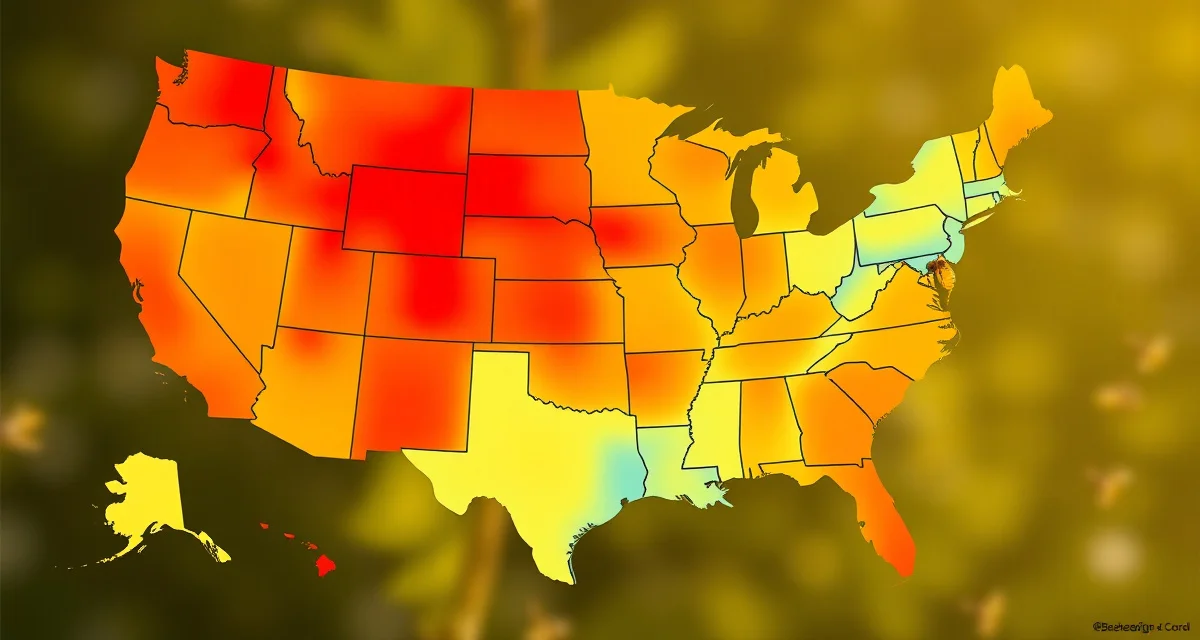
Geographic Variation in Varroa Pressure: Why Your State Matters
Florida beekeepers face 5-7 mite reproduction cycles per year versus 3-4 for Minnesota beekeepers. That difference isn't a minor calibration issue: it means a Florida colony left untreated for the same period accumulates roughly twice the mite load of an equivalent Minnesota colony. Your geographic context determines your baseline risk, your optimal monitoring frequency, and your seasonal treatment timing.
TL;DR
- PHI (pre-harvest interval) is the required waiting period between the end of treatment and adding honey supers
- PHI varies by product: oxalic acid has no PHI for approved uses, MAQS has no PHI, Apivar requires supers to be off during treatment
- Applying treatments with supers on violates the label and may contaminate honey with residues
- State apiarists can ask for PHI compliance records during inspections
- Missing PHI windows is one of the most common compliance errors among small-scale beekeepers
- VarroaVault's PHI calendar blocks super-addition dates automatically based on your logged treatment dates
Why Geography Drives Mite Pressure
Varroa mites reproduce inside capped worker brood cells. Each reproductive cycle takes approximately 12 days inside the cell. A mite entering a capped worker cell produces typically one or two viable female offspring per cycle. The faster the brood cycle turns over, and the longer it continues through the year, the faster the mite population grows.
Geography affects this through two primary mechanisms:
Brood season length. In Minnesota, brood rearing typically stops in November and doesn't restart reliably until late March: a 4-5 month broodless period. In Florida, brood rearing is nearly continuous, with only brief interruptions. A Florida colony running 10 months of brood activity gives mites 10 months of reproductive cycles. A Minnesota colony gives them 6-7 months.
Temperature effects on brood development speed. Warmer temperatures slightly accelerate bee development. A colony in coastal Georgia reaches brood-rearing conditions earlier in spring than one in the northern tier states. The warm season starts earlier and ends later.
High-Pressure Regions: The Southeast and Hawaii
The southeastern US presents the most challenging varroa management conditions in the continental US:
Florida: No reliable broodless period. Mites can reproduce year-round. OA dribble is largely impractical as a primary treatment because a true broodless condition may not exist for long enough to justify its use. Extended OA vaporization protocol or formic acid treatments are more appropriate. Year-round monitoring is essential: there's no "off season."
Gulf Coast states (Louisiana, Alabama, Mississippi, coastal Georgia): Brief broodless period possible in late December and January, but unreliable. Similar management challenges to Florida, though slightly less extreme. Treat at least 3 times per year: spring (before build-up), mid-summer (before peak pressure), and fall (post-harvest).
Hawaii: Year-round brood rearing in most locations. However, the island ecology affects mite pressure differently: isolated locations with no neighboring beekeeping operations can have dramatically lower reinfestation rates than mainland apiaries. Regional variation within Hawaii is significant.
Moderate-Pressure Regions: Mid-Atlantic and Pacific Coast
Mid-Atlantic states (Virginia, Maryland, Delaware, Pennsylvania, New Jersey): Broodless period typically 6-8 weeks in December-January. Reliable enough for OA dribble if timed correctly. Mite pressure is moderate, with peak counts typically July-September. Standard HBHC monitoring schedule (monthly April-October) applies well. A July count that comes back above threshold should trigger immediate treatment before August.
Pacific Northwest (Oregon, Washington): Variable by elevation and proximity to the coast. Coastal areas have milder winters and shorter broodless periods. Eastern Oregon and Washington have more reliable cold winters and longer broodless periods. Monitoring from March through October; broodless OA dribble typically viable from November through February in most locations.
California: Enormous geographic variation within the state. Central Valley: long brood season, high summer heat that limits formic acid options, moderate pressure. Bay Area coast: mild year-round, short broodless period. Northern coast: similar to Pacific Northwest. Mountain zones: shorter seasons, lower pressure. California beekeepers need to calibrate to their specific zone, not to the state average.
Low-Pressure Regions: Northern States and High Elevation
Upper Midwest and New England (Minnesota, Wisconsin, Michigan, Vermont, Maine, New Hampshire): Long broodless period (4-5 months) provides natural population suppression. Peak mite pressure June-August. OA dribble is highly effective during the reliable November-February broodless window. Monitoring can focus heavily on the June-September period. Standard fall Apivar or OA vaporization treatment before first frost is usually sufficient.
Mountain West at elevation (Colorado above 7000 ft, Wyoming, Idaho): High elevation means shorter active seasons. Some high-altitude apiaries have very low endemic mite pressure due to isolation. Monitoring is still essential, but beekeepers at high elevation may find counts consistently below threshold with less frequent treatment.
Northern Great Plains (North Dakota, South Dakota, Montana): Short active seasons, reliable cold winters. Mite pressure is lower than in more southern states, but late-summer treatment timing is still critical because the active season ends abruptly. Missing the August treatment window in these states leaves no recovery options before winter.
How Location Affects Your VarroaVault Configuration
VarroaVault's geographic calibration automatically adjusts default monitoring frequency and threshold alerts based on your state and climate zone when you enter your apiary location.
Florida users see the year-round monitoring calendar with no "off season" designation. Minnesota users see the seasonal calendar with a broodless period treatment prompt appearing in November.
The system uses your location's average first frost date to calibrate:
- When your fall treatment reminder fires (allowing enough time to complete a full treatment cycle before frost)
- When your spring monitoring reminder starts (calibrated to your average bee flight date)
- Whether a broodless OA dribble prompt is appropriate for your zone
If your apiary is in an unusual microclimate (a warm south-facing valley in a cold region, or a high-elevation site in a warm state), you can manually override the geographic defaults and enter your specific active season dates.
Frequently Asked Questions
How does location affect varroa pressure?
Location determines brood season length and the number of mite reproductive cycles per year. Florida colonies experience 5-7 mite reproduction cycles annually, compared to 3-4 in Minnesota, because of the near-continuous brood season. Warmer climates also tend to have higher endemic mite pressure and greater reinfestation risk from neighboring operations. Treatment timing, monitoring frequency, and product selection all need to be calibrated to your specific geographic context.
Does VarroaVault adjust its recommendations based on my location?
Yes. Entering your apiary's zip code or county in VarroaVault activates geographic calibration that adjusts default monitoring frequency, seasonal treatment prompts, and broodless period alerts based on your climate zone and average first frost date. Florida users get year-round monitoring calendars; Minnesota users get seasonally-calibrated calendars with broodless period prompts. You can manually override any geographic default if your microclimate differs from the regional average.
Which US regions have the highest varroa risk?
The southeastern US, particularly Florida and Gulf Coast states, faces the highest varroa risk due to near-continuous brood rearing and warm temperatures that support year-round mite reproduction. Hawaii is similarly high-pressure in most locations. Mid-Atlantic states face moderate pressure with seasonal peaks in July-September. The upper Midwest and high-elevation western states face lower baseline pressure due to longer broodless periods, though late-summer treatment timing remains critical even in these lower-pressure regions.
How do I know if my varroa treatment is working?
Run a mite count 2-4 weeks after the treatment ends and compare it to your pre-treatment count. The efficacy formula is: ((pre-count - post-count) / pre-count) x 100. A result above 90% indicates effective treatment. Results below 80% should trigger investigation for possible resistance, application error, or reinfestation. Log both counts in VarroaVault to track efficacy trends across treatment cycles.
How often should I check mite levels in my hives?
At minimum, once per month (every 3-4 weeks) during the active season. Increase to every 2 weeks when counts are near threshold or after a treatment to verify it worked. In fall, monitoring frequency matters most because the window to treat before winter bees are raised is narrow. VarroaVault's monitoring reminders can be set to your preferred interval for each apiary.
What records should I keep for varroa management?
Each record should include: date of count or treatment, hive identifier, monitoring method used, number of bees sampled, mites counted, infestation percentage, treatment product name and EPA registration number, dose applied, treatment start and end dates, and PHI end date. State apiarists typically expect this level of detail during inspections. VarroaVault captures all of these fields in a single log entry.
What is Geographic Variation in Varroa Pressure: Why Your State Matters?
Geographic Variation in Varroa Pressure: Why Your State Matters is an educational article on VarroaVault that explains how your location directly impacts varroa mite infestation risk in your beehives. It covers how climate and brood cycle length determine how many mite reproduction cycles occur annually in your region, why Florida beekeepers face roughly twice the mite pressure as Minnesota beekeepers, and how to adjust your monitoring frequency and treatment timing based on your state.
How much does Geographic Variation in Varroa Pressure: Why Your State Matters cost?
The article is free educational content available on VarroaVault. While the article itself has no cost, VarroaVault offers tools such as a PHI compliance calendar and treatment tracking features that may be part of a paid or freemium platform subscription. Beekeepers can access the geographic varroa pressure guidance to inform their hive management decisions without any purchase required.
How does Geographic Variation in Varroa Pressure: Why Your State Matters work?
The article works by mapping regional climate data to varroa reproductive biology. Since mites reproduce inside capped brood cells, warmer climates with longer brood seasons enable more mite cycles per year. Florida's year-round brood activity allows 5-7 cycles annually versus 3-4 in Minnesota. Using this framework, beekeepers identify their baseline risk level and apply location-appropriate monitoring schedules and seasonal treatment windows.
What are the benefits of Geographic Variation in Varroa Pressure: Why Your State Matters?
Key benefits include more accurate mite load forecasting, better-timed treatments, and reduced colony losses. Understanding your regional baseline helps you avoid undertreating in high-pressure climates or overtreating in lower-risk ones. The guidance also connects to PHI compliance, ensuring treatments are applied within legal windows. VarroaVault's integrated tools can automate calendar blocking for super-addition dates based on your logged treatment history.
Who needs Geographic Variation in Varroa Pressure: Why Your State Matters?
Any beekeeper who manages hives and wants to reduce varroa-related colony losses will benefit, but it is especially valuable for beekeepers in warm southern states like Florida, Texas, or Georgia where mite pressure is significantly higher. New beekeepers unaware of regional differences and experienced beekeepers relocating to a new climate will find the geographic framing essential for calibrating their varroa management strategy correctly.
Related Articles
Sources
- American Beekeeping Federation (ABF)
- USDA ARS Bee Research Laboratory
- Honey Bee Health Coalition
- Penn State Extension Apiculture Program
- Project Apis m.
Get Started with VarroaVault
PHI compliance is not complicated when your treatment dates and harvest windows are tracked in the same system. VarroaVault automatically calculates PHI end dates for every treatment you log and blocks honey super addition during restricted periods. See pricing and free tools at varroavault.com.