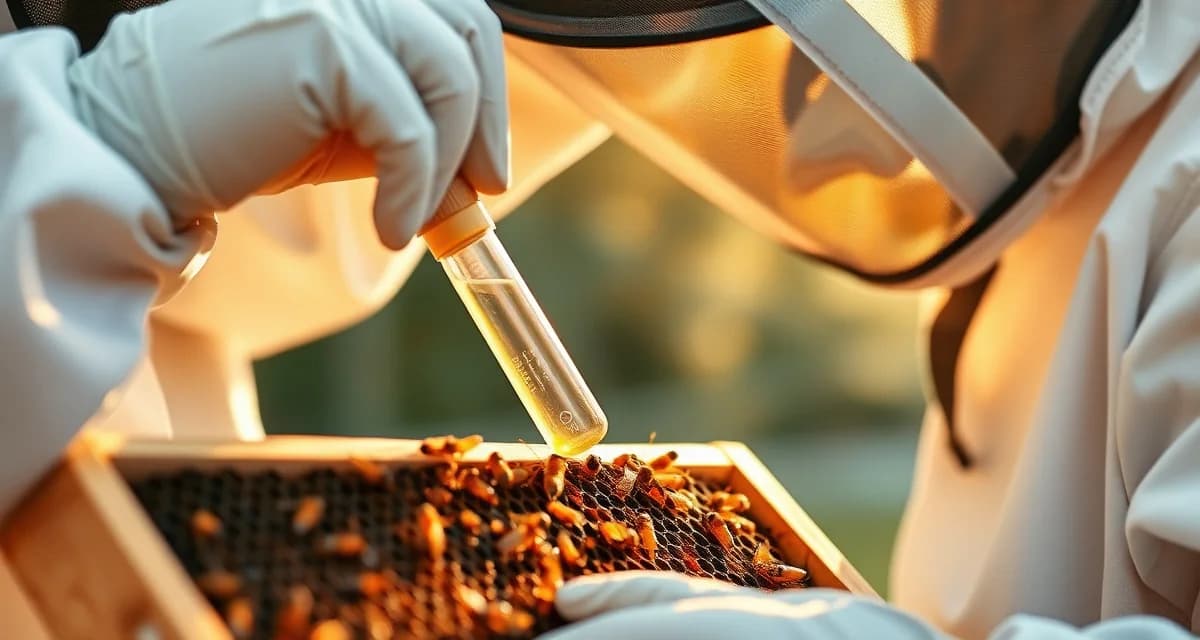
Testing Honey for Varroa Treatment Residues: What You Need to Know
Honey samples that fail acaricide testing cost producers an average of $4,200 per incident in disposal, retesting, and market damage. That figure doesn't include the longer-term damage to buyer relationships or the regulatory attention that a failed test can attract. And the frustrating reality is that most residue failures are entirely preventable with proper PHI management, the residue didn't have to be there.
This guide covers how varroa treatment residues end up in honey, what testing options exist, what the residue limits are, and how VarroaVault's PHI compliance records serve as your primary protection before product testing becomes necessary.
TL;DR
- This guide covers key aspects of testing honey for varroa treatment residues: what you need t
- Mite monitoring should happen at minimum every 3-4 weeks during active season
- The 2% threshold in spring/summer and 1% in fall are standard action points based on HBHC guidelines
- Always run a pre-treatment and post-treatment mite count to calculate efficacy
- Treatment records including product name, EPA number, dates, and counts are required for state inspection compliance
- VarroaVault stores all monitoring and treatment data with automatic threshold comparison and state export formatting
How Treatment Residues Get Into Honey
Understanding residue pathways helps you prevent them. There are three main routes:
Direct contamination during PHI violation: The most common cause. A treatment is applied in spring, the PHI expires in summer, but the beekeeper harvests from a hive that still has an active treatment or hasn't fully cleared the PHI window. Residue levels from fresh treatment violations can be 10-100x above acceptable limits.
Wax accumulation: Acaricide compounds, particularly amitraz metabolites and coumaphos, are lipophilic, they bind to wax. Repeated treatments over seasons build up in beeswax. When honey is stored in old wax with accumulated residues, trace amounts can migrate into the honey. This is typically well below regulatory action levels but can cause issues for operations with very strict buyers or export markets.
Contaminated equipment: Extractors, storage containers, and other equipment that has contacted treated hives can transfer trace residues to honey if not thoroughly cleaned between uses.
The first cause (PHI violation) accounts for the vast majority of failed tests. The other two causes typically produce levels below US regulatory action thresholds but may matter for specific market requirements.
US Residue Limits
The United States does not have a comprehensive federal Maximum Residue Level (MRL) system for honey equivalent to the EU's standards. However:
FDA and EPA oversight: Under FIFRA, treatment products must be used according to label directions, which include PHI requirements. Honey harvested in violation of PHI restrictions is technically misbranded or adulterated.
Buyer requirements: Major honey processors, co-ops, and some retail buyers have their own residue standards, which may be stricter than federal minimums. Export buyers to EU or Japanese markets face the importing country's MRLs, which are significantly lower than US tolerances.
Organic certification: Certified organic honey cannot contain synthetic acaricide residues. Organic operations are subject to testing by certifying agents and any detectable synthetic acaricide residue fails certification.
Common compounds tested:
- Amitraz (and its metabolite DMPF), from Apivar/Amitraz treatments
- Tau-fluvalinate, from Apistan treatments
- Coumaphos, from Checkmite+ treatments
- Oxalic acid, very low risk in honey at standard PHI compliance; OA breaks down rapidly
- Thymol, degrades rapidly; rarely an issue with proper PHI management
Testing Options for Producers
Third-party laboratory testing: The definitive option for pre-sale confirmation. USDA-accredited labs that test honey for acaricide residues include:
- National Honey Board approved testing laboratories (list available at nationalhoneyboard.org)
- Texas A&M Veterinary Medical Diagnostic Lab
- Pennsylvania State University's Pesticide Testing Program
- Various commercial food testing labs with honey-specific protocols
Standard acaricide screening panels test for 5-10 compounds and typically cost $100-$300 per sample. Confirm the compounds tested match the products you've used.
On-site rapid test kits: Several companies offer lateral flow assay kits for amitraz metabolites, tau-fluvalinate, and coumaphos. These are faster and cheaper ($20-50 per test) but less reliable for low-level detection. Use them for quick screening, not as a substitute for certified lab results for sale purposes.
Export market testing: Honey destined for EU markets must comply with EU MRLs, which are frequently below US tolerances. EU-directed testing panels are available from labs with specific EU accreditation. If you export, use a lab familiar with EU submission requirements.
How PHI Records Prevent Failures
The best use of PHI compliance records is to make testing unnecessary. If you have a complete, verified PHI compliance trail for every hive contributing to a harvest batch, you have documented evidence that no treatment violation occurred.
VarroaVault's PHI compliance records work as a prevention system:
Pre-harvest check: Before logging a honey extraction, VarroaVault checks the PHI status of every hive in the harvest group. If any contributing hive has an unexpired PHI, the harvest entry is flagged before you save.
Harvest batch linkage: Each harvest event in VarroaVault is linked to the contributing hives and displays the treatment history and PHI clearance status for each. This creates a chain of custody document from treatment to harvest.
Export-ready documentation: The PHI compliance report can be exported as a formatted document for buyer compliance requirements. This satisfies most processor and retailer documentation requests without requiring product testing.
The pre-harvest interval tracker in VarroaVault maintains real-time PHI status for all active hives. The honey harvest safety guide covers the complete pre-extraction workflow.
When Testing Is Still Warranted
Even with perfect PHI compliance records, testing may be appropriate in several situations:
Before entering a new market: If you're pitching to a new processor or retailer with unknown residue standards, proactive testing demonstrates quality commitment and avoids surprises.
Before export: EU, Japanese, and other international markets require documentation that meets their standards. Self-generated PHI records may not be sufficient, laboratory testing results from an accredited facility are typically required.
After suspected contamination: If equipment may have been contaminated, or if a colony was acquired from another beekeeper with unknown treatment history, baseline testing before the first harvest from that colony is prudent.
For organic certification: Annual testing is typically part of organic certification renewal requirements. Budget for it as a routine operating cost.
After unusual treatment events: If a treatment was applied in error (wrong product, wrong timing), test before harvesting from those hives regardless of your records.
Cost-Benefit of Routine Testing
For most hobby and small commercial producers selling locally, routine testing of every batch isn't financially necessary if PHI compliance records are complete and well-maintained. The protection comes from the records, not the testing.
For commercial producers, large-volume operations, or any operation selling into premium or export markets, annual or semi-annual testing is reasonable insurance. The $100-$300 per batch cost is small relative to the $4,200 average incident cost from a failed test.
The break-even point: If you produce 50+ gallons of honey per year and sell at $8+/lb, a single failed test destroys more value than several years of routine testing would cost. At that scale, routine testing is simply good risk management.
Frequently Asked Questions
What acaricide residues might be found in honey?
The most common acaricide residues found in honey testing are amitraz (and its metabolite DMPF from Apivar and amitraz treatments), tau-fluvalinate (from Apistan), and coumaphos (from Checkmite+). These compounds are lipophilic and bind to beeswax, where they can accumulate over repeated treatment seasons and migrate in small amounts into stored honey. Oxalic acid residues are very rarely an issue with proper PHI compliance, OA breaks down quickly in honey and at standard treatment doses and PHI windows, residue levels are extremely low. Thymol residues (from Apiguard) are also rarely detected at significant levels with proper PHI management. The compounds most commonly responsible for test failures are amitraz/DMPF and tau-fluvalinate.
How do I test my honey for treatment residues?
For reliable results suitable for sale or export documentation, use an accredited third-party laboratory. National Honey Board approved labs and university diagnostic labs like Texas A&M and Penn State offer acaricide screening panels for $100-$300 per sample. Submit a 100-200g honey sample in a clean glass container. Specify the compounds you want tested based on the treatments you use. For quick pre-sale screening, rapid test kits for specific compounds are available from beekeeping suppliers for $20-50 per test. These are useful for quick checks but shouldn't replace certified lab results for commercial sale purposes. If you sell into export markets, confirm the lab has accreditation for the destination country's testing standards.
How does VarroaVault help me avoid honey testing failures?
VarroaVault's PHI compliance system prevents failures before they happen. Every treatment you log generates an automatic PHI expiry date for that hive. When you attempt to log a honey harvest, the system checks the PHI status of all contributing hives and flags any that haven't cleared. This prevents you from accidentally harvesting in violation of PHI requirements. Your treatment records also serve as compliance documentation, the PHI compliance report links each harvest batch to the treatment history of contributing hives, showing that all PHI periods were respected. This document satisfies most domestic buyer compliance requirements without requiring product testing. For export markets, VarroaVault records serve as supporting documentation alongside required laboratory testing.
How do I know if my varroa treatment is working?
Run a mite count 2-4 weeks after the treatment ends and compare it to your pre-treatment count. The efficacy formula is: ((pre-count - post-count) / pre-count) x 100. A result above 90% indicates effective treatment. Results below 80% should trigger investigation for possible resistance, application error, or reinfestation. Log both counts in VarroaVault to track efficacy trends across treatment cycles.
How often should I check mite levels in my hives?
At minimum, once per month (every 3-4 weeks) during the active season. Increase to every 2 weeks when counts are near threshold or after a treatment to verify it worked. In fall, monitoring frequency matters most because the window to treat before winter bees are raised is narrow. VarroaVault's monitoring reminders can be set to your preferred interval for each apiary.
What records should I keep for varroa management?
Each record should include: date of count or treatment, hive identifier, monitoring method used, number of bees sampled, mites counted, infestation percentage, treatment product name and EPA registration number, dose applied, treatment start and end dates, and PHI end date. State apiarists typically expect this level of detail during inspections. VarroaVault captures all of these fields in a single log entry.
What is Testing Honey for Varroa Treatment Residues: What You Need to Know?
Testing honey for varroa treatment residues means analyzing honey samples for chemical compounds left behind by acaricides used to control varroa mites. Common residues include amitraz, oxalic acid byproducts, and synthetic miticides like tau-fluvalinate or coumaphos. These residues can persist in wax and honey when treatments are applied incorrectly or during active honey flows. Understanding this testing process helps beekeepers protect their product quality, maintain regulatory compliance, and avoid costly batch rejections averaging $4,200 per incident.
How much does Testing Honey for Varroa Treatment Residues: What You Need to Know cost?
The cost of honey residue testing varies by method and lab. Basic screening tests range from $25–$80 per sample, while comprehensive multi-residue panels can run $150–$400. However, the real cost consideration is a failed test: producers face an average of $4,200 per incident in disposal, retesting, and market damage. Investing in proper PHI (pre-harvest interval) management and treatment recordkeeping through tools like VarroaVault is far cheaper than remediation after a positive result.
How does Testing Honey for Varroa Treatment Residues: What You Need to Know work?
Varroa treatment residues enter honey when acaricides are applied too close to a honey flow or when contaminated wax transfers chemicals into fresh comb. Labs detect residues using gas chromatography or liquid chromatography-mass spectrometry (LC-MS). Samples are collected, extracted, and compared against MRL (maximum residue limit) thresholds set by the EPA and international food safety bodies. Beekeepers who follow product label PHI windows and maintain accurate treatment logs can typically avoid detectable residues entirely.
What are the benefits of Testing Honey for Varroa Treatment Residues: What You Need to Know?
Understanding varroa treatment residue testing helps beekeepers protect market access, comply with state and federal food safety regulations, and maintain buyer trust. Proactive residue management prevents costly batch failures, regulatory scrutiny, and long-term damage to commercial relationships. Beekeepers also gain confidence that their honey meets quality standards for export or premium market placement. Detailed treatment records, like those stored in VarroaVault, serve as your first line of defense by demonstrating PHI compliance before testing is even required.
Who needs Testing Honey for Varroa Treatment Residues: What You Need to Know?
Any beekeeper who sells honey commercially should understand varroa treatment residue testing—especially those using synthetic acaricides like Apivar or Apistan, or managing multiple hives with overlapping treatment and harvest schedules. Small-scale producers selling at farmers markets, mid-size operations supplying regional packers, and large commercial apiaries with export accounts all face residue risk. If you apply varroa treatments and harvest honey, proper PHI tracking and periodic residue awareness are essential parts of responsible production.
Sources
- American Beekeeping Federation (ABF)
- USDA ARS Bee Research Laboratory
- Honey Bee Health Coalition
- Penn State Extension Apiculture Program
- Project Apis m.
Get Started with VarroaVault
The information in this guide is most useful when you have your own mite count data to apply it to. VarroaVault stores every count, flags threshold crossings automatically, and builds the treatment history you need for state inspections and effective management decisions. See pricing and free tools at varroavault.com.