Varroa mite life cycle: how reproduction drives colony collapse
TL;DR
- A varroa mite finishes its reproductive cycle inside a capped brood cell in about 10 days, producing 1 to 3 mated daughters per foundress.
- With 5 to 7 generations a season and exponential growth, a colony that starts spring at 1 mite per 100 bees can pass the 3% treatment threshold by midsummer if left alone.
- Every effective control strategy is built on this biology.
What is the varroa mite life cycle, and how long does it take?
The varroa mite (Varroa destructor) lives in two phases: a phoretic phase riding on adult bees, and a reproductive phase locked inside capped brood cells. The full reproductive cycle, from the moment a foundress invades a cell to when her daughters emerge as mated adults, takes about 10 days in worker brood and about 14 days in drone brood [1]. That four-day gap drives a lot of management decisions, and we'll get to why.
The phoretic phase is not idle waiting. A female mite clings to a nurse bee and feeds on the bee's fat body, not mainly its hemolymph as beekeepers assumed for decades. A 2019 study by Ramsey et al. corrected the record. Its stated finding: "Varroa destructor feeds on the fat body of the honey bee" rather than exclusively on hemolymph [2]. Fat body depletion weakens the bee's immune response and shortens its life, which stacks on top of the virus damage the mite delivers.
Phoretic females live 2 to 3 months during the brood-rearing season. In a broodless winter cluster, the same mite survives 5 to 6 months, though her fertility drops with age [1]. That long winter survival is why spring populations stay dangerous even after a hard freeze.
Here is how the phases stack up in time:
| Phase | Duration (worker brood) | Duration (drone brood) |
|---|---|---|
| Phoretic (adult bee) | Variable, days to months | Same |
| Pre-oviposition in cell | ~60-70 hours post-capping | ~60-70 hours post-capping |
| First egg laid | ~60-70 hours | ~60-70 hours |
| Egg to proto-nymph | ~1 day | ~1 day |
| Deutonymph matures | ~3 days | ~3 days |
| Sons (unfertilized eggs) mature | ~5.5 days post-first egg | ~6.5 days |
| Daughters (fertilized eggs) mature | ~6.5 days | ~7.5 days |
| Foundress exits with daughters | At bee emergence (~10 days) | At bee emergence (~14 days) |
Sources: Rosenkranz et al. 2010, Apidologie [1]; Honey Bee Health Coalition Varroa Guide [3].
What happens inside the brood cell during varroa reproduction?
Everything that makes varroa hard to kill happens in the dark, inside a sealed cell. This is also where the logic of every treatment comes from.
About 20 hours before a worker cell is capped, a phoretic foundress moves off the nurse bee and into the cell. She hides in the brood food at the bottom, underneath the larva. The bees cap the cell. Now she's sealed in with a larva that's about to balloon in size.
She waits. For roughly 60 to 70 hours after capping, the foundress does nothing reproductive. She feeds on the larva as it finishes its food and prepares to pupate. Once the larva hits the right developmental stage (early pupa), she lays her first egg [1].
That first egg is always unfertilized and becomes a haploid male. His only job is to mate with his sisters inside the cell. He cannot survive outside it. Every egg after that, laid every 30 hours or so, is a fertilized female.
The order never changes: male egg first, then a run of female eggs, one after another until the bee emerges. Each egg passes through proto-nymph and deutonymph stages at a feeding site on the cell wall, a spot where the mite draws nutrients from the pupa.
The post-capping period for worker brood runs about 12 days, and the foundress burns the first 60 to 70 hours doing nothing. That leaves her roughly 9 to 10 days of laying time. She usually gets 2 to 5 eggs down, and not all nymphs survive to maturity. A well-replicated analysis by Fries et al. found that under normal conditions one foundress produces on average 1.3 to 1.5 mated daughters per worker cell cycle [11]. Drone brood stays capped for 14 to 15 days, handing the foundress more time, which is why drone cells yield roughly 2.2 to 2.6 daughters per cycle and mites crowd into them.
Mating happens entirely inside the cell, son with his sisters. The daughters emerge already mated and already gravid, ready for the phoretic phase and the next round. The son dies inside the cell or shortly after. The foundress walks out with her daughters and goes phoretic again within minutes.
If you're already thinking about how to break this sequence, good. Brood breaks (pulling capped brood or forcing a broodless spell) shut down the foundress's ability to reproduce for the length of the break. That's the biology under splits, queen caging, and the timing tricks in every integrated pest management plan.
How fast does a varroa population grow inside a colony?
Exponential growth is not a metaphor here. It's the actual math.
A single mated female produces about 1.5 mated daughters per cycle in worker brood. With overlapping generations and steady brood, the colony's mite population roughly doubles every 4 to 6 weeks through spring and summer [3]. A colony entering spring with 100 mites can carry 1,600 by August under average conditions. The Honey Bee Health Coalition's guide states plainly that "mite populations can double every 4 to 6 weeks during the brood-rearing season" [3].
The 3% infestation threshold (3 mites per 100 adult bees by alcohol wash) is the most commonly cited treatment trigger in North America [3][4]. At that level viral loads climb measurably and overwinter survival starts dropping. By the time you notice deformed wings, crawling bees, or spotty brood, counts are usually past 5%. That's a crisis, not a threshold.
Timing in spring matters for the same reason. A colony at 0.5% in April and one at 2% in April look identical to your eye. By July the first might still sit below threshold. The second is almost certainly a reservoir that crashes by September and dumps mites into every hive within flight range.
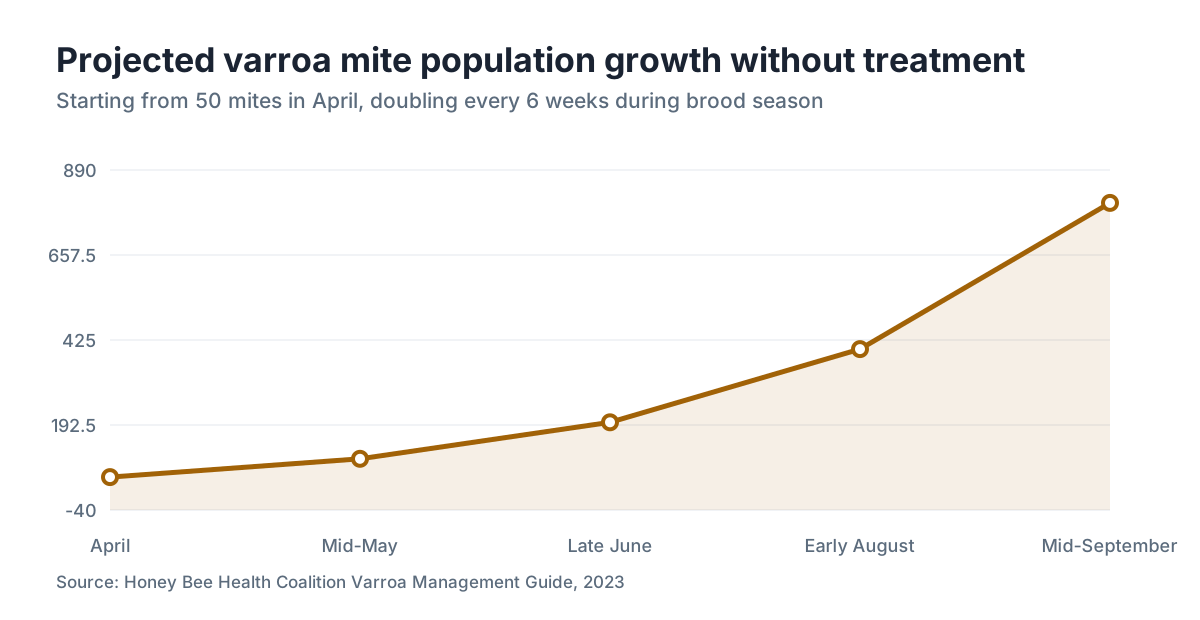
Here's what doubling looks like from a starting count of 50 mites:
| Month (approximate) | Mite count (at 6-week doubling) |
|---|---|
| April | 50 |
| Mid-May | 100 |
| Late June | 200 |
| Early August | 400 |
| Mid-September | 800 |
This assumes no treatment and normal brood rearing. Real growth shifts with drone brood, queen laying rate, and whether the colony is a fresh package or established. The shape of the curve holds regardless.
Why do varroa mites prefer drone brood?
Mites invade drone cells at 8 to 10 times the rate of worker cells [1]. Part of that is chemistry, part is timing.
Drone brood stays capped longer (14 to 15 days versus 12 for workers), so the foundress gets more laying time and more of her daughters reach sexual maturity before emergence. From the mite's fitness standpoint, drone brood is simply the better investment.
On the chemical side, drone larvae give off higher levels of the fatty acid esters that pull phoretic mites in. The exact kairomone signaling is still being worked out, but the preference is strong enough to use against them. Drone comb trapping, where you set a frame of drone-size foundation and cut it out once capped, pulls a real chunk of the mite population out of the colony [3]. It's not a standalone treatment, but as part of an integrated plan it's free and chemical-free.
The catch is brutal. You must remove that drone comb before the drones emerge. Forget, and every mite in that comb is back in the hive, now with a fresh generation of mated daughters. There's no forgiveness in the timing.
What is the phoretic phase and why does it matter for treatment timing?
Phoretic mites, the ones riding adult bees between cycles, are the only life stage most treatments can touch. Oxalic acid, the best broodless-period treatment there is, kills phoretic mites on contact but can't reach through a wax capping. Formic acid and Apivar (amitraz strips) reach into cells to some degree, but even they work best on phoretic mites [4].
That's the central problem of varroa management: 70 to 80% of the mite population sits inside capped cells at any moment during brood season. That's not a hand-wave. Several European monitoring programs put the in-cell fraction between 67% and 82%, depending on colony state and time of year [1]. So a treatment that kills 99% of phoretic mites during peak brood still leaves most of the population untouched.
The single best use of oxalic acid is during a broodless or near-broodless stretch, when nearly every mite is phoretic. In late fall or winter, one oxalic vaporization or dribble can hit 90% or better because the mites have nowhere to hide [4]. The EPA-registered label for oxalic acid (Api-Bioxal) directs single-dose applications for "when no sealed brood is present," for exactly this reason.
During brood season, three oxalic treatments spaced 5 to 7 days apart chip at the problem by catching mites as they emerge and turn phoretic. It works, but it never matches a true broodless treatment. Our varroa mite overview has a treatment calendar you can map to your local phenology.
How do varroa mites spread between colonies?
The cycle inside one colony is only half the story. Between-colony spread is how a tight, well-run apiary gets buried by a neighbor's collapse.
Phoretic mites move two ways: robbing and drifting. When a weak colony gets robbed, the robbers carry phoretic mites home. A collapsing high-mite colony in September is a mite bomb, plain and simple. Work in Ontario found that mite immigration from nearby collapsing colonies could raise a recipient colony's mite load by 60 to 100% during August and September [3].
Drifting is the quieter route. Workers and especially drones wander into hives that aren't their own. Drones get waved across colony lines routinely, and since mites strongly favor drones for transport, drone drift moves a lot of mites. One estimate put drone drift alone at several hundred mites transferred per season in an apiary setting.
So treating your own hives is necessary but not always enough. In a dense beekeeping area (community gardens, urban rooftops, a migratory outfit parked down the road), your neighbor's neglect becomes your loss. Our varroa mite article walks through monitoring protocols that flag immigration events before they wreck a colony.
How does understanding the varroa life cycle shape treatment decisions?
Every approved varroa treatment has a mechanism that maps onto a specific life stage. Once you see the cycle, the treatment calendar stops feeling arbitrary and starts reading like biology.
Oxalic acid kills by direct contact with the mite's exoskeleton. It does not cross wax cappings. So it belongs in broodless windows: winter, or an induced brood break from queen caging or a split. The Honey Bee Health Coalition recommends that fall and winter oxalic treatment "should be timed for when the colony has little or no sealed brood" [3].
Formic acid (MAQS, Formic Pro) does partly volatilize through cappings, so it reaches reproductive mites inside cells. That makes it useful during brood season, but temperature windows (above 50 degrees F, below 85 degrees F) box in your timing, and it stresses colonies harder than oxalic.
Apivar (amitraz) releases slowly from plastic strips over 6 to 8 weeks. That long window is meant to catch both phoretic mites and the mites emerging from cells across the treatment period. Amitraz resistance is documented in some U.S. populations, which is why rotation and a post-treatment count matter [4].
HopGuard (hop beta acids) barely penetrates brood and works mostly on phoretic mites. It's cleared for year-round use, including during honey flows, which is its practical niche.
VarroMed (oxalic acid plus formic acid) is registered in the EU and some markets as a dual-mechanism product. Its U.S. status is separate from standard Api-Bioxal, so check current EPA registration before assuming you can buy it.
VarroaVault's free protocol tools take your colony count, current mite load, and brood status and hand back a treatment window calendar built for your situation. That timing is where knowing the life cycle pays off in dead mites.
When you're sourcing treatments and beekeeping supplies, pick suppliers who can confirm product freshness. Amitraz degrades on the shelf, and that matters more than shaving a dollar off the price.
| Treatment | Life stage targeted | Brood penetration | Resistance documented |
|---|---|---|---|
| Oxalic acid (vaporization) | Phoretic only | None | No |
| Oxalic acid (dribble) | Phoretic only | None | No |
| Formic acid (MAQS/Formic Pro) | Phoretic + partial reproductive | Partial | No |
| Apivar (amitraz strips) | Phoretic + partial reproductive | Partial | Yes, some populations |
| HopGuard | Phoretic primarily | Minimal | No |
Sources: EPA product labels [4]; Honey Bee Health Coalition [3].
What is the difference between varroa mite reproduction in worker vs. drone brood?
The numbers say it flatly. Drone brood is where mites multiply hardest.
In worker brood, the foundress gets about 9 to 10 days of active time after the 60 to 70 hour wait. She usually lays 3 to 5 eggs. On average 1 to 2 reach maturity as mated daughters before the worker emerges. Net output: roughly 1.3 to 1.5 daughters per foundress per worker cycle [1].
In drone brood the cell stays capped 14 to 15 days. That's 4 to 5 extra days of laying. She lays 4 to 7 eggs, and 2 to 3 daughters mature and mate before the drone emerges. Net output: roughly 2.2 to 2.6 daughters per cycle [1].
Drone brood also gets invaded earlier and heavier. A worker frame runs around 8 to 10% cell infestation during peak season. Drone cells in the same colony often show 30 to 40%. That gap is why cutting out drone comb can knock down the reproductive mite pool out of proportion to how little drone brood a colony actually has.
An honest word on the limits: drone trapping works, but it's labor and easy to blow if you miss the window. Most extension programs list it as an adjunct, not a primary tool.
How do you monitor varroa levels to catch population explosions early?
You can't manage what you don't measure. The alcohol wash is the most accurate field method for estimating infestation, and it's the one the Honey Bee Health Coalition and USDA recommend for hobbyists and sideliners [3].
To run one: collect about 300 bees (half a cup) off a brood frame, since nurse bees carry the most mites. Add 70% isopropyl alcohol, shake hard for 60 seconds, pour through a strainer, and count. Divide mites by bees and multiply by 100. Nine mites in 300 bees is 3%, right at the treatment threshold [3].
The sugar roll is a non-lethal alternative, but multiple studies show it undercounts by 20 to 40% against alcohol wash [3]. If you're torn on whether to treat, run the alcohol wash and get a real number.
How often you check matters as much as how you check. The general schedule:
- Monthly through brood season (April through September across most of North America)
- Before and after every treatment, to confirm it worked
- In late summer (August), because that's when populations peak and the winter bees being raised right now decide spring survival
The USDA Agricultural Research Service publishes monitoring protocols through its bee research labs that line up with the Honey Bee Health Coalition guidance [5]. The threshold most used in North America: treat at 2 to 3% or more by alcohol wash during brood season, or 1 to 2% in late summer and fall when winter bees are being reared [3].
A single August count above 2% that goes untreated is one of the most reliable predictors of a dead colony by spring. That's not alarmism. That's what the overwinter survival data keeps showing.
Does varroa mite biology differ in Africanized or other bee subspecies?
Yes, and it's an underappreciated part of the story. Bee genetics change how well the mite reproduces.
African-lineage bees, including africanized honey bees, show real resistance to varroa through mechanisms tied straight to the mite's reproduction. They perform hygienic behavior more aggressively, sniffing out and pulling infested pupae before the mite's daughters mature. That cuts the foundress's success per cell hard. Work in Brazil, where Africanized bees have lived with varroa since the 1970s without colony-level collapse, credits population control largely to hygienic removal of infested cells [6].
African-lineage colonies also tend to run shorter post-capping periods for worker brood. Less capped time means less time for mite daughters to mature, so fewer daughters per cycle.
Breeding programs in Europe and North America have worked to move hygienic behavior into Apis mellifera ligustica and carnica lines. USDA's development of Varroa Sensitive Hygiene (VSH) stock is the best-documented effort [5]. VSH bees detect and remove a high share of reproducing mites. Colonies with VSH queens show lower mite growth rates than unselected stock, though they still need monitoring and often the odd treatment under heavy pressure.
Short version: queen source affects mite reproduction directly. That's why genetic selection for hygienic behavior earns a spot in a long-term plan next to chemical treatment.
What viruses does varroa transmit, and when in the life cycle does that happen?
Varroa is more than a parasite. It's the main vector for at least 10 bee viruses, and it moves them at multiple life stages.
Deformed Wing Virus (DWV) is the worst of them. Mites feeding on pupae inside capped cells inject DWV straight into the developing bee's hemolymph, skipping the gut's natural barriers. That drives far higher viral titers than oral transmission ever could. A high-varroa colony carries DWV titers millions of times higher than a mite-free colony [7]. The Honey Bee Health Coalition's guide states that "mite-transmitted viruses are responsible for much of the colony loss associated with Varroa infestation" [3].
Acute Bee Paralysis Virus, Sacbrood Virus, and Israeli Acute Paralysis Virus (IAPV) also move by varroa feeding. The mite picks up virus from an infected host and injects it into the next bee it feeds on.
The reproductive phase inside the cell is when transmission does the most damage. A foundress feeding on a pupa can pass DWV straight to that pupa, and her daughters, feeding in the same cell, pick up the virus and carry it out as mated phoretic females. The cell is both a mite nursery and a virus amplifier.
That chain is why cutting mite loads even a little pays off way beyond the mite count. Halving the mite population can drop DWV titers by orders of magnitude, more than half, because mites multiply the per-bee virus dose through direct injection during reproduction.
What tools and resources exist to track and respond to varroa life cycle timing?
The Honey Bee Health Coalition's Varroa Management Guide (a free download at honeybeehealthcoalition.org) is still the single best free resource for hobbyists. It puts monitoring methods, treatment options, thresholds, and timing in one place, and a coalition of researchers, beekeeping groups, and industry people keeps it current [3].
University extension programs run localized guides. Penn State Extension covers treatment timing for the mid-Atlantic [8]. The University of Minnesota Bee Lab has material on VSH queens and breeding for resistance [9]. North Carolina State University's apiculture program publishes work on treatment efficacy [10].
For your own data, any system that logs mite counts by colony and date beats any single reading. Trajectory tells you more than a snapshot. Go from 1% in June to 2.5% in July and you're on a collision course with a September crisis, even though the July number alone looks fine.
VarroaVault's free protocol tools are built for exactly this: enter counts over time, get trend lines, and get timing recommendations tied to your climate zone. The tool isn't the point. Having a record is. A paper notebook works fine too.
When picking beekeeping supply companies, confirm that any amitraz or oxalic acid product is EPA-registered (Api-Bioxal for oxalic, Apivar for amitraz). Unregistered products are illegal to use and can leave residue in your wax that follows you into beeswax products down the line.
Frequently asked questions
How long does the varroa mite life cycle take from egg to adult?
From the foundress laying her first egg inside a capped worker cell, a daughter mite reaches full maturity and mating in about 6.5 days. Adding the 60 to 70 hour pre-oviposition wait after capping, the full in-cell cycle runs roughly 10 days for worker brood. In drone brood the longer post-capping period stretches it to about 14 days total, which is why drone cells produce more daughters per cycle.
Can varroa mites reproduce in worker brood and drone brood both?
Yes, but at very different success rates. A foundress averages 1.3 to 1.5 mated daughters per worker cycle and 2.2 to 2.6 per drone cycle. Mites favor drone brood because the longer capping period (14 to 15 days versus 12 for workers) gives offspring more time to mature before emergence. Drone comb trapping uses that preference as a low-tech management tool.
Why does oxalic acid only work when there's no sealed brood?
Oxalic acid kills mites by direct contact with their exoskeleton. It can't cross wax cappings, so mites inside sealed cells are fully protected. During peak brood season, 70 to 80% of mites sit inside capped cells at any moment. A broodless period, natural or induced, concentrates nearly all mites on adult bees, where one oxalic treatment can hit 90% or better. That's why late fall or winter treatment works so well.
What's the treatment threshold for varroa mites?
The most widely used threshold in North America is 2 to 3% infestation by alcohol wash during brood season (2 to 3 mites per 100 bees). In late summer and fall, when the colony rears its long-lived winter bees, many programs drop that to 1 to 2%, because mite-transmitted viruses at this stage cause outsized overwinter loss. The Honey Bee Health Coalition recommends treating at or before 2% in August and September.
How do varroa mites spread from one hive to another?
Mites move between colonies mainly through robbing and drifting. When a high-mite colony collapses and gets robbed, the robbers carry phoretic mites home. Drones are the other big route: they enter other colonies freely and are preferred hosts. Studies found that mite immigration from a single collapsing colony can raise neighboring mite loads by 60 to 100% during the August and September robbing season.
How many mite generations occur in one bee season?
In most temperate North American climates, varroa completes 5 to 7 overlapping generations during brood season (roughly April through October). Because generations overlap and brood rearing runs continuously, growth is exponential rather than stepped. That's why the Honey Bee Health Coalition reports mite populations can double every 4 to 6 weeks without intervention.
Does the varroa male mite leave the brood cell?
No. The male is haploid, produced from an unfertilized egg, and exists only to mate with his sisters inside the capped cell. He has reduced mouthparts and can't survive outside it. He mates the emerging female nymphs and usually dies inside the cell or within hours of emergence. Every mite you see on an adult bee or count in a wash is female.
How does hygienic behavior in bees disrupt the varroa life cycle?
Hygienic bees detect chemical cues from mite-infested pupae, uncap those cells, and remove the pupae before the mite's daughters mature. That cuts the foundress's reproductive output, sometimes to near zero in highly hygienic colonies. USDA-developed Varroa Sensitive Hygiene (VSH) stock can find and remove over 90% of reproducing mites, producing measurably lower mite growth than unselected stock.
What viruses do varroa mites transmit during their life cycle?
Varroa transmits at least 10 bee viruses. Deformed Wing Virus (DWV) is the most damaging and the most directly tied to collapse. Mites inject virus straight into the bee's hemolymph while feeding on pupae inside capped cells, skipping gut defenses and driving viral titers millions of times higher than in mite-free colonies. Acute Bee Paralysis Virus and Israeli Acute Paralysis Virus are also commonly vectored.
How do I do an alcohol wash to count varroa mites?
Collect about 300 bees (half a cup by volume) off a brood frame by shaking or brushing into a jar with 70% isopropyl alcohol. Shake hard for 60 seconds, then pour through a fine strainer into a white tray and count the mites. Divide mites by bees and multiply by 100 for a percentage. Over 2 to 3% during brood season means treat now. The sugar roll is less accurate and can undercount by 20 to 40%.
Can a varroa foundress reproduce more than once in her lifetime?
Yes. A successful foundress exits the cell with her adult daughters, goes phoretic on a nurse bee, and can enter another brood cell to reproduce again after a rest. During brood season a single foundress may complete 2 to 3 reproductive cycles. Phoretic females survive 2 to 3 months during active brood rearing and up to 5 to 6 months over the broodless winter, though fertility drops with age.
What is the difference between a phoretic varroa mite and a reproductive varroa mite?
A phoretic mite is a mated adult female riding an adult bee between cycles. She feeds on the bee's fat body, is exposed to most treatments, and is the only stage you see in an alcohol wash or sugar roll. A reproductive mite is inside a capped cell laying eggs and rearing daughters. She can't be reached by oxalic acid, and only partly by formic acid. That split drives the entire logic of treatment timing.
Is resistance to varroa treatments related to the mite's life cycle?
Indirectly, yes. Amitraz resistance is documented in some U.S. varroa populations, likely from selection pressure where sub-lethal exposure during the reproductive phase (when mites are partly protected inside cells) lets resistant mites survive and breed. Rotating treatment classes and confirming efficacy with a follow-up wash 4 to 6 weeks after treatment ends are the main practical responses.
When is the best time of year to treat for varroa based on mite life cycle biology?
Late summer (August) and again in late fall or early winter, when brood is minimal or absent, are the two most important windows. August treatment protects the winter bees being reared right then. Winter oxalic acid during broodlessness gets the highest efficacy because nearly all mites are phoretic. A spring treatment after supers come off (or before they go on, with the right products) closes out the annual cycle.
Sources
- Rosenkranz, Aumeier, Ziegelmann, Apidologie, 2010: Biology and control of Varroa destructor: Full reproductive cycle timing (10 days worker, 14 days drone), pre-oviposition period of 60-70 hours, average daughters per cycle (1.3-1.5 worker, 2.2-2.6 drone), phoretic lifespan 2-3 months brood season, 5-6 months winter
- Ramsey et al., PNAS, 2019: Varroa destructor feeds primarily on honey bee fat body tissue: Varroa mites feed on fat body tissue, not primarily hemolymph; quote: 'Varroa destructor feeds on the fat body of the honey bee'
- Honey Bee Health Coalition, Varroa Management Guide (honeybeehealthcoalition.org): Mite populations double every 4-6 weeks in brood season; 2-3% alcohol wash treatment threshold; 70-80% of mites in sealed brood during season; oxalic acid timing guidance; drone comb trapping; mite immigration from collapsing colonies; mite-transmitted viruses responsible for much colony loss
- EPA, Api-Bioxal (oxalic acid) product label and Apivar (amitraz) product label: Oxalic acid label specifies use when no sealed brood is present for single-dose application; amitraz resistance documented in some U.S. varroa populations; treatment mechanisms and life stage targeting
- USDA Agricultural Research Service, Honey Bee Research, Beltsville and Baton Rouge labs: USDA development of Varroa Sensitive Hygiene (VSH) stock; monitoring protocols published by USDA bee labs; VSH colonies show lower mite population growth
- Moretto et al., Genetics and Molecular Biology; Africanized bee varroa tolerance research: Africanized bees in Brazil have coexisted with varroa since 1970s without colony-level collapse; hygienic removal of infested cells attributed as key mechanism
- Wilfert et al., Science, 2016: Deformed wing virus is a recent global epidemic originating from European honey bees: Mite-transmitted DWV produces viral titers millions of times higher than in mite-free colonies; varroa vectoring bypasses gut barriers via direct hemolymph injection
- Penn State Extension, Varroa Mite Management for Honey Bees: Treatment timing guidance for mid-Atlantic region; monitoring frequency recommendations
- University of Minnesota Bee Lab, Varroa and Hygienic Behavior resources: Breeding for hygienic behavior and VSH trait; queen selection for varroa resistance
- North Carolina State University, Apiculture Program, treatment efficacy research: Published research on varroa treatment efficacy and monitoring
- Fries et al., Apidologie: Varroa destructor reproductive biology: Foundress reproductive output per cell cycle: 1.3-1.5 daughters per worker cell; comparative drone vs. worker cell reproductive success
Last updated 2026-07-09