Varroa mite reproduction inside capped brood explained
TL;DR
- A varroa mite slips into a brood cell just before capping, feeds on the developing pupa, and produces 1 to 2 new mated female mites per worker brood cycle (about 12 days).
- Roughly 80% of a colony's mites hide inside capped brood at any moment, so treatments aimed only at phoretic mites on adult bees miss most of the population.
What actually happens when a varroa mite enters a brood cell?
The foundress mite is the reproducing female. She spends her phoretic phase riding an adult bee and feeding on its fat body tissue, but she can only reproduce inside a capped cell. Roughly 15 to 20 hours before a nurse bee caps the cell, the foundress drops off her carrier and slips into the larval cell, burrowing under the larval food at the bottom [1].
Then she waits. The larva eats the food, the cell gets capped, and the mite is sealed in with everything she needs. Once the cell closes, she feeds on the developing bee's fat body (not hemolymph, as beekeepers believed for decades; a 2019 study by Ramsey et al. corrected that record [2]). She feeds enough to produce eggs, and the whole hidden process runs on a roughly 12-day clock for worker brood.
That timing is no accident. The mite has co-evolved with Apis mellifera brood biology so tightly that her reproductive window fits almost perfectly inside the worker post-capping period. The capped cell is a fortress, and the mite helped design it. That's why varroa is so hard to break.
How does varroa mite egg-laying work inside the capped cell?
About 60 to 70 hours after capping, the foundress lays her first egg [1]. That first egg is always male (haploid, unfertilized). She lays the rest at roughly 30-hour intervals, each one female (diploid, fertilized from sperm stored in her spermatheca from an earlier mating).
The eggs hatch in order. The male hatches first and matures fastest. Each female feeds on the host pupa's fat body, molts through protonymph and deutonymph stages, and reaches sexual maturity. The male mates with his sisters inside the sealed cell before any of them ever see daylight. Obligate inbreeding, and varroa has no other option and no evolutionary pressure to find one.
Mating happens in a specific spot called the mating tube, a structure the mites partially build from bee feces and wax debris. The male works through each available sister in sequence.
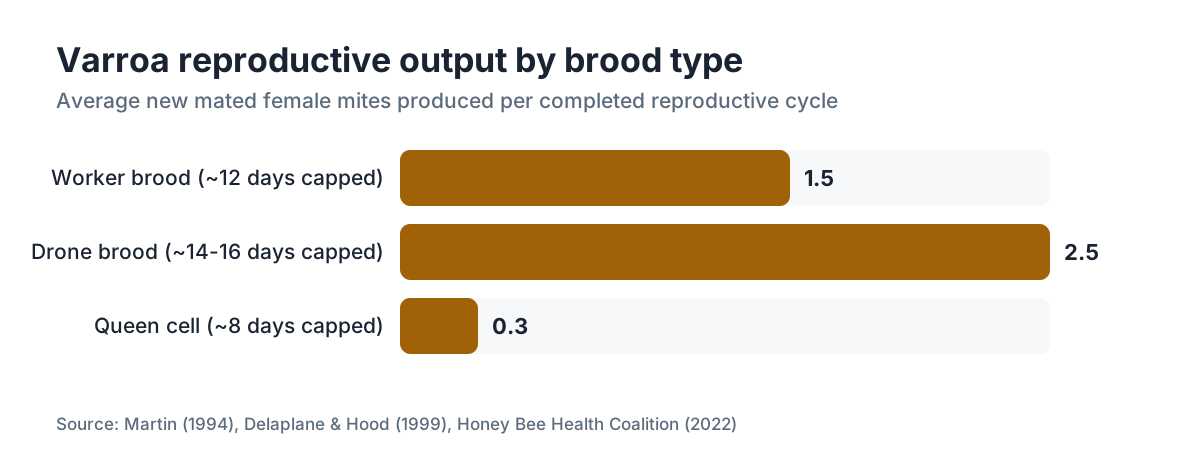
Here's where the numbers matter for you. In a worker cell capped about 12 days, the foundress has time for roughly 2 to 3 female egg cycles, but only 1 to 2 daughters actually reach full maturity and get mated before the adult bee emerges [1][3]. The male almost always dies in the cell. So each successful worker brood cycle produces the foundress plus 1 to 2 new mated, reproductive females. Net gain: 1 to 2 mites per infested cell.
Why do mites prefer drone brood over worker brood?
Drone brood stays capped about 14 days after capping, against roughly 12 days for worker brood [3]. That extra time lets more egg-laying cycles finish before emergence, so reproductive success runs higher in drone cells. Studies put the average at 2 to 3 new mated females per drone cycle, versus 1 to 2 per worker cycle [1].
Mites are 8 to 10 times more likely to pick a drone cell over a worker cell when given the choice [4]. The chemistry is documented: drone larvae give off higher levels of certain fatty acid esters, and foundress mites detect those cues. This is why drone brood removal is a real, evidence-based tool. Pull capped drone frames before emergence and you physically strip out a disproportionate share of the reproducing mite population.
Drone brood removal won't save a heavily infested colony on its own. It suppresses; it doesn't treat. But in spring, when drone production ramps up and mite numbers start climbing, pulling and freezing a frame of capped drone brood every three weeks can slow the infestation curve in a way you can measure.
What percentage of varroa mites are inside capped brood at any time?
Roughly 80% of the mite population in a colony with brood sits inside capped cells at any given moment [3][5]. Only about 20% are phoretic, riding adult bees where most treatments can reach them. This one number drives almost every treatment decision you make.
The Honey Bee Health Coalition's Varroa management guide states: "In a colony with brood, roughly 80 percent of varroa are in capped cells and unavailable to treatments that kill only phoretic mites." [5] That single fact explains why alcohol wash or sugar roll results sometimes feel deceptively low, and why a lone oxalic acid dribble in a brood-right colony barely moves the needle.
The 80/20 split is an average, and it shifts with season. In fall, as brood rearing winds down, the phoretic fraction climbs. In a fully broodless colony, 100% of mites are phoretic, which is exactly why winter broodless periods (or artificially induced ones) are the best window for oxalic acid. One well-timed oxalic acid vaporization in a broodless colony can drop mite loads by 90% or more [6].
For anyone running alcohol washes through the season, understanding this split is what separates a beekeeper who monitors correctly from one going through the motions.
How fast can varroa mite populations grow in a colony?
Under good conditions, a varroa population can double every 4 to 6 weeks during active brood season [3]. Start spring with 100 mites and you can be sitting at 1,600 by mid-summer with no treatment. That's not a worst case. That's just exponential growth running on a colony cycling 80,000-plus capped brood cells continuously.
Growth rate depends on several things: how many cells are open, the share of drone brood, temperature, and how many mites fail to reproduce. Not every foundress succeeds. A meaningful fraction (estimates run from 10% to 30% depending on bee genetics and conditions) lay infertile eggs or enter cells too late [1]. Hygienic bees and Varroa Sensitive Hygiene (VSH) bees suppress reproduction by detecting and uncapping infested cells before daughters mature. That's the genetic mechanism behind VSH breeding programs.
The practical part for hobbyists: the 3% treatment threshold (3 mites per 100 bees on an alcohol wash) exists because above that level the mite population grows faster than the colony can compensate [5]. You don't treat at 3% because 3% is immediately fatal. You treat because 3% in July reaches colony-killing levels by September, and you get very little time to reverse it.
How does brood type and capping duration affect mite reproductive success?
The table below sums up the reproductive parameters across brood types. These figures come from peer-reviewed studies and match the numbers extension educators and the Honey Bee Health Coalition use in their management frameworks [1][3][5].
| Brood type | Post-capping duration | Avg. new mated females per cycle | Mite preference (relative to worker) |
|---|---|---|---|
| Worker | ~12 days | 1.0 to 2.0 | Baseline (1x) |
| Drone | ~14 days (some sources say up to 16) | 2.0 to 3.0 | 8 to 10x more preferred |
| Queen | ~8 days (varies) | 0 to 1 (low success) | Not significantly preferred |
Queen cells are an odd edge case. The post-capping period is shorter and conditions inside differ enough that mite reproductive success runs poor. A foundress entering a queen cell often fails to complete even one successful daughter cycle [1]. That doesn't make queen rearing a mite strategy, but it explains why queen cells never swamp your mite counts.
The drone column is the one to memorize. Eight to ten times the attraction, and nearly double the reproductive output per cycle. A colony running heavy drone production in spring is running a mite amplification program.
Why does the varroa reproductive cycle make treatment timing so important?
Every treatment is racing the 80/20 brood problem. Oxalic acid (dribbled or vaporized) works almost entirely on phoretic mites. Residual miticides like ApiVar (amitraz strips) or Apistan (fluvalinate) work by contact over weeks, so bees emerging from brood pick up the chemical as they walk across treated strips [6]. That extended exposure is designed to catch mites as they cycle out of cells.
Treatment duration matters for the same reason. A two-week ApiVar treatment doesn't work. The label calls for 6 to 8 weeks precisely because the treatment has to outlast multiple brood cycles to reach the mites that were sealed in capped cells at the start [6]. Beekeepers who pull strips early because "the mites look gone" leave the brood-protected 80% mostly untouched.
For oxalic acid vaporization in colonies with brood, you need multiple applications for the same reason. You only hit phoretic mites each time, so you keep treating as mites emerge from cells. The Honey Bee Health Coalition recommends 3 to 5 vapor treatments at 5-day intervals when brood is present [5]. Even that protocol is partial control, not elimination.
Want to see these windows mapped to your local brood cycle and monitoring schedule? Tools like the VarroaVault protocol planner translate your wash results and location into specific treatment windows. The biology is fixed. The timing is what you control.
Can honey bees detect and remove varroa-infested brood cells?
Yes, and it's one of the most promising areas in breeding research. The behavior is Varroa Sensitive Hygiene (VSH), once called Suppressed Mite Reproduction or SMR. Worker bees with this trait detect cues from infested cells and uncap them before the mite's daughters reach maturity [7].
In high-VSH colonies, researchers have found the share of mites reproducing successfully can drop to 20% or less, against 70 to 80% in typical commercial stock [7]. That's a huge gap. A mite population where 80% of attempted reproductions fail simply can't grow fast enough to overwhelm the colony.
The USDA ARS Honey Bee Breeding, Genetics and Physiology Research Unit in Baton Rouge has been the main U.S. center for VSH research, and the trait is available in commercial queen lines [7]. It's not a perfect fix. VSH expression dilutes when queens mate with non-VSH drones, which is the norm in open mating. But if you're buying queens, buying VSH-certified lines is a legitimate strategy that works in the background with no treatment inputs.
Simple hygienic behavior (related but distinct from VSH) also helps by clearing diseased and dead brood generally. Both traits together give a hobbyist the best defensive genetics currently on the market.
How do beekeepers use knowledge of varroa reproduction to choose the right treatment?
The reproductive biology tells you when and what to use.
Broodless colonies, or colonies in a brood break, are the easy scenario. Every mite is phoretic. A single well-timed oxalic acid treatment, vapor or dribble, hits the whole population. Many northern beekeepers treat once in late fall after brood stops and see efficacy above 95% [5][6].
Colonies heavy with brood need extended-residue treatments. Amitraz strips (ApiVar) or oxalic acid vapor repeated on a schedule are the realistic options. Formic acid products (MAQS, Formic Pro) have one advantage the others don't: the vapor penetrates capped cells and reaches mites directly. That's the only approved treatment mechanism that does. Formic acid earns its keep mid-season when brood levels are high, though the temperature window is narrow (above 50F, generally below 85F for colony safety) [8].
Drone brood removal fits spring and early summer, before mite numbers accelerate. Pull a frame of capped drone brood, freeze it 48 hours, then scratch it out or compost the frame. Do it every 21 to 25 days and you're removing a mite amplification site on a schedule.
No single approach covers most hobbyist operations. Integrated Pest Management for varroa means combining monitoring (alcohol wash every 30 days minimum in brood season), threshold-based decisions, treatment rotation to slow resistance, and genetic pressure through VSH queens. The mental model that makes all of it click: 80% of your mites are locked away in capped brood at any moment.
For a practical look at the full range of tools, see our overview of varroa mite management options and the reasoning behind each one.
What is mite wash vs mite count, and how do brood dynamics affect both?
An alcohol wash (or ether roll) measures only phoretic mites on adult bees. You take roughly 300 bees (about half a cup) from a brood frame, wash them in alcohol or soapy water, and count the mites that fall out. The result reads as mites per 100 bees [5].
Because only about 20% of mites are phoretic in a brood-right colony, your wash count is a sample of a sample. If you get 3 mites per 100 bees, the true colony load isn't 3 per 100 across all bees. It's a reading of the phoretic fraction, which you interpret against thresholds already calibrated for the brood fraction. The 3% threshold bakes in that math [5].
A sticky board count (natural mite drop over 24 or 72 hours) captures both phoretic mites falling off bees and mites emerging from cells. It's less precise for threshold calls but useful for a directional read across a large operation where washing every hive isn't practical.
Natural mite drop above 8 to 10 mites per 24 hours is a rough emergency signal that loads are high, but the Honey Bee Health Coalition and most extension services now recommend the alcohol wash as the primary monitoring method because it's more consistent [5]. If you're serious about monitoring, own a varroa wash kit and run it on a calendar schedule, not only when you're worried.
Does varroa mite reproductive success vary by honey bee subspecies or breed?
It does, and by a lot. Apis mellifera capensis (the Cape honey bee) supports varroa reproduction less efficiently than Apis mellifera scutellata or the European subspecies common in the U.S. [4]. Africanized honey bees, hybrids of European and African subspecies (see our article on africanized honey bee), often hold lower mite loads in the field, though the mechanisms are still debated. They show stronger grooming and hygienic behavior in many studies, and they swarm often, which builds in natural brood breaks.
Among European stock, Italian bees run more continuous brood for more of the year, giving varroa fewer natural breaks and faster population growth. Carniolans shut down brood more sharply in fall, opening a cleaner window where oxalic acid hammers the phoretic population. Russian honey bees, bred from a stock that co-evolved with varroa in the Russian Far East, show behavioral resistance including lower mite reproductive success and elevated grooming [7].
None of these genetics erase the need for management. Even Russian or VSH colonies need monitoring and will occasionally need treatment. But they cut the frequency and urgency of interventions, which matters a lot for sideliners and hobbyists managing colonies without weekly inspections.
How should hobbyist beekeepers use this reproductive biology in their seasonal calendar?
The mite's reproductive cycle points straight at a seasonal rhythm.
Spring (buildup): Mite numbers are low but starting to climb as brood expands. Drone brood appears and the amplification cycle kicks in. Monitor with an alcohol wash in March or April (sooner in southern states). If loads already run above 1 to 2%, treat before the population gets ahead of you.
Summer (peak brood): The highest brood levels mean the highest mite brood protection. Extended-residue treatments fit best here. Hold a strict 30-day monitoring schedule. Don't wait for symptoms. Deformed wing virus in adult bees means mites have been high long enough to do damage, which is too late for an easy recovery.
Fall (ramp-down): This is arguably the most important treatment window all year. The bees raised in late summer and fall are your winter bees, and they have to survive to spring. Mites feeding on them during development cause immune and physiological damage that shortens their lives even when DWV symptoms aren't visible [3]. Treat before or as brood ramps down, ideally getting loads below 1% before the winter cluster forms.
Winter (broodless): The perfect window for oxalic acid. Cheap, simple, highly effective. This is the one situation where a single treatment genuinely reaches the full mite population.
VarroaVault's free protocol tools map these windows to your region and colony count, which helps most if you're running more than a few hives and coordinating treatments across them.
Frequently asked questions
How many eggs does a varroa mite lay inside a capped brood cell?
A foundress varroa mite lays one male egg followed by up to 5 or 6 female eggs across the capped period. Only 1 to 2 female daughters typically mature and get mated before the adult bee emerges in a worker cell. In drone cells, the longer capping period lets 2 to 3 daughters complete development successfully.
Why can't you just treat once and eliminate varroa?
Because roughly 80% of mites sit inside capped brood cells at any moment and most treatments only reach phoretic mites on adult bees. A single treatment kills the exposed fraction, then the sealed-in mites emerge and repopulate. Effective control needs either extended-residue treatments that outlast multiple brood cycles, or repeated applications timed to catch mites as they emerge.
How long does varroa reproduction take inside a capped worker cell?
Capping to emergence runs roughly 12 days for worker brood. The foundress lays her first egg about 60 to 70 hours after capping, and later eggs follow at 30-hour intervals. The male matures first and mates with his sisters in the cell. When the adult bee chews out, the foundress and any mature mated daughters leave with her.
What percentage of varroa mites fail to reproduce successfully?
In typical European honey bee colonies, roughly 10% to 30% of foundress mites fail to produce viable offspring per cycle. Failure happens when mites enter cells too late, when bee larvae die early, or when hygienic workers uncap the host cell. In VSH (Varroa Sensitive Hygiene) colonies, that failure rate can top 80%, which is why VSH genetics slow mite population growth so much.
Does varroa feed on bee blood (hemolymph) inside the capped cell?
Not exactly. A 2019 study by Ramsey et al. (published in PNAS) corrected the decades-old belief that varroa feeds on hemolymph. The study found mites feed primarily on bee fat body tissue, an organ central to immunity and overwintering physiology. This matters for treatment because fat body damage is harder to detect and lasts longer than simple blood loss.
Why is drone brood so much more attractive to varroa mites than worker brood?
Drone cells stay capped about 14 days versus 12 for worker brood, giving mites more time for extra reproductive cycles. Drone larvae also give off higher levels of fatty acid esters that varroa detects and uses to pick those cells. Studies show mites enter drone cells at 8 to 10 times the rate of worker cells when given a choice, which makes drone brood removal a valid suppression technique.
What is the best time of year to treat varroa when brood is a problem?
Late fall into early winter, when the colony goes broodless or nearly so, is the best window for a clean, high-efficacy treatment. With no brood, 100% of mites are phoretic and reachable by oxalic acid. If loads run high entering summer, use an extended-residue treatment like amitraz strips or a multi-application formic acid protocol, since you can't wait months on a growing infestation.
How does a brood break help control varroa mite populations?
A brood break, natural (winter) or induced by caging the queen, forces all mites into the phoretic phase where treatments can reach them. Even without treatment, a brood break halts reproduction for several weeks. Paired with an oxalic acid application during the break, efficacy routinely tops 90%. Induced mid-season brood breaks are a legitimate strategy for colonies with dangerously high summer mite loads.
Can varroa mites reproduce in queen cells?
Technically yes, but reproductive success in queen cells runs very low. The post-capping period is only about 8 days, often too short for the mite's daughters to finish development and mate. Queen cells also carry different chemical cues than worker or drone cells. Foundress mites that enter queen cells usually fail to produce viable offspring, so queen cells don't drive varroa population growth.
How does grooming behavior in bees affect varroa reproduction?
Bees with strong grooming behavior detect, dislodge, and sometimes injure or kill mites on nestmates. Mites with broken or missing legs can't reproduce well. Some populations, including Africanized and Russian bees, groom at measurably higher rates than Italian or Carniolan stock. Grooming doesn't eliminate varroa, but colonies with high grooming scores tend to hold lower mite loads under comparable conditions.
What is VSH (Varroa Sensitive Hygiene) and how does it disrupt varroa reproduction?
VSH is a heritable trait where worker bees detect and uncap cells with reproducing varroa, exposing the foundress and her eggs before daughters can mature and mate. In high-VSH colonies, only 20% or fewer of attempted mite reproductions succeed. The trait comes in commercially bred queen lines, primarily from USDA research stock and select breeders. Open mating dilutes VSH expression, so requeening with VSH stock needs repeating periodically.
How accurate is an alcohol wash for measuring varroa when brood is present?
An alcohol wash measures only phoretic mites on adult bees, about 20% of the total mite population in a brood-right colony. The 3% treatment threshold is calibrated for this, so use the standard thresholds rather than trying to back-calculate total colony load. Wash 300 bees from a brood frame nurse bee area, count mites, and compare directly to the threshold. Don't wash bees off honey super frames.
Is it worth doing drone brood removal as a varroa management technique?
Yes, as one layer of an integrated approach. Because mites prefer drone brood at 8 to 10 times the rate of worker brood and produce more offspring per drone cycle, removing capped drone frames before emergence strips out a disproportionate share of your reproducing mites. It works best in spring before loads build. It won't do the job alone, but it costs nothing beyond the lost drones and takes little time per inspection.
Sources
- Martin, S.J. (1994). Ontogenesis of the mite Varroa jacobsoni Oud. in worker brood of the honeybee. Experimental and Applied Acarology 18(2):87-100: Foundress lays first egg 60-70 hours post-capping; male egg laid first; 30-hour intervals between subsequent female eggs; 1-2 mated daughters per worker cycle
- Ramsey, S.D. et al. (2019). Varroa destructor feeds primarily on honey bee fat body tissue and not hemolymph. PNAS 116(5):1792-1801: Varroa mites feed primarily on bee fat body tissue, correcting the prior belief that they feed on hemolymph
- Delaplane, K.S. & Hood, W.M. (1999). Economic threshold for Varroa jacobsoni Oud. in the southeastern USA. Apidologie 30(5):383-395: Approximately 80% of mites are in capped brood at any time; drone brood capped longer than worker; mite population can double every 4-6 weeks in active brood season
- Ruttner, F. & Hänel, H. (1992). Active defense against Varroa mites in a Carniolan strain of honeybee. Apidologie 23(2):173-187: Mites enter drone cells at 8-10 times the rate of worker cells; differential attraction driven by larval chemical cues
- Honey Bee Health Coalition, Tools for Varroa Management Guide (7th edition, 2022): Roughly 80% of varroa are in capped cells; 3% treatment threshold via alcohol wash; oxalic acid in broodless colonies; 3-5 vapor treatments at 5-day intervals with brood present; alcohol wash as primary monitoring method
- EPA, ApiVar (amitraz 3.3%) product label and registration: ApiVar label specifies 6-8 week treatment duration; oxalic acid (Api-Bioxal) EPA label specifies dribble and vaporization methods and efficacy in broodless colonies above 90%
- USDA ARS Honey Bee Breeding, Genetics and Physiology Research Unit, Baton Rouge LA: VSH colonies show mite reproductive success below 20%; Russian honey bees show elevated grooming and lower mite reproductive rates; VSH trait available in commercial queen lines
- Formic Pro (formic acid 65%) product label, NOD Apiary Products: Formic acid vapor penetrates capped brood cells; labeled for use above 50°F and generally below 85°F for colony safety; temperature window restriction for hobbyist use
- University of Minnesota Extension, Varroa Mite Management: Alcohol wash protocol: 300 bees from brood frame, threshold of 3 mites per 100 bees triggers treatment; treatment timing recommendations by season
- Pennsylvania State University Extension, Varroa Mite: A Serious Honey Bee Pest: Drone brood removal as integrated pest management technique; brood break strategy for high summer mite loads; seasonal protocol calendar recommendations
- Boecking, O. & Spivak, M. (1999). Behavioral defenses of honey bees against Varroa jacobsoni. Apidologie 30(2-3):141-158: Hygienic behavior and grooming can reduce mite loads; colonies with high grooming scores maintain lower mite populations under comparable conditions
Last updated 2026-07-09