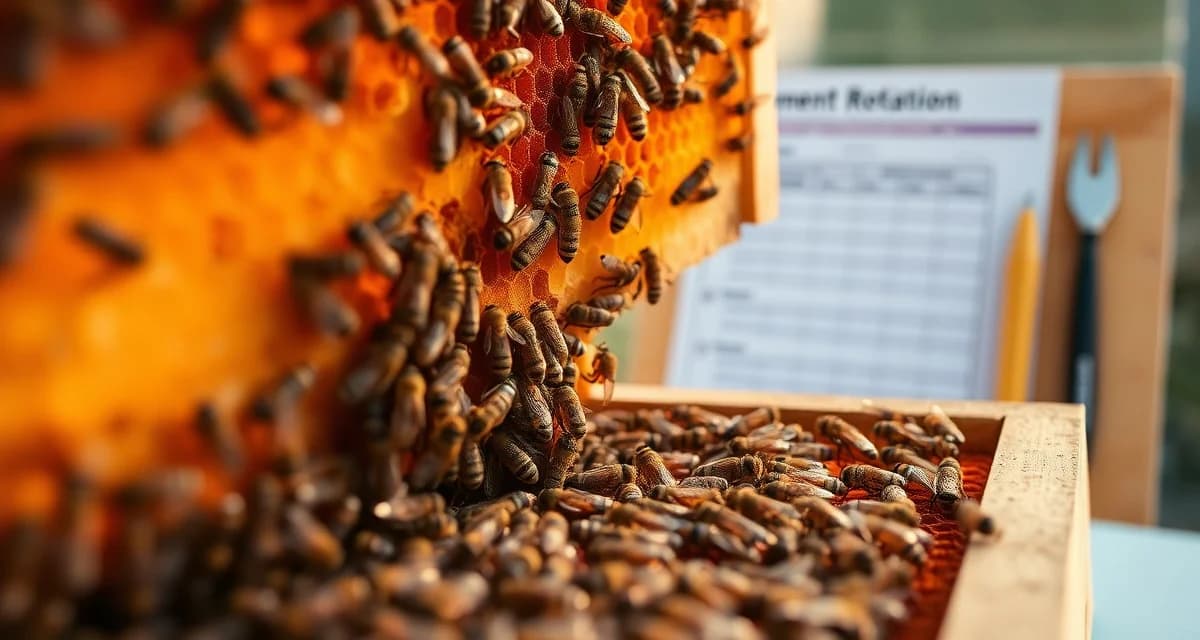
Varroa Resistance Management: How to Rotate Treatment Classes
Varroa resistance to acaricides is not theoretical. Amitraz resistance has been documented in commercial US operations. Tau-fluvalinate (Apistan) and coumaphos (CheckMite+) resistance is widespread enough that many beekeepers have abandoned both products entirely. If you rely on a single chemical class year after year, you are selecting for mites that survive it.
A structured resistance management program is how you avoid that outcome.
Why Resistance Develops
Every treatment application kills susceptible mites and leaves survivors. If the survivors carry genetic traits that confer tolerance to the active ingredient, those traits are passed to the next mite generation. Repeat the same treatment enough times and you shift the population toward tolerant individuals. This process accelerates when:
- You use the same product every single treatment cycle
- You underdose or cut treatments short
- You treat colonies that have already high-resistance mite populations without any rotation
The mechanism differs by chemical class. Amitraz resistance involves metabolic detoxification pathways. Oxalic acid kills mites through contact irritation; resistance to oxalic acid is rare and develops slowly because the mechanism is physical rather than biochemical. Thymol operates similarly. Formic acid works by fumigation.
Because these mechanisms differ, rotating between chemical classes prevents any single resistance pathway from being continuously selected.
The Four Major Treatment Classes
Amitraz (Apivar, Amitraz strips): Long-acting, placed between brood frames for 6 to 8 weeks. Highly effective when used correctly. No honey super restrictions during treatment. Resistance is emerging in some heavily managed operations.
Oxalic acid (Api-Bioxal, OAV vaporization, dribble): Most effective during broodless periods when all mites are on adult bees. Vaporization can be repeated in short cycles during broodless conditions. Very low resistance risk. Temperature-tolerant.
Thymol (Apiguard, Api Life Var): Vaporizes from gel packs or tiles. Effective in cooler to moderate temperatures, above 60F and below about 95F. Works against phoretic and some capped-brood mites through vapor penetration. Resistance reports are rare.
Formic acid (MAQS, Formic Pro): Penetrates capped brood to kill mites in cells, which oxalic acid cannot do. Temperature-limited: most labels specify use between 50F and 85F. Effective but requires careful queen safety monitoring.
Building a Rotation Program
A functional rotation program uses different chemical classes in successive treatment cycles. The simplest version:
- Summer/early fall treatment: Amitraz strips (Apivar), then
- Late fall/winter treatment: Oxalic acid vaporization during broodless period, then
- Spring or next year's summer treatment: Formic acid or thymol, then
- Following late fall/winter: Oxalic acid again
This cycle means no chemical class is repeated in back-to-back treatment seasons. Oxalic acid can appear in every winter slot because it is broodless-period treatment and resistance development is slow, but the warm-season treatment class should rotate.
A three-class rotation across three years looks like:
| Year | Warm Season | Winter |
|------|-------------|--------|
| Year 1 | Amitraz (Apivar) | Oxalic acid |
| Year 2 | Formic acid (Formic Pro) | Oxalic acid |
| Year 3 | Thymol (Apiguard) | Oxalic acid |
Then restart with amitraz in Year 4.
What Undermines Resistance Management
The most common failure modes are:
Not completing full treatment duration. Apivar strips pulled at four weeks instead of six to eight weeks leave late-cycle mites alive and reduce efficacy. Incomplete treatment is a selection pressure generator.
Using the same product because it is familiar. Many beekeepers stick with what they know. This is understandable but gradually increases resistance risk in your local mite population.
Treating too infrequently and only when colonies are visibly struggling. If you only treat symptomatic colonies, you never get ahead of the population. See varroa scouting frequency for commercial operations for guidance on timing.
Ignoring temperature requirements. A formic acid treatment applied in 90-degree heat is a stressor on the colony without guaranteed mite kill. Varroa treatment temperature restrictions explains what each product needs to work.
Monitoring Efficacy After Treatment
Resistance shows up as treatment failure. If you apply a product correctly and your mite counts do not drop significantly within the expected timeframe, you may have a resistance problem. A post-treatment alcohol wash 14 days after treatment completion is the only way to verify efficacy objectively.
If efficacy is poor, switch to a different chemical class for the next treatment and document the failure. Your records will matter if resistance becomes a pattern.
How VarroaVault Supports Rotation
VarroaVault logs every treatment with the product name, active ingredient, and date. The dashboard highlights when the same chemical class is due to repeat and flags it so you can make an intentional rotation decision. Treatment history across multiple yards is visible in one place, which matters when you have different staff applying treatments at different locations.
The varroa treatment calendar builder lets you plan a full-season rotation in advance, accounting for honey super timing, temperature forecasts, and brood cycle length. Build your rotation program before the season starts, not in reaction to a mite crisis.
FAQ
What is Varroa Resistance Management: How to Rotate Treatment Classes?
Varroa resistance management through treatment class rotation is a beekeeping strategy designed to prevent varroa mites from developing immunity to acaricides. Rather than relying on a single chemical year after year, beekeepers alternate between distinct treatment classes—amitraz, oxalic acid, thymol, and synthetic pyrethroids—to prevent any one resistance mechanism from dominating the mite population. It's the same principle used in antibiotic stewardship and agricultural pest management.
How much does Varroa Resistance Management: How to Rotate Treatment Classes cost?
Rotating treatment classes doesn't require expensive products. Oxalic acid (Api-Bioxal) costs a few dollars per treatment. Amitraz strips (Apivar) run roughly $2–4 per colony per treatment. Thymol-based products (Apilife VAR, Apiguard) fall in a similar range. The cost of a structured rotation program across a full year is typically under $20 per colony—far less than the cost of losing a colony to an untreatable mite infestation.
How does Varroa Resistance Management: How to Rotate Treatment Classes work?
Treatment class rotation works by denying mites the consistent selective pressure needed to evolve resistance. Each chemical class kills mites through a different mechanism: amitraz disrupts octopamine receptors, oxalic acid causes contact-based mortality, thymol acts as a neurotoxic vapor. By switching classes between treatment cycles, you prevent tolerant mites from reproducing unchecked. Susceptible mites are killed at each rotation point, keeping overall population resistance low across the season.
What are the benefits of Varroa Resistance Management: How to Rotate Treatment Classes?
The primary benefit is preserving the long-term efficacy of every registered varroa treatment. Secondary benefits include reduced treatment failures, lower mite loads heading into winter, and healthier overwintering colonies. Resistance management also protects the broader beekeeping community—when commercial operations maintain susceptible mite populations, local feral and managed colonies benefit. Properly rotated programs also tend to catch resistance drift early, before product failure becomes a crisis.
Who needs Varroa Resistance Management: How to Rotate Treatment Classes?
Any beekeeper running colonies through multiple treatment cycles per year should be rotating treatment classes. This is especially critical for commercial and sideliner operations treating dozens or hundreds of hives, where selection pressure is magnified. Hobbyists using the same product annually are also at risk. If you've noticed declining efficacy from Apistan or CheckMite+, your mite population may already carry resistance—rotation is both a preventive and a corrective strategy.
How long does Varroa Resistance Management: How to Rotate Treatment Classes take?
A full annual rotation cycle typically spans 8–12 months, depending on your climate and brood break opportunities. Individual treatment durations vary: oxalic acid dribble treatments are applied once; Apivar strips remain in the hive for 6–8 weeks; thymol-based products treat over 3–6 weeks. Planning rotations means mapping your treatment windows—post-honey-harvest, pre-winter, early spring—and assigning a different chemical class to each window throughout the year.
What should I look for when choosing Varroa Resistance Management: How to Rotate Treatment Classes?
When building a rotation program, prioritize three things: chemical class diversity (never use the same class in consecutive treatment cycles), confirmed product efficacy in your region (check your local extension service for documented resistance patterns), and treatment timing aligned with brood cycles. Oxalic acid is most effective when colonies are broodless. Amitraz and thymol require temperature windows to work correctly. Choose products with verified label registrations in your country and follow dosing instructions precisely.
Is Varroa Resistance Management: How to Rotate Treatment Classes worth it?
Yes—resistance management is one of the highest-ROI investments a beekeeper can make. Losing effective treatments is irreversible at the colony level; once your mite population is resistant, recovering efficacy from that product is not practical. The cost and effort of rotating treatments is minimal compared to the cost of colony collapse, re-queening, or purchasing replacement packages. Given that amitraz and pyrethroid resistance is already documented in the US, structured rotation is no longer optional for serious beekeepers.
Sources
- Honey Bee Health Coalition Varroa Management Guidelines
- USDA ARS Bee Research Laboratory
- Rosenkranz, Aumeier, Ziegelmann (2010): Biology and control of Varroa destructor
- Milani (1999): The resistance of Varroa jacobsoni to acaricides