Where in the hive to take a bee sample for accurate mite count
TL;DR
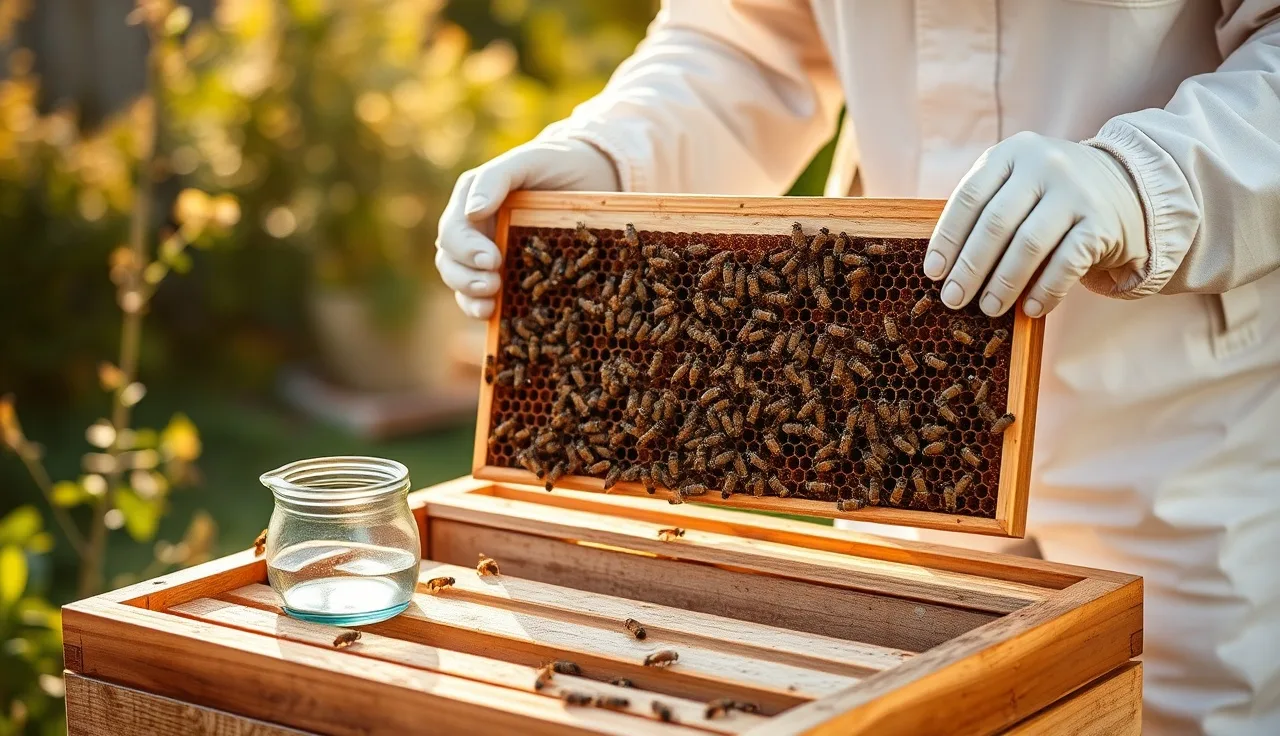
- For an accurate varroa count, scoop your 300-bee sample from the brood nest, off a frame with open brood and young nurse bees.
- Nurse bees carry the heaviest phoretic mite loads.
- Sample the entrance or outer honey frames instead and you can undercount by 30-50%, which means you skip a treatment the colony actually needs.
Why does sampling location inside the hive matter so much?
Mites are not spread evenly through a colony, and that single fact decides whether your count means anything. Varroa spend their reproductive phase sealed inside capped brood cells. Between cycles they ride on adult bees, a stage called phoretic, and those phoretic mites strongly favor nurse bees, the young workers that tend brood and feed larvae [1]. Nurse bees pack into the brood nest, the center frames of the lower box in most Langstroth setups.
Scoop off the bottom board, off bees hanging at the entrance, or off honey frames near the outer walls, and you catch mostly foragers and house bees with lighter mite loads. Multiple university extension trials, including work summarized by Penn State Extension, found that samples taken outside the brood nest can undercount true infestation by 30-50% [8].
That gap gets colonies killed. A hive reading 1.5% on a bad sample might really sit at 2.5 to 3%, past the 2% action threshold most beekeepers use during brood season [3]. So you wait. The mite population roughly doubles every 3 to 4 weeks at the peak of brood rearing, and by your next test the colony is already in a hole it can't climb out of.
Location is the biggest controllable variable in a mite count. It matters more than alcohol wash versus sugar roll, even though alcohol wash wins on accuracy for other reasons. Get the frame wrong and the number is fiction.
Which part of the hive gives the highest and most representative mite load?
The center frames of the brood nest. Pull a frame carrying a mix of open brood (uncapped larvae) and capped brood, check both sides, and find where the nurse bees are thickest. The slow-moving bees with their heads down in cells are your target [1].
In a single box or a fresh package this is easy. The brood nest is obvious. In a two or three-box stack during warm months, the nest usually sits in the upper box because heat rises, but that shifts. Use open brood as your anchor every time. Mites crowd onto nurses attending open larvae because that's their fastest route into the next cell to reproduce.
The Honey Bee Health Coalition's Varroa management guide, one of the best practical resources going, says samples should come "from a frame of open brood in the brood nest," where nurse bees are working [2]. That's not a nice-to-have. It's the only way to get a count that means something.
A few caveats. When a colony is broodless (midwinter, a laying gap, a queen loss), phoretic mites have nowhere to hide and spread across all the adults fairly evenly. Any frame in the cluster works then, and your count will run higher than you've ever seen because none of the mites are locked in cells [4]. That's the best moment to hit them with oxalic acid, but that's a different article.
How many bees do you need in your sample for a reliable count?
Three hundred bees. Not a round number somebody liked. It comes from modeling how many bees you need to land within one percentage point of the colony's true infestation level with reasonable confidence [5].
Three hundred bees is about half a cup by volume (roughly 120 ml). Most beekeepers mark a jar at that line or just use a measuring cup. Close counts: 250 to 350 bees is fine in the field. Drop below 200 and your percentage gets shaky enough to flip a treatment decision the wrong way.
Don't count bees one by one. Scoop from the densest part of the nurse cluster on your target frame, cap the jar fast, and measure by volume. Half a cup lands near enough to 300 that the rounding error is smaller than the natural mite variation across the colony anyway.
One trap for newer beekeepers: keep the queen out of the sample. Shake or brush bees from the brood frame into a tub first, confirm she's not in the pile, then scoop from the pile into your jar. Your colony stays queenright and you skip the stomach-drop moment of realizing she's in the alcohol.
Should you sample from the top box or bottom box in a multi-box hive?
Follow the brood, not the honey. In a standard two-deep during the main flow, the queen often drops to the bottom box while the top fills with capped honey. That flips with the season. By late summer and early fall the brood nest can ride up into the top box while the bottom holds older stores [11].
The rule is short: open the hive, find open brood, sample there. Brood in both boxes? Sample from the box where the nest looks most concentrated, usually the frame with the biggest patch of open larvae ringed by nurse bees.
Never sample a honey super. The bees up there are mostly older foragers with light mite loads, and a sample from that box almost guarantees an undercount.
Run a single deep under honey supers and the brood box picks itself. For Warre or top-bar hives the logic holds: find the youngest, busiest brood area and sample there.
What's the step-by-step method for taking a brood nest sample correctly?
Here's how I'd walk a friend through it.
Gather gear before you open anything: a clean half-cup measuring cup or a jar marked at 120 ml, a mesh lid (for alcohol wash) or a vented jar (for briefly holding live bees for a sugar roll), isopropyl alcohol if you're washing, a white tray or plate, and good light. A basic kit and suppliers are covered at beekeeping supplies if you're starting from scratch.
Light the smoker. Give the entrance a few puffs, wait 30 seconds. Pull the outer and inner covers. On a two-box hive, set the top box on an upturned lid so you can check the bottom box while you hunt for the nest.
Pull the frame with the most open brood and the busiest nurse activity. Look at both sides. You want the frame that reads like a nursery: wet-looking open cells, bees moving slowly and attentively, lots of heads-down work.
Hold that frame over a deep plastic bin or a spare hive body. Shake the bees off hard into the container. Shake, don't brush. A firm shake drops nurse bees; brushing tends to clear foragers first and skew your sample. One sharp downward snap does it.
Scan for the queen. Spot her, set her aside on another frame.
Scoop bees from the pile with your measuring cup, fast, and cap the jar. For an alcohol wash, add isopropyl alcohol right away to kill the bees and knock mites loose. Swirl hard for 30 to 60 seconds. Pour through a mesh strainer over a white tray and count the mites. Divide mites by your bee count (call it 300 for a half-cup scoop) for your percentage [5].
Alcohol wash pulls more mites than sugar roll, reliably. A 2021 comparison found sugar roll recovers roughly 40 to 60% of the mites an alcohol wash gets from the same sample [6]. If a colony is sitting near your action threshold and you're deciding whether to treat, wash it.
Log every result across hives and seasons with something like VarroaVault's free mite count tracker so you catch a rising trend before it turns into a dead-out.
Does the time of day or season affect where and how you should sample?
Time of day barely changes where you sample, but it changes who's home. Mid-morning to early afternoon sends the most foragers out, which actually helps: the bees left on brood frames skew heavily toward nurses, the exact population you want.
Season changes a lot more.
Spring buildup: the nest is expanding fast. Sample the warmest, most central brood frames. Counts often read low in early spring because the colony wintered with a reduced mite load, but the numbers climb quickly once brood rearing picks up.
Summer peak: this is when frame discipline pays off. The brood nest may spread across 6 to 8 frames in both boxes. Phoretic mites are a smaller share of the total because most are reproducing in cells. Your nurse-bee sample is still the single most accurate spot you can pick.
Fall pre-winter: the sample that decides the colony's survival. The winter bees being raised now carry varroa into next season. A falsely low count here can kill the hive before March. The University of Minnesota Extension calls late summer to early fall (August to September in northern climates) the most important monitoring window of the year [3].
Winter broodless period: sample anywhere in the cluster, because phoretic mites are spread evenly. These counts run higher than summer counts at the same real infestation level. Don't panic. Higher is accurate, not worse.
For the mite's biology and why timing bites this hard, the varroa mite overview lays out the full reproductive cycle.
What is the 2% action threshold and how does sampling location affect it?
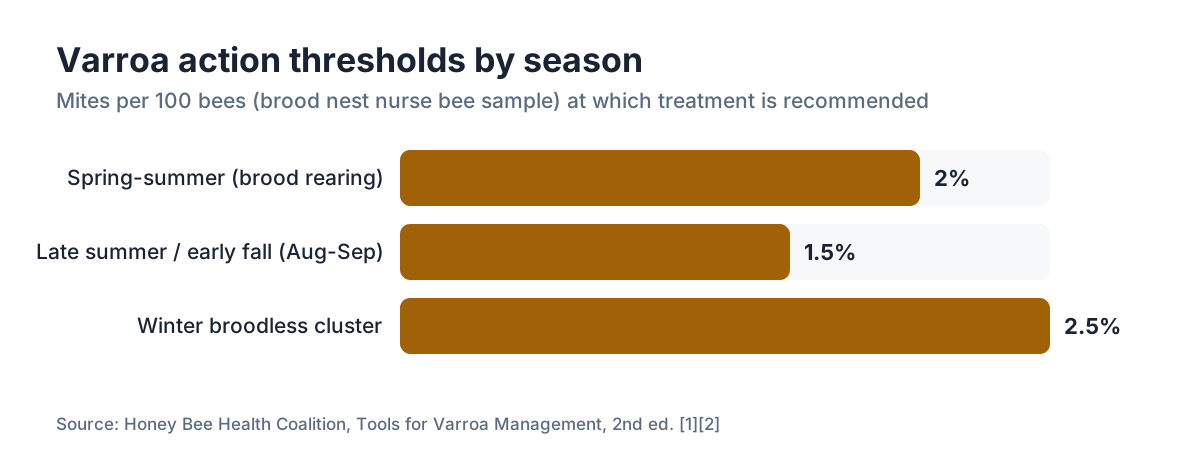
The 2% action threshold means 2 mites per 100 bees, and it's the most common trigger for treatment during brood season. The Honey Bee Health Coalition recommends treating at or above 2% from spring through late summer, and at 1 to 2% in August and September as winter bee production starts [2].
Here's the math trap. Your sample reads 1.8% but you took it off outer honey frames. The real number in the nurse population could be 2.5 to 3.5%. You skip treatment. The colony rolls into fall carrying a heavy mite load. Winter cluster bees get parasitized as pupae, which cuts their lifespan and wrecks their immune function.
Accurate sampling protects you the other direction too. A legitimate 1.5% off a proper brood nest sample means you can reasonably wait and retest in 3 to 4 weeks instead of burning a miticide you didn't need.
Thresholds by season, from the Honey Bee Health Coalition guide [2]:
| Season | Action threshold |
|---|---|
| Spring through summer (brood rearing) | 2% (2 mites per 100 bees) |
| Late summer / early fall (Aug-Sep) | 1-2% (treat at lower end for winter prep) |
| Winter broodless cluster | 2-3% (oxalic acid if above this) |
Every one of these numbers assumes a clean brood nest sample. Feed them a bad-location count and they stop meaning anything.
Can you sample from multiple locations and average the results?
You can, and it almost always hurts. Sample half your bees off a brood frame and half off a honey frame and you've watered down the signal. The average lands below the real brood nest infestation.
The one exception is a colony with two brood chambers where the queen seems to lay in both boxes about equally. Then pulling from the main brood cluster in each box and combining into one 300-bee wash makes sense. Even so, if you can spot the densest nurse area in a single location, just sample there.
Some researchers sample multiple spots to map within-hive variation. Interesting science. For a treat-or-don't decision, one well-placed 300-bee sample off the best nurse frame beats two poorly chosen samples averaged together [5].
Multiple hives are a different story. Sample each colony on its own. Mite loads swing wildly between neighbors; one hive at 0.5% next to one at 4% is common. Average across hives and you bury the hot colony that needs treatment today.
What mistakes lead to inaccurate mite counts, and how do you avoid them?
Wrong frame choice is the most common error, and it's covered above. Several others wreck counts too.
Sampling in the wrong season without adjusting how you read the number. A 3% count in a broodless winter cluster is nothing like a 3% count in June. In winter, every mite is phoretic. In June, only about 30% of the colony's mites are phoretic at any moment, because the rest are reproducing in capped cells [4]. Your alcohol wash only sees phoretic mites. So a June colony reading 3% phoretic is carrying a total load near 10%, which is a collapsing colony.
Too few bees. A 100-bee sample carries twice the statistical error of a 300-bee sample. Pull 100 bees, find 1 mite, and you report 1%. Pull 300, find 4 mites, and you report 1.3%. That gap can flip your decision.
Sugar roll instead of alcohol wash near a threshold. Sugar roll spares the bees and works fine for demos, but it misses mites. A 2021 study published in PLOS ONE found alcohol wash significantly more accurate for estimating true infestation rates [6]. Near a threshold, wash.
Bad timing relative to a recent treatment. Treated with formic acid two weeks ago? Your count reflects post-treatment levels. Useful, but label it that way in your records. Set it against a pre-treatment baseline and you get an efficacy number.
Rushing the swirl. An alcohol wash needs 30 to 60 seconds of hard swirling to strip mites off bee bodies. A 10-second shake leaves mites stuck and undercounts your load.
The EPA requires that varroa treatment products (Apivar, Mite Away Quick Strips, oxalic acid products) be used according to their registered labels, which point to monitoring as the basis for treatment decisions [7]. Getting the sample right is the foundation the whole label-directed system leans on.
How often should you be sampling, and where do you record results?
Monthly through the brood-rearing season is the standard call from most university extensions and from the Honey Bee Health Coalition [2]. The University of Minnesota Extension recommends sampling every 30 days from April through October in northern climates, plus a hard look in August or September [3].
For a hobbyist with 2 to 5 hives, that's manageable: maybe 20 to 30 minutes per hive to open, find the nest, take a sample, wash, and count. The payoff is catching mite buildup early, when treatments work best and stress the colony least.
For a sideliner running more colonies, monthly sampling of every hive gets ambitious. A workable middle ground: sample a random 30% of your hives each month, and every hive at the late-summer window. If a sampled hive hits threshold, sample its nearest neighbors too.
Records matter here. A single count tells you where you are today. A run of counts tells you the trend: flat, creeping up, or accelerating. A colony that jumps from 0.8% to 2.4% in 30 days needs a different response than one holding at 2.0% for the third month straight.
VarroaVault's free sampling tracker logs each hive by date and where in the hive you sampled (brood nest, estimated bee count, method) so the acceleration shows up before it becomes a crisis. It sits alongside the other free tools on the main site.
Does hive type change where you should sample?
The principle holds across every design: find the brood nest, sample nurse bees. Only the mechanics change.
Langstroth (standard US design): pull the busiest brood frame in the main brood box. In summer that's often frame 3, 4, or 5 in a 10-frame box, counting from either side. Viewed from above, the nest has a recognizable football shape.
Top-bar hives: the nest usually sits in the first third of bars from the entrance. Find the bars with the most open brood and nurse density. Sampling is a little awkward since you can't shake into a tub without risking the comb. Brush gently into a container, or slide a sheet under the bar.
Warre hives: brood lives in the lower box because Warre management adds boxes underneath. Same approach, just reach lower.
Flow Hive: the brood setup matches a standard Langstroth. Ignore the Flow super and sample the brood box below.
Nucleus colonies (5-frame nucs): nearly every frame is brood territory. Sample the frame with the most open brood and nurse activity, same as always. Nucs can carry heavy mite loads because the small bee population gives mites a short hop to new brood. Don't skip monitoring a nuc just because it's small [12].
Frequently asked questions
Can I just shake bees off the entrance board to get my sample?
No. Entrance bees are overwhelmingly foragers and guards, both older workers with much lighter phoretic mite loads than nurses. An entrance sample can undercount your true infestation by half. Always sample nurse bees on brood frames in the active nest. The few extra minutes to find the right frame pay off every single time.
How do I find nurse bees if I can't tell them apart from other bees visually?
You can't reliably spot nurse bees by looks. Identify them by location and behavior instead: they cluster on frames with open brood, heads often down in cells, moving slowly and deliberately. Foragers move fast and drift toward the edges. Shake bees off an open-brood frame and scoop from that pile and you get a high proportion of nurses without picking out individual bees.
Does it matter if the queen is on the frame I sample from?
Yes, but only because you don't want to kill her. Before scooping from the pile of shaken bees, do a quick check for the queen. She's longer, with a tapered abdomen, and bees around her orient toward her. Set her aside on another frame. The mite load on the queen herself doesn't matter to your count; the surrounding nurse population does.
Is alcohol wash or sugar roll more accurate for brood nest samples?
Alcohol wash. A 2021 PLOS ONE study found sugar roll recovers roughly 40 to 60% of the mites an alcohol wash pulls from the same sample. For a routine check well below your action threshold, sugar roll is fine. For a decision near the 2% threshold, where accuracy matters most, wash. The bees die in an alcohol wash, but 300 bees is a small loss for a strong colony.
What if my colony has no brood right now? Where do I sample?
During a broodless period, all phoretic mites sit on adult bees and spread fairly evenly across the cluster. Sample anywhere in the cluster. Expect higher counts than usual because none of the mites are hidden in capped cells. This is the ideal window to treat with oxalic acid, which is highly effective on phoretic mites and registered for use in broodless colonies.
How far into the hive do I need to go to reach the brood nest?
As far as it takes to find open brood. In a two-box hive that means lifting the top box or at least tilting it back. In a single deep you're usually there once the outer and inner covers are off. Don't guess or grab the first reachable frame. A mite count is only worth doing if you open the hive properly and reach the actual brood nest.
Can I take multiple small samples from different frames and combine them?
Combining samples from multiple brood nest frames (all in the same brood area) is acceptable and can give a slightly better average. Avoid mixing brood-frame bees with honey-frame or outer-frame bees. Every bee in your 300-bee sample should come from the brood nest population. Diluting with outer-frame foragers lowers your count and drags down its accuracy.
Does a swarm or newly installed package need mite monitoring from the start?
Yes, but timing matters. A newly hived package with no established brood reads very low at first, because the founding bees came from a larger colony that diluted mite density. Start monitoring 30 to 45 days after installation, once brood is established and you have a real nurse population to sample. Swarms caught from wild colonies can carry heavy mite loads from day one and should be sampled within the first month.
How do I sample a queenright versus a queenless colony differently?
In a queenright colony, find the laying queen's brood pattern and sample nurse bees attending that brood. In a queenless colony with brood from a recently lost queen, sample whatever brood remains. If the colony is queenless and broodless, treat it as a broodless colony and sample anywhere in the cluster. A queenless, broodless colony is actually an ideal treatment window if mites are above threshold.
My hive is aggressive. How do I safely reach the brood nest to sample?
Full gear and a calm, well-lit day help a lot. Smoke the entrance and under the top cover before opening. Work slowly and confidently. If the colony stays unmanageable, consider requeening with a gentler line. Aggressive temperament paired with high mite loads points to colony stress and, in some regions, Africanized genetics. See the africanized honey bee overview for more on temperament.
What's the minimum number of bees needed for a meaningful mite count?
Two hundred bees is the practical floor for a count you can act on. Below that, the statistical error gets large enough that a 1% result could plausibly be anything from 0.5% to 2%. The standard 300-bee sample (about half a cup by volume) lands within roughly one percentage point of true infestation with reasonable confidence. Near a threshold, take a second sample rather than using fewer bees.
How long does it take to get a reliable mite count from a brood nest sample?
Hands-on time runs about 10 to 15 minutes per hive once you're practiced: 5 minutes to open and find the brood frame, 2 minutes to shake and scoop, 5 minutes to wash and count on a white tray. The counting step drags when mite loads are high. Budget 20 to 30 minutes per hive the first few times. It speeds up once finding the nest is second nature.
Should I sample the same frame every time for consistent data?
Sample the same general area (the brood nest center) every time, but don't lock onto one physical frame. The nest shifts as the queen moves her laying pattern. Chasing the same frame number across visits can actually add inconsistency. Find the densest open-brood frame each visit instead. Consistent method (same time of day, same bee count, same wash technique) matters more than a fixed frame identity.
Sources
- Honey Bee Health Coalition, Tools for Varroa Management (Varroa management guide): Phoretic mites preferentially associate with nurse bees attending open brood in the brood nest; samples should be collected from brood nest frames where nurse bees are tending open brood
- Honey Bee Health Coalition, Tools for Varroa Management, 2nd edition: Action thresholds: 2% during spring-summer brood rearing; 1-2% in August-September for winter preparation; recommends monthly monitoring
- University of Minnesota Extension, Varroa mite management for honey bee colonies: Late summer or early fall (August-September in northern climates) is the most important monitoring window; sampling every 30 days from April through October recommended
- Rosenkranz, P., Aumeier, P., and Ziegelmann, B. (2010). Biology and control of Varroa destructor. Journal of Invertebrate Pathology, 103, S96-S119.: During active brood season a large majority of mites are in capped cells at any time; during broodless periods all mites are phoretic on adult bees
- Delaplane, K.S., van der Steen, J., and Guzman-Novoa, E. (2013). Standard methods for estimating strength parameters of Apis mellifera colonies. Journal of Apicultural Research, 52(1).: A 300-bee sample (approximately half a cup by volume) provides an estimate within one percentage point of true infestation level with reasonable statistical confidence
- Iowa State University Extension, Integrated Crop Management, comparing methods for estimating varroa mite infestations: Sugar roll recovers approximately 40-60% of mites compared to alcohol wash from the same sample; alcohol wash is significantly more accurate for threshold-based decisions
- U.S. Environmental Protection Agency, varroa mite treatments for honey bees: Registered varroa treatment products (Apivar, Mite Away Quick Strips, oxalic acid products) must be used according to EPA-registered labels, which assume mite monitoring as the basis for treatment decisions
- Pennsylvania State University Extension, varroa mite monitoring methods: Sampling from outside the brood nest (entrance, outer frames) can undercount infestation levels by 30-50% compared to brood nest samples
- NC State Extension, varroa mite management in honey bee colonies: Alcohol wash method for varroa monitoring; 300 bee sample from brood nest nurse bees recommended as standard protocol
- USDA Agricultural Research Service, honey bee research: Varroa destructor reproductive biology; phoretic mite preference for young nurse bees documented in ARS colony health research
- Oregon State University Extension, varroa mite monitoring and management: Multi-box hive sampling guidance: sample the box containing the active brood nest with open brood, not honey storage areas
- Cornell University, College of Agriculture and Life Sciences, varroa mite monitoring: Consistent monthly monitoring from brood nest nurse bee populations recommended; nuc colonies require same monitoring frequency as full colonies
Last updated 2026-07-09