Why oxalic acid only kills phoretic varroa mites

TL;DR
- Oxalic acid kills varroa mites that are riding adult bees (phoretic mites) but cannot penetrate wax-capped brood cells where most mites reproduce.
- Because the acid works by direct contact, any mite sealed inside a cell survives.
- Timing treatments during broodless periods, or using extended-release methods like Apivar alongside OA, is the fix.
What is a phoretic varroa mite, exactly?
A phoretic mite is one that is hitchhiking on an adult bee rather than reproducing inside a capped cell. The word comes from the Greek "phorein," meaning to carry, and it describes the part of the varroa life cycle that happens outside the comb.
During the phoretic phase, the mite clings to the bee's abdomen, feeding on the bee's fat body tissue [1]. It's waiting. It's looking for an opening to slip into a brood cell just before a nurse bee caps it with wax. That window is short, usually the last few hours before capping, and the mite times it with unsettling precision.
The phoretic phase is the only part of the varroa life cycle that oxalic acid can touch. Once a mite drops into a cell and that cell gets capped, it is physically out of reach. No liquid, no vapor, no gel gets past the wax cap in concentrations that matter.
For more background on varroa biology, see our full varroa mite overview.
How does oxalic acid actually kill a varroa mite?
Oxalic acid (OA) is a dicarboxylic acid found naturally in rhubarb, spinach, and other plants. The concentrated form used in beekeeping is a crystal you dissolve in water or syrup, or vaporize into the hive as a gas. In all three delivery methods, the mechanism is the same: direct contact kills the mite.
When the acid contacts the mite's cuticle (its outer exoskeleton), it disrupts the protective waxy layer, destabilizes ion channels, and causes cell death fairly quickly [2]. The mite has no meaningful detox pathway for oxalic acid at the concentrations used in registered treatments.
Honey bees tolerate OA far better than mites do. The leading hypothesis is that bees can metabolize low levels of oxalate through their gut, and the wax coating on bee cuticle is chemically different enough from the mite's cuticle that equivalent exposure does far less damage to the bee [2]. High doses do harm bees, which is why the EPA-registered label rates matter.
The contact requirement is the whole story. If acid cannot physically reach the mite, the mite lives. Capped wax is a good barrier. This is not a flaw in oxalic acid's chemistry. It's physics.
Why can't oxalic acid get into capped brood cells?
Wax cappings are not porous to aqueous solutions or to most vapors at the concentrations you can achieve inside a hive. The cap is roughly 70 microns thick on average and is largely made of long-chain hydrocarbons and fatty acid esters that repel water-based chemistry [3].
Vaporized OA does spread through the hive and lands on bees and exposed comb surfaces. But the vapor pressure of oxalic acid is low enough that meaningful concentrations do not build up inside a sealed cell. The mite inside the cell exchanges gas through the cell environment, not through the wax cap directly, and that exchange is too little to deliver a lethal dose [2].
Drip or trickle application puts liquid oxalic acid straight onto adult bees in the cluster. Bees groom each other and spread the acid across the colony. Any mite already inside a capped cell never gets touched.
Spray methods work the same way. You're coating bees and open comb, not sealed cells.
Roughly 80 to 90 percent of the total varroa population in an active colony with brood is inside capped cells at any given moment [4]. Treat during peak brood season with a single OA application and you leave most of your mite problem untouched.
What percentage of mites survive a single oxalic acid treatment?
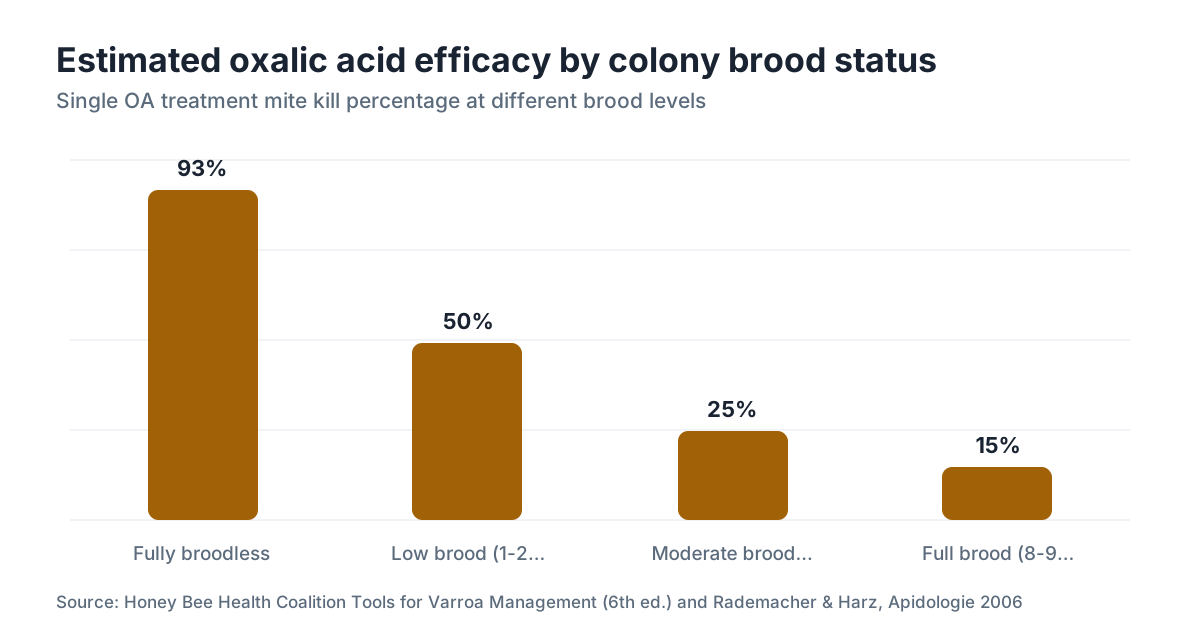
This depends almost entirely on how much brood is in the colony when you treat.
During a true broodless period (mid-winter in cold climates, or an induced broodless state), nearly 100 percent of mites are phoretic. A single, properly applied OA treatment in that window reaches reported efficacy of 90 to 97 percent mite kill [5]. That's about as good as it gets with any approved treatment.
Treat the same hive in late summer when all eight or nine frames of brood are capped and you might kill only 10 to 30 percent of mites. The rest sit sealed inside cells, protected, and will emerge over the following two to three weeks to re-infest the colony.
The Honey Bee Health Coalition's "Tools for Varroa Management" guide puts it plainly: oxalic acid "is most effective when used during broodless or low-brood periods" [6]. That's the key line. Treat at the wrong time and you're not failing because OA is weak. You're failing because you're aiming at a small slice of the population.
| Colony brood status | Estimated % mites phoretic | Single OA treatment efficacy |
|---|---|---|
| Fully broodless | ~95-100% | 90-97% mite kill [5] |
| Low brood (1-2 frames) | ~40-60% | 40-60% mite kill (estimated) |
| Moderate brood (4-5 frames) | ~20-30% | 20-30% mite kill (estimated) |
| Full brood (8-9 frames) | ~10-15% | 10-20% mite kill (estimated) |
Estimates for partial-brood scenarios are extrapolated from the phoretic proportion data in [4]. Direct controlled studies at each brood level are limited.
When is the right time to use oxalic acid?
The classic window is mid-winter, after the queen has stopped laying and before she starts again. In most of the northern US and Canada, that's roughly December through early February [6]. The colony is clustered, there's little to no capped brood, and nearly every mite in the hive is riding an adult bee. One good treatment at this point knocks the population down hard before spring buildup.
If you keep bees in the South or in a mild climate, you may never get a natural broodless period. Your options:
- Confine the queen with a cage for about 25 days (long enough for all existing brood to emerge) before treating. Labor intensive, but effective.
- Make a split or nuc, which forces a temporary broodless period in the queenless portion.
- Use an extended-contact method like Apivar (amitraz strips) alongside OA to catch mites as they emerge from cells over multiple weeks.
The Honey Bee Health Coalition recommends combining methods when treating during the brood season rather than leaning on a single OA application [6]. That's practical advice, not hedging.
If you want a structured protocol that matches treatment windows to your local calendar, the free planning tools at VarroaVault can map broodless windows and set treatment reminders for your region.
Does vaporizing oxalic acid work any differently than dribbling it?
Both methods kill only phoretic mites. The delivery system doesn't change the core limitation. Vaporization does carry some practical advantages over dribbling that are worth knowing.
Vaporized OA spreads more evenly through the hive, reaching bees in all parts of the cluster, including spots that are hard to wet with a dribble applicator. Some studies suggest slightly higher efficacy per application with vapor versus dribble during broodless periods, though the gap is modest when both are done right [5].
Vaporization also lets you treat without opening the hive, which matters in cold weather. Cracking a cluster in January to dribble syrup can chill brood (if any remains) and stress the bees.
The registered vaporization product in the US is Api-Bioxal (the same oxalic acid dihydrate crystal registered for dribble use), and the label specifies 1 gram of OA per brood box, up to three treatments with a minimum of seven days between applications [7]. Follow the label. It's a federal document, and the rates are there for a reason.
Repeated vapor treatments every seven days across brood emergence (three to four rounds) is one approach for colonies that carry some brood. You're not treating the capped mites directly. You're killing the phoretic ones as they emerge from cells over successive weeks. It works, but it's slow and imperfect. A broodless period is cleaner.
Can you use oxalic acid during the honey flow or on honey supers?
Yes, and this is one of OA's biggest advantages over most other varroa treatments. The EPA-registered Api-Bioxal label permits use when honey supers are present [7]. Oxalic acid occurs naturally in honey in small amounts, and the residue added by treatment is considered negligible against natural background levels [2].
Amitraz (Apivar) and the thymol-based products (ApiLife Var, Apiguard) restrict use when honey supers are present, which limits them during the flow. OA carries no such restriction under current US labeling.
That said, treating during a honey flow with OA when the colony has full brood still hits the efficacy problem described above. You can do it legally, but you won't get much mite kill. You're better off waiting for the fall window after the flow ends, using OA then with lower brood levels, or pairing OA with a longer-acting treatment.
How does oxalic acid compare to other varroa treatments for brood-penetration?
No contact-based treatment penetrates capped cells. The treatments that do affect mites in brood work through different mechanisms or extended exposure.
Amitraz (Apivar strips) releases vapor slowly over six to eight weeks. Mites that emerge from cells face continuous amitraz vapor across that whole period, which is why it stays effective even with full brood present [8]. It's not that amitraz gets into cells. The exposure window is long enough to cover the entire brood cycle.
Thymol-based products work the same way: slow vapor release over several weeks at temperatures above 59°F (15°C), long enough to catch mites as they emerge [9].
Formic acid (Mite Away Quick Strips) is the only contact treatment with documented ability to penetrate cappings and kill mites inside brood cells, at least partially [10]. It's volatile enough at hive temperatures to build concentrations inside cells that hit mites, though efficacy inside cells runs lower than on phoretic mites. Formic acid is also temperature-sensitive and can harm the queen or brood if applied wrong.
Oxalic acid's lack of brood penetration is not a defect. It's a different tool with a specific best-use window.
| Treatment | Kills phoretic mites | Kills mites in brood | Honey super safe | Temperature sensitive |
|---|---|---|---|---|
| Oxalic acid (OA) | Yes | No | Yes (Api-Bioxal label) [7] | Mildly (cluster access) |
| Amitraz (Apivar) | Yes | Partially (via extended exposure) | No | Somewhat |
| Formic acid (MAQS) | Yes | Partially | Some conditions | Yes, strongly |
| Thymol (Apiguard) | Yes | Partially (via extended exposure) | No | Yes, strongly |
Sources: [6][7][8][9][10]
What happens if you treat with oxalic acid repeatedly during brood season?
This is the "trickle" or "multiple vapor" strategy some beekeepers use when they can't get a broodless period. The idea holds up in theory: if a worker brood cycle is 21 days and you treat every seven days, you hit each emerging cohort of mites before they can re-enter new cells.
In practice it's imperfect. Bee brood isn't perfectly synchronized, so some mites always slip through. The efficacy of repeated treatments also hinges on whether the cluster covers all the combs, because mites riding bees in poorly reached areas survive.
A small US study published in Apidologie found that five to seven vapor treatments applied at five to seven day intervals during brood-present conditions reached 60 to 80 percent mite reduction, compared to 90 to 97 percent in broodless colonies with a single treatment [5]. That's a lot of treatments to approach broodless-period efficacy.
There's also a real cost in time, propane or electricity for the vaporizer, and stress on the beekeeper and the colony. Nobody has good long-term resistance data for OA yet, but varroa resistance to amitraz is documented [8], and it pays not to overdo any single compound. The Honey Bee Health Coalition recommends rotating modes of action across seasons [6].
If you're going to run repeated OA vapor in the brood season, set a clear mite count target (below 2 mites per 100 bees is the commonly cited threshold before the honey flow) and stop when you hit it, not when you run out of treatments.
Does oxalic acid leave residue in wax or honey?
Oxalic acid is already present in honey naturally. Concentrations in untreated honey typically run 8 to 65 mg/kg depending on floral source [2]. Treatment studies show that OA application raises honey oxalate levels by a small, transient amount that returns to baseline within weeks.
In wax, OA residues are similarly low and fade over time. The European Food Safety Authority reviewed residue data and concluded that "the use of oxalic acid in beekeeping does not pose a safety concern for consumers" [2]. The EPA reached a compatible conclusion in granting the Api-Bioxal registration [7].
Wax from repeatedly OA-treated hives picks up some oxalate, but current data don't suggest this harms bees or meaningfully contaminates honey. The data on multi-year wax residue accumulation is thinner than anyone would like. If you rewax foundation regularly (which you should do for other reasons anyway), you're not building up a residue problem.
How do you know if your oxalic acid treatment actually worked?
Wash or roll a sample of bees and count mites before and after treatment. That's the only reliable way to know.
The alcohol wash is the most accurate field method for phoretic mite counts. Take a sample of about 300 bees (roughly half a cup) from a brood frame, not the entrance, wash them in 70 percent isopropyl alcohol for 30 to 60 seconds, and count the mites that fall out. Divide mites by bees, multiply by 100, and you have a percentage [6].
Treat when your count tops 2 percent (2 mites per 100 bees) before the honey flow, or 1 percent in late summer when you're raising winter bees. These are widely cited thresholds from the Honey Bee Health Coalition and university extension services [6][11].
After an OA treatment during a broodless period, recount in five to seven days. If OA worked as expected and the colony was truly broodless, your count should drop sharply, often to zero or near zero. If it doesn't, you either had more brood than you thought, or your application was uneven.
For managing your mite count calendar and keeping records across several hives, structured tracking tools help. VarroaVault's free varroa management tools include a mite count log and treatment scheduler built around published threshold recommendations.
Is there any research on varroa developing resistance to oxalic acid?
No confirmed OA resistance has been documented in field populations as of this writing. That matters, because varroa resistance to amitraz is well-established in some regions [8], and resistance to tau-fluvalinate (Apistan) became a widespread problem in the 1990s and 2000s.
OA resistance is considered less likely (though not impossible) for a mechanistic reason. Oxalic acid works by physical chemical disruption of the cuticle and ion channels, not through a specific receptor pathway. Receptor-based mechanisms are much easier for varroa to evolve around through single-gene mutations. Physical disruption of cuticle chemistry is harder to route around [2].
Less likely is not the same as impossible, and varroa is a fast-reproducing organism under heavy selective pressure. The responsible play is to rotate treatments across seasons rather than use OA exclusively, as the Honey Bee Health Coalition recommends [6]. Use OA in the broodless window, use an extended-contact treatment like amitraz during the brood season, and monitor often so you know if anything stops working.
Frequently asked questions
Why does oxalic acid not work on mites inside capped brood cells?
Wax cappings are a hydrophobic barrier that oxalic acid cannot penetrate in meaningful concentrations. OA works by direct contact with the mite's cuticle. Any mite sealed inside a cell never contacts the acid, whether applied as vapor, dribble, or spray, and survives the treatment. This is a physical limitation, not a chemical weakness.
How long after an oxalic acid treatment can I expect new mite reinfestation?
If the colony was truly broodless, your mite count can stay near zero for several weeks, until foragers start drifting in mite-carrying bees from neighboring colonies. In active brood season, reinfestation from emerging brood begins immediately. Phoretic mites that survived in cells emerge and re-enter new cells within days. This is why monitoring after treatment is necessary.
Can I use oxalic acid when my queen is laying?
You can, and it's legal under the Api-Bioxal label. But efficacy is much lower because most mites sit inside capped cells, not riding adult bees. A single treatment during full brood season may kill only 10 to 20 percent of mites. If treating in brood season, plan for multiple applications seven days apart, or pair OA with a longer-acting treatment like amitraz.
How many times can I vaporize oxalic acid in one season?
The Api-Bioxal label in the US registers up to three treatments per application period, with a minimum of seven days between treatments. For winter broodless treatment, one application is usually enough. In brood season, some beekeepers run extended series of vapor treatments, but always follow the label rate and rotation guidelines from the Honey Bee Health Coalition to avoid overexposure.
What temperature is needed for oxalic acid vaporization to be effective?
The bees need to be clustered and accessible, which generally means hive temperatures above 10°C (50°F) so bees move enough to spread the acid through grooming. Extremely cold conditions can cut effectiveness, not because the chemistry changes, but because bees cluster too tightly for even distribution. Most practitioners treat on days when outdoor temps are above 40°F.
Is oxalic acid safe to use with honey supers on?
Yes. The EPA-registered Api-Bioxal label explicitly permits use when honey supers are present, a significant advantage over amitraz and thymol-based products. Oxalic acid occurs naturally in honey, and treatment residues are considered negligible against background levels based on European Food Safety Authority and EPA review.
What mite count threshold should I treat at before using oxalic acid?
The Honey Bee Health Coalition recommends treating when alcohol wash counts exceed 2 percent before the honey flow and 1 percent in late summer when winter bees are being raised. A count above 2 to 3 percent at any point in the season warrants immediate action. Count bees from a brood frame, not the entrance, for an accurate phoretic mite sample.
Can oxalic acid be used in combination with other varroa treatments?
Yes, and it's often the right approach. OA during the winter broodless period pairs well with amitraz strips used in late summer. Avoid running two treatments at once unless you've checked compatibility data. Layering modes of action across seasons is the goal, not stacking them in the same two-week window. The Honey Bee Health Coalition's rotation guidance covers this clearly.
Does formic acid penetrate brood cells better than oxalic acid?
Yes, partially. Formic acid is volatile enough to build concentrations inside capped cells that kill some mites inside brood, which oxalic acid cannot do. Studies show formic acid has partial brood-penetrating efficacy. It is strongly temperature-sensitive, can harm queens and brood if applied incorrectly, and is not labeled for use with honey supers under all conditions.
How do I create a broodless period if my climate doesn't provide one naturally?
Cage your queen for 25 days. After all existing brood emerges, the entire mite population turns phoretic and one good OA treatment knocks them down hard. Making a split or nuc also forces a broodless period in the queenless part. Both work but need planning and extra inspections. In warm climates without natural winter breaks, caging is the most practical option.
Will varroa eventually develop resistance to oxalic acid?
No confirmed field resistance has been documented as of 2026. OA works by physically disrupting the mite's cuticle rather than binding a specific receptor, making resistance harder to evolve than with amitraz or pyrethroids. Rotating treatments across seasons is still wise. Using OA exclusively and repeatedly over many years creates selection pressure that isn't worth risking.
What personal protective equipment do I need when applying oxalic acid?
For vaporization, a half-face respirator rated for organic vapors and acid gas (N95 minimum, NIOSH P100 recommended), acid-rated goggles, and nitrile gloves are standard. Never vaporize near your face or in an enclosed space. For dribble application, nitrile gloves and eye protection are enough. Always read the Api-Bioxal label PPE requirements before treating, as they are legally required.
How long does oxalic acid stay active in the hive after treatment?
OA does not persist as an active compound. Once it contacts surfaces, it's neutralized or diluted quickly. There's no residual kill effect on mites entering the hive after treatment, unlike a slow-release strip. This is another reason timing matters: treat during peak phoretic mite presence, not at random, because you get one contact event per application.
Sources
- Ramsey et al., PNAS 2019, Varroa destructor feeds on honey bee fat bodies: Varroa mites feed on the fat body tissue of adult honey bees during the phoretic phase, not hemolymph as previously thought
- European Food Safety Authority (EFSA), Oxalic acid in honey bees assessment: Oxalic acid works by contact disruption of mite cuticle; natural honey oxalate is 8-65 mg/kg; OA residues from treatment are negligible and not a consumer safety concern
- University of Minnesota Extension, Beeswax chemistry and structure: Wax cappings are composed of long-chain hydrocarbons and fatty acid esters that repel water-based solutions
- Honey Bee Health Coalition, Tools for Varroa Management Guide (6th ed.): Approximately 80-90 percent of the total varroa mite population in an active colony is inside capped brood cells at any given time
- Rademacher & Harz, Apidologie 2006, Oxalic acid for the control of varroosis: Single OA treatment during broodless period achieves 90-97% mite kill; multiple treatments during brood season achieve 60-80% reduction
- Honey Bee Health Coalition, Tools for Varroa Management Guide (6th ed.): OA is most effective during broodless or low-brood periods; treatment thresholds are 2% before honey flow and 1% in late summer; rotating modes of action is recommended
- EPA, Api-Bioxal (oxalic acid) Federal Pesticide Registration Label: Api-Bioxal label permits use when honey supers are present; specifies 1g OA per brood box vapor; up to 3 treatments with 7-day minimum intervals
- Traynor et al., Scientific Reports 2021, Varroa resistance to amitraz: Varroa resistance to amitraz is documented in field populations in some US regions; extended-contact methods cover brood cycle through prolonged exposure
- Pennsylvania State University Extension, Varroa Mite Management: Thymol-based products require temperatures above 59°F (15°C) for effective vapor release and are not approved for use when honey supers are present
- Giovenazzo & Dubreuil, Experimental and Applied Acarology 2011, Formic acid vs varroa in brood: Formic acid has partial brood-penetrating efficacy, with documented though lower kill rates on mites inside capped cells compared to phoretic mites
- University of California Agriculture and Natural Resources, Varroa Mite Management in Honey Bees: Alcohol wash threshold recommendations: treat above 2 mites per 100 bees before honey flow, above 1 mite per 100 bees in late summer for winter bee protection
Last updated 2026-07-10