Beehives explained: types, costs, setup, and Minecraft basics
TL;DR
- A beehive is a structure, natural or manufactured, where a honey bee colony builds comb, raises brood, and stores food.
- For beekeepers, a managed hive setup (Langstroth, top bar, or Warre) typically runs $200 to $800 before bees.
- In Minecraft, beehives and bee nests are blocks that hold up to three bees and let you collect honey or honeycomb without killing anyone, if you use a campfire first.
What is a beehive, exactly?
A beehive is any enclosed cavity where honey bees build wax comb, raise brood, and store honey and pollen. That's the biological definition, and it covers a hollow tree, a wall void, a clay pot in the Mediterranean, or a plastic nuc box. In beekeeping, "hive" usually means the human-made structure, while "colony" means the bees living inside it. People use the words interchangeably in casual conversation, but they're not the same thing. You can have an empty hive with zero bees in it.
Wild honey bee colonies in North America mostly nest in tree cavities, and research from Cornell University's Dyce Lab and other apiculture programs has long documented that feral colonies favor cavities around 40 liters (roughly 10 gallons) in volume, with a small entrance high up and facing south [1]. Managed hives try to approximate that same basic environment, just in a box you can open, inspect, and harvest from.
The core biological needs don't change based on hive style: bees need enough cavity volume to store winter honey, a defensible entrance, ventilation to manage moisture, and enough comb surface for the queen to lay and for workers to store food. Every hive design on the market is really just a different way of solving those same problems.
What are the main types of beehives beekeepers actually use?
Three designs dominate US backyard and sideline beekeeping: Langstroth, top bar, and Warre. A fourth, the skep, is now illegal to keep as a working hive in most US states because you can't inspect the comb for disease.
The Langstroth hive, patented by Lorenzo Langstroth in 1852, is the industry standard. It uses removable wooden frames stacked in boxes (deeps and mediums), built around the concept of "bee space," a gap of about 3/8 inch that bees won't fill with comb or propolis, which is what makes the frames pull out cleanly. Roughly 100 years later it's still what almost every commercial beekeeper in the US uses, and it's what most state apiary inspection programs are built around.
A top bar hive is a horizontal box where bees build comb hanging from bars laid across the top, with no full frames or foundation. It's cheaper to build, easier on the back (no lifting heavy boxes), but the comb is fragile and can't go through a mechanical honey extractor.
A Warre hive is a vertical box system, developed by French monk Abbe Emile Warre, that adds boxes to the bottom rather than the top, meant to mimic a more "natural" cavity. It's popular with hands-off, low-intervention beekeepers, but it makes varroa mite inspection harder, which matters a lot given that untreated colonies have a well-documented high failure rate from mite-vectored viruses [2].
| Hive type | Comb removable? | Typical cost (box + frames, no bees) | Best for |
|---|---|---|---|
| Langstroth | Yes, full frames | $150-$350 per hive body set | Most beekeepers, honey production, easy mite inspection |
| Top bar (KTBH) | Partial, fragile comb | $100-$250 | Low-cost builds, no heavy lifting |
| Warre | Yes, but boxes stack awkwardly | $150-$300 | Low-intervention hobbyists |
| Skep | No | Not legal to keep as working hive in most states | Historical/decorative only |
If you're picking your first hive, go Langstroth. It's not close. Every extension publication, every mentor, every bit of used equipment at your local bee club will be Langstroth-compatible, and you'll be able to do a real varroa mite check without destroying comb.
How much does a beehive setup actually cost?
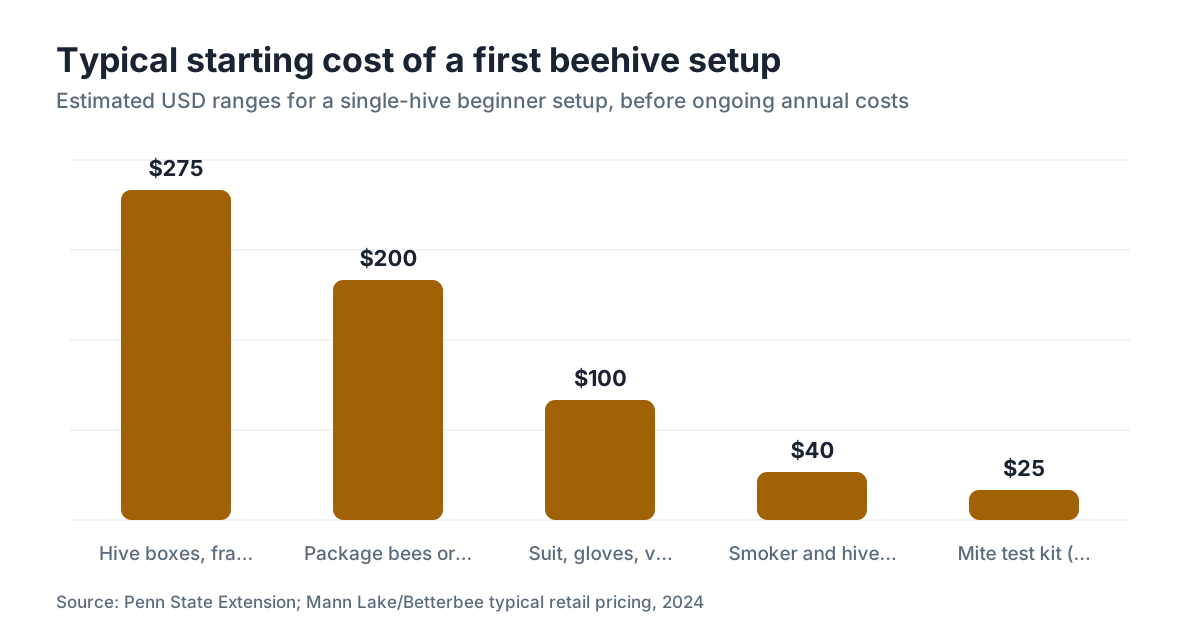
Budget $200 to $500 for a single complete Langstroth hive body (boxes, frames, foundation, bottom board, inner cover, telescoping cover) before you buy bees. That's assembled-and-painted pricing from major suppliers; unassembled kits run cheaper, often $150-$250.
Bees themselves add real cost on top of the box. A 3-pound package of bees with a mated queen typically runs $150-$200 as of recent seasons, and a nucleus colony ("nuc," a mini already-drawn-out hive with a laying queen) runs $180-$250 or more depending on region and demand. Add a bee suit or jacket ($60-$150), gloves, a smoker ($25-$40), and a hive tool ($10-$15), and first-year startup for one hive lands somewhere around $500-$900 all-in, which lines up with the range extension programs commonly cite for new beekeepers [3].
Ongoing annual costs are lower but not zero: mite treatments (roughly $20-$60 per hive per year depending on product), supplemental feed (sugar for syrup, maybe $10-$20), and replacement equipment as boxes rot or frames wear out. Sideliners running 10+ hives should budget for losing some colonies every winter; national surveys from the Bee Informed Partnership have recorded average annual colony loss rates in the 40-50% range across US beekeepers for over a decade [4], so replacement bees are a recurring cost, not a one-time one.
How do you set up a beehive for the first time?
Pick a site with morning sun, wind protection, and a water source within a few hundred yards, then orient the entrance southeast if you can. Bees warm up faster with morning sun hitting the entrance, which gets them foraging earlier in the day.
Step by step, a first setup looks like this: level the hive stand (even a few cinder blocks work) so rain runs off and comb builds straight; assemble and paint or seal the boxes if using raw wood; install the bottom board, then the brood box with frames; install your package or nuc following your supplier's instructions (most package installs involve spraying bees lightly with sugar water, dumping them in, and hanging the queen cage between frames for a few days so the colony accepts her); add the inner cover and outer cover; and put a entrance reducer on for the first few weeks so a small colony can defend itself against robbing wasps and other bees.
Check the colony about a week after installing the queen to confirm she's been released and is laying. After that, plan on inspecting every 7-10 days during active season, mainly looking for laying pattern, food stores, and (once the colony has some size to it) varroa mite levels via a sugar roll or alcohol wash. The Honey Bee Health Coalition's Varroa Management Guide recommends monitoring mite levels at least monthly during the growing season and treating when counts exceed their published thresholds, which vary by time of year and hive size [2]. If you want a structured way to track those checks instead of guessing from memory, VarroaVault's free varroa tools build a simple monitoring and treatment schedule around exactly this kind of calendar.
How many beehives should a beginner start with?
Start with two hives, not one. That's near-universal advice from extension apiculturists, because a single hive gives you no comparison. If your one colony looks weak, sluggish, or is failing to build up, you have no baseline to know if that's normal or a real problem.
With two hives, you can also borrow a frame of eggs from the stronger colony if the other goes queenless, which is often cheaper and faster than buying a new queen. Penn State Extension and multiple other university beekeeping programs recommend starting with two colonies for exactly this comparative and backup value [5].
More than two starts to be a time and cost commitment beyond "hobbyist testing the waters." Three to ten hives is a common sideliner range where you're selling some honey or nucs to offset costs. Beyond ten, you're managing enough colonies that record-keeping (queen ages, mite counts, treatment dates) stops being optional and starts being the difference between a good year and losing half your bees to varroa-vectored viruses over winter.
What's the difference between a beehive and a bee nest?
A beehive is a human-made structure; a bee nest (or feral nest) is wherever bees have set up naturally, with no human management. The distinction matters legally and practically. Most US municipalities that regulate backyard beekeeping define a "hive" as a managed, inspectable structure and require it to meet certain setback, registration, or hive-count rules, while a wild nest in a tree isn't subject to those ordinances because nobody's keeping it.
It also matters for disease control. Every state apiary inspection program (run out of the state Department of Agriculture in most states) inspects registered managed hives for American foulbrood and other reportable pests, but has no authority over a wild nest in your neighbor's oak tree. If you're removing a wild nest from a structure, that's a cutout, a different skill set from routine hive management, and it usually doesn't leave you with a hive you can treat for mites right away since the comb is often irregular and hard to inspect.
How do you know if a beehive is healthy?
A healthy hive shows a solid, mostly-solid brood pattern (not spotty), visible eggs and larvae, capped brood that's flat and uniform (not sunken or perforated, which can signal American foulbrood), and steady forager traffic at the entrance on warm days. Bees should be calm on the comb, not boiling out aggressively when you crack the lid.
Beyond visual inspection, the single most useful health metric a beekeeper can measure is varroa mite load, expressed as mites per 100 bees from an alcohol wash or sugar roll. The Honey Bee Health Coalition's guide sets a commonly cited treatment threshold around 2-3 mites per 100 bees in spring and lower thresholds heading into fall, since mite populations that look tolerable in July can explode by September and take the colony into winter compromised [2]. USDA-ARS research and multiple university studies have tied varroa, and the viruses it spreads (especially deformed wing virus), to the majority of overwintering colony losses in the US [6].
A hive can look fine from the outside right up until it collapses, because mite-driven viral loads build quietly. That's the whole reason regular mite testing matters more than visual inspection alone.
How do beehives work in Minecraft?
In Minecraft, a beehive is a craftable wooden block (made from wood planks and honeycomb) that functions almost identically to a bee nest, the naturally generating version found in plains, sunflower plains, and flower forest biomes. Both blocks can house up to three bees at once, and both let a player collect honey or honeycomb.
Bees inside gather pollen from flowers within a set range, return to the hive or nest, and after enough trips the hive's "honey level" rises, visible as a texture change on the block. Once the honey level reaches 5, a player can either use a glass bottle on the hive to collect honey (which doesn't anger the bees) or use shears to collect honeycomb (which does anger the bees unless you've lit a campfire underneath first). Placing a campfire directly beneath a beehive or bee nest, within about 5 blocks vertically with no blocks in between, suppresses the smoke-detection mechanic that would otherwise make bees aggressive when harvested, matching real-world smoker use almost exactly, and that behavior is documented on the Minecraft Wiki's beehive and bee pages [7].
This is one of the rare cases where Minecraft's mechanics track real beekeeping surprisingly closely: real smokers calm real bees during inspection for the same underlying logic, masking alarm pheromone signals, that the campfire trick fakes in-game. If you're building a Minecraft farm, placing multiple hives near a flower field and adding campfires underneath each one lets you harvest repeatedly without ever provoking the bees, and you can go deeper on placement and breeding mechanics in a dedicated beehive Minecraft guide.
Can you keep bees in a natural or wild-style beehive with no inspection?
You can, but most state apiary laws either require registration of managed hives or strongly recommend inspectable equipment, and low-intervention systems like skeps or unmanaged log hives make it functionally impossible to check for American foulbrood or varroa without destroying the colony. Some states, including Ohio and others, require beekeepers to register hive locations with the state Department of Agriculture specifically so inspectors can respond to and track reportable diseases [8].
The practical problem isn't legality so much as biology. Varroa destructor doesn't care whether your hive philosophy is "natural" or conventional; it reproduces in capped brood cells at the same rate either way, and colonies with no monitoring and no treatment plan fail at high rates. Research summarized by the Bee Informed Partnership's annual loss surveys consistently shows that colonies managed with more consistent mite monitoring and treatment have meaningfully lower loss rates than those managed with a purely hands-off approach [4]. If your goal is truly natural beekeeping with no inputs at all, understand you're accepting a much higher chance of losing the colony within a year or two, not a hypothetical risk, a well-documented pattern.
What equipment do you need beyond the hive box itself?
A minimum kit is a smoker, a hive tool, a veil (bare minimum protection), and something to test for mites (an alcohol wash kit or sugar roll jar with a mesh lid). Add a bee brush, an entrance feeder or top feeder for syrup, and a set of frame grips if you want to save your fingers.
For mite testing specifically, you need 1/2 cup of bees (roughly 300 bees) from a brood frame, either rubbing alcohol or powdered sugar, and a jar with a mesh top matched to bee size. The alcohol wash kills the sample but gives a more accurate mite count than the sugar roll, which is why most extension programs, including Penn State's, recommend alcohol wash for anyone serious about tracking real numbers [5].
On treatments, keep in mind that varroa control products are regulated as pesticides and their use is legally dictated by the EPA label, not by beekeeper preference. Products like Apivar (amitraz strips), Formic Pro, and Api-Bioxal all carry specific label instructions on temperature range, duration, and number of applications per year, and using them outside label directions is a violation of federal pesticide law under FIFRA [9]. Read the label. It's not a suggestion.
How much honey can you expect from one beehive per year?
A healthy, established Langstroth hive in a good nectar flow region typically produces 30 to 60 pounds of surplus honey a year, though first-year colonies often produce little to none since they're spending most of their energy building comb and growing population. USDA National Agricultural Statistics Service honey production reports have shown national average honey yield per colony fluctuating year to year, commonly in the 55-65 pound range across commercial operations, though backyard hives often run lower due to smaller-scale management and less optimal placement [10].
Yield depends heavily on local forage (clover, basswood, tulip poplar, and goldenrod are strong regional nectar sources in much of the eastern US), weather during the main flow, and colony strength going into the flow. A colony that entered spring with a high mite load and a weak population in February will likely produce far less honey than one that came through winter strong, which is one more practical reason mite management isn't just a survival issue, it's a production issue too.
Where can you buy a beehive or the equipment to build one?
Major suppliers like Mann Lake, Betterbee, Dadant, and Brushy Mountain (now part of Mann Lake) sell complete kits, individual components, and package bees or nucs by mail or regional pickup. Many local bee clubs also run group equipment orders each spring, which can save on shipping for heavy items like boxes and frames.
For bees specifically, buying local (a nuc from a beekeeper within a few hours of you) tends to give you bees already adapted to your regional forage and climate, versus a package shipped from a warmer southern state that may need more time to adjust. If you're comparing suppliers, our guide to honey bee supply companies in the United States breaks down the major national and regional options, and if you specifically need mated queens rather than a full colony, see honey bee queens for sale or free shipping queen honey bees for sale in the United States for what to expect on pricing and shipping windows.
Frequently asked questions
What is the best beehive for a beginner?
A Langstroth hive is the best choice for almost every beginner. It's the industry standard, uses removable frames for easy mite and disease inspection, and every extension publication, local bee club, and used-equipment listing is built around it. Top bar and Warre hives work, but they make inspection and mite management harder for someone still learning.
How much does it cost to start a beehive?
Budget $500 to $900 for a first complete setup: hive boxes and frames ($200-$500), a package or nuc of bees ($150-$250), and basic gear like a suit, smoker, and hive tool ($100-$200). Ongoing annual costs (mite treatments, feed, replacement equipment) typically add another $50-$100 per hive per year.
How many bees live in one beehive?
A strong, established colony holds 30,000 to 60,000 bees at peak summer population, dropping to as few as 10,000-20,000 during winter. Population size depends heavily on queen quality, season, and forage availability, and a colony with a high varroa mite load will often show a much smaller population than a healthy one of the same age.
Do beehives need to be inspected by the government?
Many states require managed hives to be registered with the state Department of Agriculture, and state apiary inspectors can inspect registered hives for reportable diseases like American foulbrood. Requirements vary significantly by state; some are mandatory, some voluntary. Check your specific state's Department of Agriculture apiary program page for local rules.
What is the difference between a beehive and a bee nest in Minecraft?
A beehive is a player-crafted wooden block made from planks and honeycomb; a bee nest generates naturally in plains, sunflower plains, and flower forest biomes. Both function identically: they hold up to three bees, fill with honey as bees forage, and can be harvested with a bottle (honey) or shears (honeycomb, safely if a campfire is lit underneath).
How do you harvest honeycomb from a Minecraft beehive without angering the bees?
Place a campfire directly below the beehive or bee nest, within about 5 vertical blocks with no blocks blocking the smoke, before using shears on it. This mirrors real-world smoker use and prevents the bees from becoming hostile. Without a campfire, shearing a full hive will anger every bee inside and they'll attack.
How often should you inspect a beehive?
Every 7 to 10 days during active spring and summer growing season is standard advice from most university extension programs. Reduce to monthly or less in late summer and fall as the colony slows down, and avoid opening the hive at all during winter except for a quick check on very warm days above roughly 50°F (10°C).
Can you keep a beehive in your backyard legally?
In most US cities and counties, yes, though rules vary widely on hive count, setback distances from property lines, and whether registration with the state Department of Agriculture is required. Some municipalities ban beekeeping entirely or cap hive numbers for small lots. Always check your specific city or county zoning code before installing a hive.
What's the difference between a beehive and a hive body or super?
"Beehive" refers to the whole assembled structure, top to bottom. A "hive body" (or brood box) is one individual box within that stack, usually where the queen lays and the colony overwinters. A "super" is an additional box added above the brood boxes specifically for honey storage that beekeepers harvest, kept separate from the brood nest with a queen excluder.
How long does a wooden beehive last?
A well-built, properly painted or sealed wooden Langstroth hive body can last 10 to 20 years or more with basic maintenance (repainting, replacing rotted bottom boards). Cheaper unfinished pine degrades faster if left unpainted, especially bottom boards exposed to ground moisture, which often need replacement well before the rest of the hive.
Do you need a permit to have a beehive?
It depends entirely on your state and municipality. Some states require registering hive locations with the Department of Agriculture apiary program; some cities require a separate local permit or cap the number of hives per lot. There's no federal permit requirement for backyard beekeeping, but local rules vary enough that you need to check your specific area.
What is the ideal placement and direction for a beehive?
Face the entrance southeast to catch morning sun, which warms the colony and gets foragers flying earlier in the day. Choose a spot with partial afternoon shade in hot climates, wind protection (a hedge or fence works), good drainage so the hive stand doesn't sit in standing water, and a water source within a few hundred yards.
Sources
- Cornell University Dyce Lab for Honey Bee Studies, cavity nesting research: Feral honey bee colonies favor cavities around 40 liters with entrances high and facing south
- Honey Bee Health Coalition, Varroa Management Guide: Recommended mite monitoring frequency and seasonal treatment thresholds (roughly 2-3 mites per 100 bees in spring)
- University Extension beekeeping startup cost guidance: Typical first-year startup costs for new beekeepers
- Bee Informed Partnership, Annual Colony Loss Survey: US beekeepers have reported average annual colony loss rates in the 40-50% range for over a decade
- Penn State Extension, beekeeping for beginners guidance: Recommendation to start with two hives for comparison and backup queen resources, and alcohol wash preferred for mite counts
- USDA Agricultural Research Service, honey bee health research: Varroa mites and the viruses they vector are tied to the majority of US overwintering colony losses
- Minecraft Wiki, Beehive and Bee pages: Beehive and bee nest mechanics, honey level, campfire smoke suppression of bee aggression
- U.S. Environmental Protection Agency, pesticide product labeling (FIFRA): Varroa treatment products are regulated pesticides and must be used according to EPA label directions
- USDA National Agricultural Statistics Service, Honey Production report: National average honey yield per colony figures, commonly in the 55-65 pound range for commercial operations
Last updated 2026-07-09