What is a beekeeper? What they actually do all year
TL;DR
- A beekeeper is someone who manages honey bee colonies, most often European honey bees (Apis mellifera), for pollination, honey production, or simply to keep bees alive.
- The job means inspecting hives every 7 to 14 days in season, monitoring and treating for varroa mites, managing swarms, feeding when needed, and preparing colonies for winter.
What is a beekeeper?
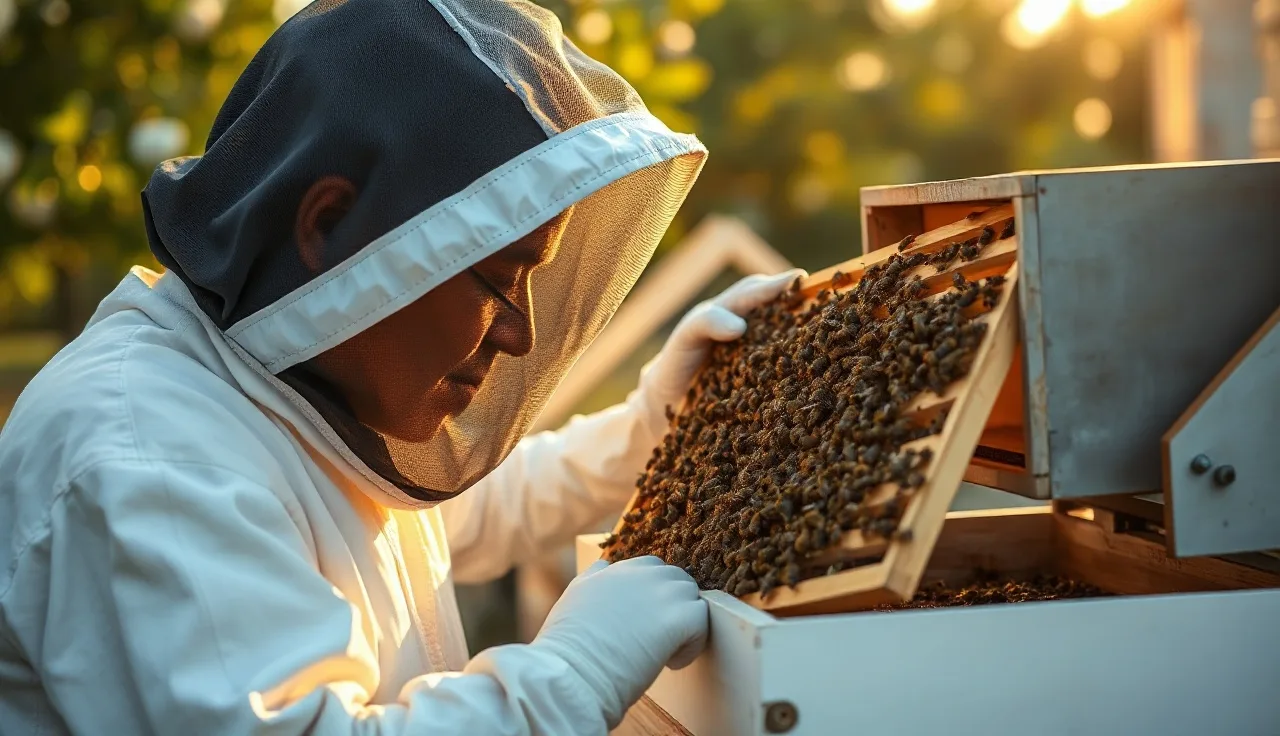
A beekeeper is a person who owns and manages honey bee colonies, usually housed in movable-frame hives, for honey, wax, pollination services, or just the experience of keeping bees. That's the whole definition. What varies wildly is scale and purpose.
The USDA and most state apiary programs split beekeepers into rough tiers: hobbyist (fewer than 25 colonies), sideliner (25 to a few hundred, often selling nucs, queens, or honey as a side income), and commercial (hundreds to tens of thousands of colonies, frequently moving hives across states for pollination contracts like California almonds). The Bee Informed Partnership's annual loss survey tracks all three groups separately because their management realities are so different [1].
Most people asking "what is a beekeeper" are picturing the hobbyist end: one to ten hives in a backyard or a rented plot, done for honey, pollination of a home garden or orchard, or the plain enjoyment of it. That's the reader this article is written for.
A beekeeper is not a passive landlord. Honey bee colonies in North America don't survive long-term without human management anymore, mostly because of the varroa mite (Varroa destructor), an external parasite that arrived in the US in 1987 and now infests the vast majority of managed colonies. Untreated colonies commonly collapse within one to three years. So "beekeeper" today functionally means "varroa manager" whether people love that framing or not.
What do beekeepers do, day to day and season to season?
What beekeepers do changes completely by season. There's no single job description because a colony's needs in April look nothing like its needs in September.
Spring (colony buildup): inspect for a laying queen, check food stores, add space (supers or boxes) as the colony grows, watch for swarm cues like queen cells, and do the season's first mite check once brood is present in volume.
Summer (nectar flow and mite pressure): monitor honey flow, add or pull supers, requeen failing colonies, and treat for varroa if the mite count crosses a threshold. Varroa populations track brood production almost exactly, so summer is often when mite loads peak even though colonies look strongest.
Late summer to fall (the make-or-break window): this is the single most important treatment window most experts point to. The Honey Bee Health Coalition's Varroa Management Guide is explicit that late summer mite treatment protects the "winter bees" (the physiologically distinct bees raised in fall that need to survive months without brood rearing) from viral damage caused by mites [2]. Miss this window and losses show up in January regardless of how strong the colony looked in October.
Winter (monitoring, mostly hands-off): check weight, check for dead-outs on warm days, keep entrances clear of snow and dead bees, and otherwise leave the colony alone. Opening a hive in cold weather does more harm than good.
Across all seasons, a beekeeper also does the unglamorous stuff: cleaning equipment, replacing old comb, feeding sugar syrup or pollen substitute when natural forage is thin, and record-keeping so mite counts and treatment dates aren't just guessed from memory.
What does a beekeeper do about varroa mites specifically?
A beekeeper monitors mite levels using an alcohol wash or sugar roll, compares the count against an action threshold, and treats with an EPA-registered product if that threshold is crossed. This is the single most consequential recurring task in modern beekeeping.
The standard monitoring method, recommended by the Honey Bee Health Coalition and university extension programs alike, is an alcohol wash of about 300 bees (roughly a half-cup scoop from a brood frame) [2][3]. Sugar rolls work too and don't kill the sample bees, but tend to undercount mites compared to alcohol washes, per research summarized by the University of Minnesota Bee Lab [3].
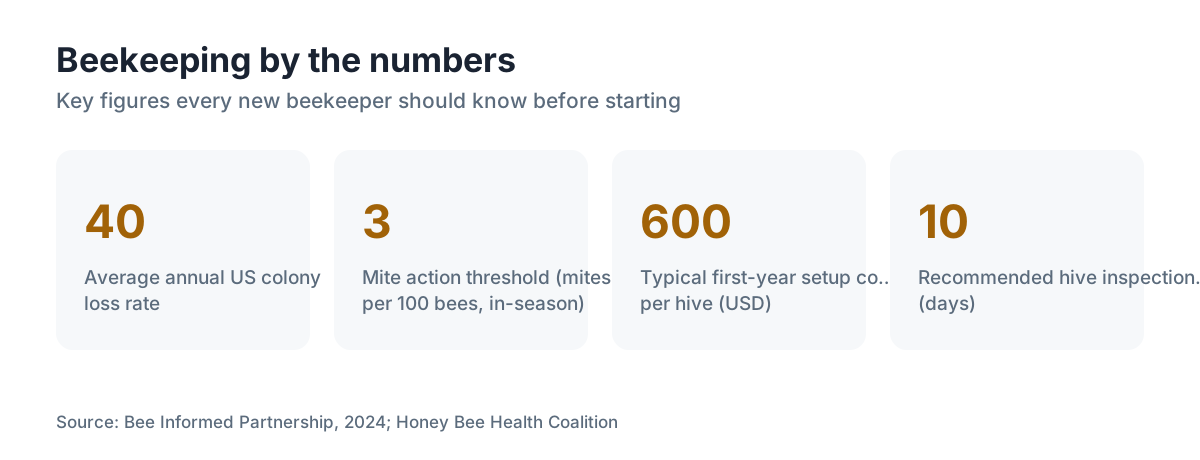
Action thresholds commonly cited: 2 to 3 mites per 100 bees (2 to 3%) during active season is a common trigger point for treatment, while thresholds tighten going into fall because the margin for error shrinks as brood rearing slows [2]. These aren't universal laws, they're guidance ranges, and local conditions (climate, colony strength, treatment history) shift them.
EPA-registered treatment options beekeepers rotate through include formic acid products (Formic Pro, Mite Away Quick Strips), oxalic acid (Api-Bioxal, used as a vaporization or dribble), amitraz-based strips (Apivar), and thymol-based products (Apiguard). Each has a specific label for temperature range, application timing, and honey super restrictions, and the label is a legal document, not a suggestion. The EPA's pesticide product label search lets any beekeeper pull the current label text for exact directions [4].
This is also where record-keeping tools matter. Tracking mite counts, treatment dates, and product rotation across a season is what separates beekeepers who catch problems early from ones who lose colonies to a mite bomb they never saw coming. Free tools like the varroa tools protocol trackers exist specifically so hobbyists don't have to rebuild this system from a notebook every year.
How do you become a beekeeper? (how to be a beekeeper)
Becoming a beekeeper takes four real steps: learn the basics before buying bees, check your local laws, get equipment and bees, then commit to regular hive inspections through your first full year.
Step 1: Learn before you buy. Take a beginner course through a local beekeeping association or university extension (Penn State, Cornell, University of Florida, and Michigan State all run well-regarded beginner programs) [5][6]. Read one solid book. Join a local bee club if one exists, because local mentorship beats any book for region-specific timing.
Step 2: Check zoning and registration rules. Many states legally require registering hives with the state apiary inspector or department of agriculture. Pennsylvania, for example, requires all beekeepers to register their colonies annually with the Department of Agriculture [7]. Cities often have their own hive-number limits and setback rules. Skipping this step is the most common first-year mistake.
Step 3: Get equipment and bees. A basic setup is one or two Langstroth hives (boxes, frames, foundation), a smoker, a hive tool, a veil, and gloves if you want them. Budget roughly $300 to $600 per hive for equipment in the US as of the mid-2020s, plus $150 to $200 for a package or nucleus colony (nuc) of bees, though prices vary by region and supplier [8]. A nuc (an established mini-colony with a laying queen and drawn comb) generally establishes faster and more reliably than a package (loose bees and a caged queen with no comb).
Step 4: Inspect on a schedule and don't skip mite checks. Plan on opening the hive every 1 to 2 weeks in active season. Expect to lose colonies in year one; the national average annual loss rate for US beekeepers has run between roughly 30% and 50% depending on the year, per the Bee Informed Partnership's long-running survey [1]. That's not a personal failure, it's the current baseline for the whole industry, driven mostly by varroa and the viruses it spreads.
For equipment sourcing and comparing suppliers, see honey bee supply companies in the United States, and for starting colonies, honey bee queens for sale and free shipping queen honey bees for sale are worth comparing before you commit to one supplier.
What does a beekeeper do with the honey and equipment?
A beekeeper harvests honey only after the colony has stored more than it needs for winter, extracts it from drawn comb using an extractor or crush-and-strain method, and then maintains equipment (the actual beehive boxes, frames, and hive tools) year-round so it doesn't rot, warp, or harbor disease.
Harvest timing depends entirely on region and nectar flow, but the rule most extensions teach is: leave enough honey for the colony to survive winter before pulling any for yourself. In cold climates that's often 60 to 90+ pounds of stored honey per colony going into fall, though this varies by region and colony size [6]. A beekeeper who harvests too aggressively in a good year can starve their own bees by December.
Beyond harvest, equipment maintenance is a real, recurring job. Wooden ware needs scraping and occasional repainting. Old brood comb should be rotated out every few years because it accumulates pesticide residue and pathogen buildup over time. Frames get rebuilt or replaced. None of this is optional if you want colonies that stay healthy for more than a season or two.
The actual beehive itself, most commonly the Langstroth design with removable frames, was patented in 1852 by L.L. Langstroth and remains the dominant hive style in US beekeeping because it lets a beekeeper inspect, treat, and manipulate comb without destroying it, something older fixed-comb hive designs never allowed.
What is the difference between a beekeeper, an apiarist, and a hobbyist?
"Beekeeper" and "apiarist" mean the same thing; apiarist is just the more formal or old-fashioned term, derived from apiary (a place where bees are kept). There's no functional distinction.
The real distinctions people care about are scale and purpose:
| Type | Typical colony count | Primary goal |
|---|---|---|
| Hobbyist | 1 to 25 | Honey for self/family, pollination, enjoyment |
| Sideliner | 25 to a few hundred | Supplemental income (honey, nucs, queens sold locally) |
| Commercial | Hundreds to 10,000+ | Pollination contracts, wholesale honey, queen/package production |
This tiering comes directly from how the Bee Informed Partnership structures its national loss survey, because management practices, treatment access, and even loss rates differ meaningfully by tier [1]. A commercial beekeeper trucking hives to California for almond pollination (a single almond bloom season requires roughly 2 million colonies nationally, according to USDA data) operates on a completely different risk model than someone with two hives in a backyard [9].
Some people also use "backyard beekeeper" interchangeably with hobbyist. There's no official cutoff, but most state apiary registration forms and insurance products treat anything under roughly 25 to 50 colonies as hobbyist-scale.
What skills or qualities does a beekeeper need?
A beekeeper needs comfort working calmly around stinging insects, basic mechanical aptness for hive assembly and manipulation, a tolerance for record-keeping, and enough discipline to inspect on a schedule even when it's inconvenient. None of this requires physical strength beyond lifting a full honey super, which can weigh 40 to 60 pounds.
The more overlooked skill is observation. A good beekeeper can look at a frame and read it: is the brood pattern solid or spotty (spotty can signal a failing queen or disease), are there enough eggs and larvae relative to capped brood, does the pattern of stores look right for the season. This kind of pattern recognition takes a full season or two to develop and doesn't come from books alone, which is why local mentorship matters so much for new beekeepers.
Risk tolerance for stings matters too, though less than people assume. Most beekeepers get stung occasionally regardless of gear; true bee venom allergy (anaphylaxis) is uncommon but real, and anyone with a known allergy should talk to an allergist and carry an epinephrine auto-injector before working bees, per CDC and allergy society guidance on insect sting allergy [10].
Finally, patience with variance. Two identical hives started the same week from the same supplier can end up wildly different by fall, one thriving, one dead. That's normal in this hobby, not a sign you did something wrong.
What do beekeepers actually spend money on?
Beekeepers spend money in four recurring categories: equipment (boxes, frames, tools), bees (packages, nucs, replacement queens), treatments (mite and disease control products), and feed (sugar syrup, pollen substitute). None of these are one-time costs; all of them recur annually to some degree.
First-year setup for one hive typically runs $300 to $600 in equipment plus $150 to $200 for bees, so call it $450 to $800 total before any honey comes back, and it usually doesn't come back meaningfully in year one [8]. Ongoing annual costs per hive after that drop substantially, often to $50 to $150 a year for treatments, occasional feed, and replacement parts, assuming no colony loss requiring a full restart.
Treatment costs specifically: a round of formic acid strips or oxalic acid treatment for one colony typically runs $10 to $30 depending on product and colony count, applied one to three times a year depending on mite pressure and regional protocol [2][4]. This is cheap insurance against losing a colony that cost $150 to replace and a full season of buildup to recover.
The honest financial reality for hobbyists: very few backyard beekeepers make money on honey once equipment, bee replacement, and treatment costs are counted. Most people who keep bees do it for the experience, the pollination benefit to their garden, or the honey itself as a product worth more to them than its market price. That's a fine reason to keep bees. It's just not usually a profit center at hobbyist scale.
How is a beekeeper different from working with other pollinators, like bumblebees?
A beekeeper managing honey bees is doing something structurally different from someone keeping bumblebees, because honey bee colonies are perennial (the same colony persists year to year if managed well) while bumblebee colonies are annual (the whole colony dies at the end of each season except a new queen).
Honey bees also store large surplus honey stocks specifically because the colony overwinters as a full group of thousands of bees clustered for warmth; bumblebee colonies never get anywhere near that scale, topping out at a few hundred workers, and don't need to store food through winter because they don't survive as a colony through winter at all.
This means bumblebee keeping, often done for tomato and greenhouse pollination, is a completely different management task: no honey harvest, no multi-year mite management strategy, and typically commercially reared queens purchased fresh each season rather than an overwintered colony. If you're weighing which pollinator to start with, bumblebee beekeeping covers that path in more depth, and beekeeping species breaks down the honey bee subspecies (Italian, Carniolan, Russian, and others) that hobbyists actually choose between.
What tools and protocols do beekeepers use to track hive health?
Beekeepers track hive health through a combination of physical inspection records, mite count logs, and treatment calendars, historically kept on paper or spreadsheets and increasingly kept through dedicated apps and tracking tools built for this exact purpose.
At minimum, a useful hive record includes: date of inspection, queen status (seen, eggs present, brood pattern quality), mite wash count and method used, treatment applied and date, and any feeding done. Extension programs like Penn State's beekeeping program and the Honey Bee Health Coalition both publish free inspection log templates for exactly this reason [2][5].
This is one area where free digital tools genuinely save beekeepers from repeating past mistakes. VarroaVault's protocol tools exist to give hobbyist and sideliner beekeepers a structured way to log mite counts against real thresholds, get reminded when a treatment window (like the critical late-summer window) is approaching, and see treatment history per hive rather than guessing from memory. None of this replaces the actual inspection work, but a beekeeper without records is a beekeeper re-learning the same lessons every single year.
For a broader look at how honey bee colonies function biologically (which explains why mite counts and brood timing matter the way they do), and how a beehive is structured and inspected, those foundational pieces make the recordkeeping make more sense.
Frequently asked questions
What is a beekeeper in simple terms?
A beekeeper is someone who manages honey bee colonies, most often in movable-frame hives, for honey, pollination, or just to keep bees alive and healthy. It involves regular inspections, feeding when needed, swarm management, and, in almost all of North America today, active varroa mite monitoring and treatment.
What do beekeepers do on a weekly basis?
During active season (roughly spring through fall), beekeepers inspect hives every 7 to 14 days to check the queen's laying pattern, food stores, space needs, and mite levels. In winter they mostly leave hives alone, checking weight and entrance clearance only on warmer days without opening the boxes.
What does a beekeeper do about swarms?
A beekeeper watches for queen cells and overcrowding signs in spring, then prevents swarming by adding space, splitting strong colonies into two, or removing queen cells. Once a colony swarms, roughly half the bees and the old queen leave permanently, so prevention is far more effective than trying to recapture a swarm afterward.
How much does it cost to become a beekeeper?
First-year setup for one hive typically costs $450 to $800 total, covering equipment ($300 to $600) and bees, either a package or nucleus colony ($150 to $200). Ongoing annual costs after that usually run $50 to $150 per hive for treatments, feed, and replacement parts, though costs vary by region and supplier.
How many hives should a beginner beekeeper start with?
Most extension programs, including Penn State's beginner beekeeping course, recommend starting with two hives rather than one. Two colonies let a new beekeeper compare progress side by side and, critically, let you pull a frame of eggs from a healthy hive to save a queenless one, an option you don't have with just one colony.
What is the difference between a beekeeper and an apiarist?
Nothing functionally. Apiarist is simply a more formal term for beekeeper, derived from apiary, the term for a place where bees are kept. Both describe the same role: someone managing honey bee colonies.
Do beekeepers need a license?
Not typically a license, but many US states require annual hive registration with the state department of agriculture or apiary inspector, and some cities cap how many hives a residential property can hold. Requirements vary significantly by state, so check your state department of agriculture's apiary program before acquiring bees.
What does a beekeeper do about varroa mites?
A beekeeper monitors mite levels regularly using an alcohol wash or sugar roll (sampling roughly 300 bees), compares the count against an action threshold (commonly 2 to 3 mites per 100 bees in season), and applies an EPA-registered treatment like formic acid, oxalic acid, or amitraz strips when the threshold is crossed.
Can a beekeeper make money selling honey?
Some sideliner and commercial beekeepers do, but most hobbyists with a handful of hives don't turn a real profit once equipment, bee replacement, and treatment costs are counted. Honey from a backyard hive is usually valued for personal use and gifting rather than as an income source.
What is the average colony loss rate for beekeepers?
US beekeepers have reported average annual colony loss rates roughly between 30% and 50% in recent years, according to the Bee Informed Partnership's national survey, driven mainly by varroa mites and the viruses they spread. Losses vary by year, region, and management tier (hobbyist, sideliner, commercial).
What is the best time of year to treat for varroa mites?
Late summer to early fall is the treatment window most experts, including the Honey Bee Health Coalition, point to as most consequential, because it protects the long-lived winter bees from viral damage before brood rearing slows down for the season. Missing this window often shows up as colony loss the following January.
How is beekeeping different from bumblebee keeping?
Honey bee colonies are perennial and store large honey surpluses to survive winter as a full colony; bumblebee colonies are annual and die off each year except for a new mated queen. This makes bumblebee keeping a simpler, single-season task with no honey harvest or long-term mite management strategy involved.
Sources
- Honey Bee Health Coalition, Varroa Management Guide: Fall mite treatment protects winter bees; alcohol wash monitoring method and action thresholds
- University of Minnesota Bee Lab, Varroa Mite Sampling: Alcohol wash vs. sugar roll accuracy comparison
- US EPA, Pesticide Product Label System: EPA-registered varroa treatment products and label requirements
- Penn State Extension, Beekeeping: Beginner beekeeping course content and inspection log templates; two-hive recommendation for beginners
- University of Florida IFAS Extension, Bee College: Honey stores needed for winter survival and regional harvest timing guidance
- Pennsylvania Department of Agriculture, Apiary Registration: State requirement to register beehives annually
- USDA National Agricultural Statistics Service, Honey Report: General cost context for honey bee colonies and equipment in the US market
- USDA Agricultural Research Service, Pollination and Almonds: Roughly 2 million colonies needed annually for California almond pollination
- CDC, Insect Sting Allergy: Guidance on bee venom allergy risk and need for epinephrine auto-injector
Last updated 2026-07-09