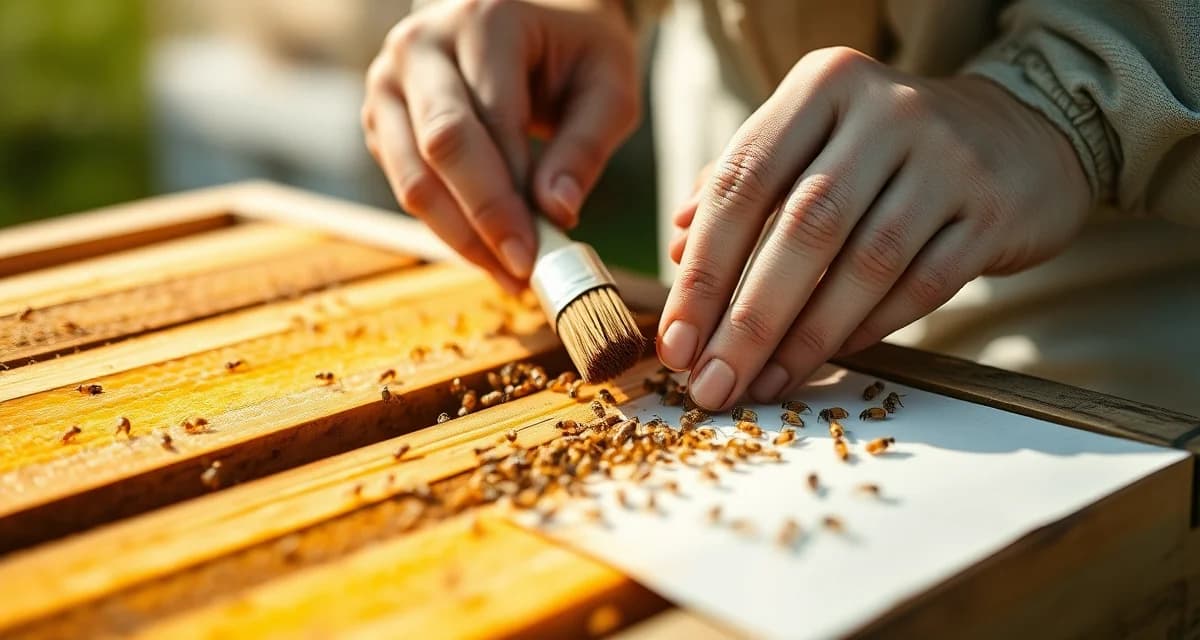
How to Do a Field Varroa Count in Under 5 Minutes
Beekeepers who report that counting takes under 5 minutes test 4x more frequently than those who estimate it takes 20 minutes. The barrier to regular monitoring isn't biology or chemistry; it's perceived time cost. Strip out the unnecessary steps and counting becomes something you do every time you open a hive.
Here's the complete field count process, stripped down to what actually matters.
TL;DR
- This guide covers key aspects of how to do a field varroa count in under 5 minutes
- Mite monitoring should happen at minimum every 3-4 weeks during active season
- The 2% threshold in spring/summer and 1% in fall are standard action points based on HBHC guidelines
- Always run a pre-treatment and post-treatment mite count to calculate efficacy
- Treatment records including product name, EPA number, dates, and counts are required for state inspection compliance
- VarroaVault stores all monitoring and treatment data with automatic threshold comparison and state export formatting
What You Need (Minimal Kit)
- A wide-mouth mason jar or purpose-built mite wash container with a mesh lid (or a lid with mesh stapled in)
- 70% isopropyl alcohol (a small flask or spray bottle)
- A white or light-colored surface to count on (white paper towel or a white plate)
- Your phone with VarroaVault's quick-entry mode
That's it. You don't need a fancy kit. Many experienced beekeepers use a mason jar with a piece of window screen held on with a rubber band. The goal is to wash bees in alcohol and drain the mites onto a surface where you can count them.
Step 1: Collect the Sample (90 seconds)
Open the hive. Find a frame of capped brood with nurse bees clustered on it. This is usually the second or third frame from the center of the brood nest.
You want nurse bees, not foragers. Nurse bees are younger bees that tend to cluster on brood frames. Mites prefer nurse bees (because they're in close proximity to brood where mites reproduce), so a nurse bee sample gives you the highest accuracy.
Shake or scoop about 300 bees into your jar. The easiest method: hold the jar upside down under a brood frame and shake the frame sharply. The bees fall into the jar. Cap it quickly before they can fly out.
How many is 300? About a half cup by volume, roughly 1/2 to 2/3 of a standard mason jar filled with bees. You don't need to count exactly. A sample between 250-350 bees is accurate enough. Counting less than 200 bees increases error margin; more than 400 is unnecessary.
Step 2: Wash (60 seconds)
Add alcohol to the jar. You need enough to submerge all the bees: typically 1/2 to 1 cup in a quart mason jar.
Cap the jar and shake vigorously for 30-60 seconds. The alcohol dislodges the mites from the bees and they wash off into the solution. You're killing the bee sample; that's unavoidable with alcohol wash, but the accuracy is worth it for treatment threshold decisions.
Step 3: Drain and Count (90 seconds)
Hold the jar upside down and pour the alcohol through the mesh lid onto a white paper towel or into a white container. The mites wash through the mesh; the bees stay inside.
The mites appear as small reddish-brown oval specks on the white surface. Count them. This takes under a minute for most counts. When counts are high (20+ mites from 300 bees), take a moment to be systematic: count left to right, mark groups of five.
Record the raw number.
Step 4: Calculate and Log (30 seconds)
Divide your mite count by the number of bees in your sample. Multiply by 100 to get the percentage.
Example: 6 mites from 300 bees = 6/300 x 100 = 2% infestation.
Open VarroaVault and enter the count. Quick-entry mode reduces the form to three fields: hive ID, date, and mite count. Log it immediately while you're at the hive. Don't rely on memory.
That's the complete field count process. From pulling the frame to logging the result: under 5 minutes.
Common Time Wasters to Eliminate
Waiting to find the "perfect" frame. Any frame in the brood area works. Don't spend 3 minutes searching for the ideal nurse bee frame. Shake from the second or third frame in.
Exact bee counting. You don't need exactly 300 bees. A reasonable scoop gives you a workable sample. Adjust the result if you clearly got far fewer (fewer than 200) or far more (above 400).
Waiting to record. Log while you're standing at the hive. Walking back to your truck and logging later introduces errors and sometimes you just don't do it.
Waiting for alcohol to dry. Mites are visible immediately in wet alcohol on a white surface. You don't need to let anything dry.
Accuracy: Is a Quick Count Good Enough?
For threshold decisions, yes. An alcohol wash from 300 nurse bees has 95%+ sensitivity for detecting infestation levels above 1%. At the thresholds you're making decisions around (2% and 3%), the alcohol wash result is reliable.
What matters more than sample size precision is using alcohol wash instead of sugar roll. Sugar roll underestimates counts by 30-40%, which can give you false confidence when you're actually approaching threshold. A quick alcohol wash gives you a better number than a careful sugar roll.
Using VarroaVault's Quick-Entry Mode
VarroaVault's standard count log form has seven fields for complete documentation. Quick-entry mode cuts that to three: hive ID, date, count result. The app auto-calculates the infestation percentage, compares it to your threshold setting, and flags treatment recommendations without you having to do any math.
Tap the quick-entry shortcut from the main dashboard. Select the hive, enter the count, submit. Your count is logged, your trend graph updates, and any threshold alerts fire automatically.
Frequently Asked Questions
What is the fastest way to do a mite count in the field?
Alcohol wash with a minimal kit: mason jar with mesh lid, isopropyl alcohol, white paper towel. Shake 300 bees from a brood frame into the jar, add alcohol, shake for 60 seconds, drain mites onto a white surface, count and divide by 300. Log in VarroaVault immediately. The total time from opening the hive to logged result is under 5 minutes once you've practiced the process a few times.
Can I use a quicker method and still get accurate results?
Alcohol wash is already the quickest method that provides threshold-level accuracy. Sugar roll is slightly faster but undercounts mites by 30-40%, making it unreliable for treatment threshold decisions. Sticky board monitoring is passive (no active counting required) but only detects trends and misses 40-50% of actual infestation levels. For any decision about whether to treat, alcohol wash is the correct method regardless of how quickly you want to work.
Does VarroaVault have a quick-entry mode for field counts?
Yes. Quick-entry mode reduces the standard count form from seven fields to three: hive ID, date, and count number. The app calculates infestation percentage, compares to your threshold setting, and updates your trend graph automatically. Access it from the main dashboard shortcut so you can log from the field in under 30 seconds.
How do I know if my varroa treatment is working?
Run a mite count 2-4 weeks after the treatment ends and compare it to your pre-treatment count. The efficacy formula is: ((pre-count - post-count) / pre-count) x 100. A result above 90% indicates effective treatment. Results below 80% should trigger investigation for possible resistance, application error, or reinfestation. Log both counts in VarroaVault to track efficacy trends across treatment cycles.
How often should I check mite levels in my hives?
At minimum, once per month (every 3-4 weeks) during the active season. Increase to every 2 weeks when counts are near threshold or after a treatment to verify it worked. In fall, monitoring frequency matters most because the window to treat before winter bees are raised is narrow. VarroaVault's monitoring reminders can be set to your preferred interval for each apiary.
What records should I keep for varroa management?
Each record should include: date of count or treatment, hive identifier, monitoring method used, number of bees sampled, mites counted, infestation percentage, treatment product name and EPA registration number, dose applied, treatment start and end dates, and PHI end date. State apiarists typically expect this level of detail during inspections. VarroaVault captures all of these fields in a single log entry.
What is How to Do a Field Varroa Count in Under 5 Minutes?
A field varroa count is a quick method for measuring the mite load in a honey bee colony using an alcohol wash. By collecting roughly 300 bees from the brood nest, washing them in isopropyl alcohol, and counting the dislodged mites, beekeepers get an accurate mite-per-100-bees percentage in under 5 minutes. Regular counts help beekeepers decide when treatment is needed before mite levels become colony-threatening.
How much does How to Do a Field Varroa Count in Under 5 Minutes cost?
The field varroa count itself costs almost nothing — a mason jar, mesh lid, and a small amount of 70% isopropyl alcohol are all you need. The only real cost is the ~300 bees sacrificed per sample, which is negligible relative to a healthy colony population. Tools like VarroaVault can store and track your count data automatically, removing the recordkeeping burden at no additional equipment cost.
How does How to Do a Field Varroa Count in Under 5 Minutes work?
Collect roughly 300 bees from a brood frame using a scoop or jar, cover them with 70% isopropyl alcohol, shake vigorously for 60 seconds, then pour the wash through a mesh lid onto a white surface and count the mites. Divide mite count by bee count and multiply by 100 for your mite percentage. The entire process takes under 5 minutes once you've done it a couple of times.
What are the benefits of How to Do a Field Varroa Count in Under 5 Minutes?
Regular varroa counts let you act before mite levels reach colony-damaging thresholds — 2% in spring/summer and 1% in fall per HBHC guidelines. Beekeepers who monitor frequently catch infestations earlier, treat more precisely, and avoid unnecessary chemical applications. Running pre- and post-treatment counts also confirms whether a treatment actually worked, protecting both colony health and your investment in treatments.
Who needs How to Do a Field Varroa Count in Under 5 Minutes?
Any beekeeper managing colonies during active season should be doing field varroa counts every 3–4 weeks at minimum. This is especially critical for beekeepers in regions with high varroa pressure, those preparing colonies for winter, and anyone running treatment programs who needs to verify efficacy. Hobbyists, sideliners, and commercial operations alike benefit — mite loads don't self-resolve, and regular counting is the only reliable early-warning system.
Related Articles
- Mite Count Expectations by Treatment Type: What Success Looks Like
- How to Count Varroa Mites in a Nucleus Colony: Adapting the Standard Method
Sources
- American Beekeeping Federation (ABF)
- USDA ARS Bee Research Laboratory
- Honey Bee Health Coalition
- Penn State Extension Apiculture Program
- Project Apis m.
Get Started with VarroaVault
The information in this guide is most useful when you have your own mite count data to apply it to. VarroaVault stores every count, flags threshold crossings automatically, and builds the treatment history you need for state inspections and effective management decisions. See pricing and free tools at varroavault.com.