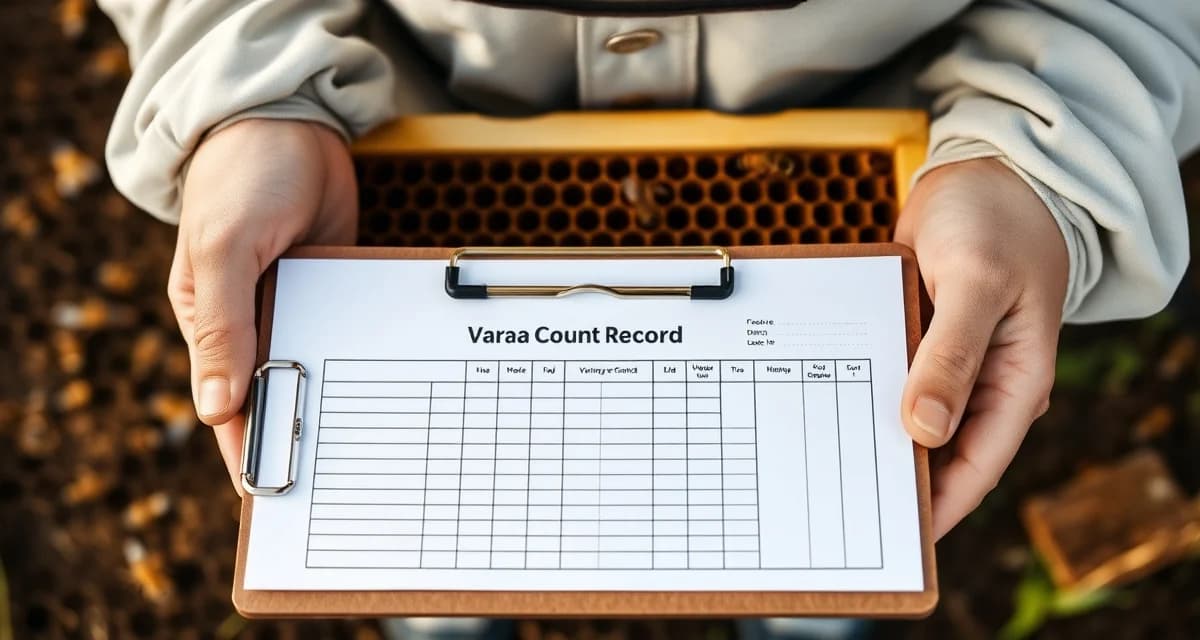
Varroa Mite Count Record Template: Free Download
Beekeepers who use a standardized count form are 60% more likely to detect treatment failures than those using freeform notes. That's because a structured form captures the same fields every time: date, method, bee count, mite count, percentage, and threshold comparison. Freeform notes get you "checked for mites in June, looked okay," which tells you nothing useful six months later.
This free varroa mite count record template is designed to give you a consistent, auditable record for every count you do. Download it as a PDF for paper use or as an Excel file for digital entry.
TL;DR
- A valid mite count sample requires approximately 300 bees from the brood nest for statistically reliable results
- alcohol wash is 15-20% more accurate than sugar roll for detecting mite infestation levels
- The calculation is: (mites counted / bees in sample) x 100 = infestation percentage
- A 2% threshold triggers treatment in spring/summer; 1% is the fall action threshold
- Count at least once per month during active season; increase to every 2 weeks if levels are near threshold
- Log every count in VarroaVault to build a trend dataset that shows whether populations are rising or stable
What the Template Includes
The VarroaVault mite count record template covers every field you need for a defensible count record:
Date and Time: Specific date and time of the count, not just "June."
Apiary and Hive Identifier: Which apiary, which specific hive. Essential if you're managing multiple locations.
Monitoring Method: Alcohol wash, sugar roll, or sticky board. Method matters because accuracy varies across these options. Your treatment decisions should be based on alcohol wash data, not sugar roll estimates.
Bees Sampled: How many bees were in your sample. The standard is approximately 300 bees (roughly half a cup). Samples under 300 increase count variability and make threshold decisions less reliable.
Mites Found: Raw mite count from your wash or roll.
Infestation Percentage: (Mites / Bees) x 100. The template includes this calculation automatically in the Excel version.
Seasonal Threshold: The current threshold for the time of year you're counting (2% summer, 1% late summer/fall before winter bee raising). A checkbox indicates whether you're above or below threshold.
Treatment Decision: What you decided to do based on this count, and when you plan to do it.
Notes: Observations about colony strength, queen status, brood pattern, or anything relevant to interpreting this count.
How to Use the Paper Template
Print one template per count event per hive. Keep printed templates in a binder by apiary or by year. File them by hive name and date so you can pull a specific hive's history quickly.
When your state apiary inspector visits, having a binder of completed count forms demonstrates active monitoring. Most inspectors are impressed by organized paper records, even in an era of digital tracking.
The limitation of paper is that it doesn't do math for you, can't alert you when you're overdue for a count, and doesn't visualize trends across multiple counts or multiple hives. For those functions, an app is the obvious upgrade.
Using the Excel Template
The Excel version calculates infestation percentage automatically from your bee count and mite count entries. It also highlights the threshold cell in red when you're above the seasonal threshold. Download, save a copy per year, and maintain one tab per hive or add a new row per count on a single hive tab.
Export to PDF for inspection or insurance documentation. Filter by hive or date for trend analysis.
Upgrading to VarroaVault
The template gets you recording. VarroaVault gets you acting on what you record. The difference:
- Automated threshold alerts: You enter a count; VarroaVault tells you whether you need to act.
- Treatment reminders: The app tracks when treatments are due based on your count history and season.
- PHI tracking: Log a treatment and the app calculates your honey harvest clearance date.
- Trend graphs: See whether your colony's mite load is rising, falling, or stable across multiple counts.
- State compliance exports: Generate inspection-ready records for your state in one click.
The template is a paper tool. VarroaVault is a management system. You can use both: the template in the field when you don't have signal, then transfer data to the mite count tracking app when you're back at the truck or home.
Beekeepers who use a standardized count form are more likely to detect treatment failures, and beekeepers who log those counts digitally with threshold alerts are more likely to act on them in time.
For a full walkthrough of how to do a count, see our guide on how to do a mite wash.
Frequently Asked Questions
What should a varroa count record include?
Date, apiary and hive identifier, monitoring method used, number of bees sampled, number of mites found, calculated infestation percentage, seasonal threshold for comparison, your treatment decision, and any relevant notes about colony condition. This information creates a defensible, auditable record that's useful for your own management and for state inspection or insurance purposes.
Can I use a paper template alongside VarroaVault?
Absolutely. Many beekeepers use paper templates in the field, especially in locations without reliable cell service, and then enter the data into VarroaVault when they return to a connected location. The app accepts manual count entries for any date, so you can log a count from the field hours later without losing the timestamp accuracy of your actual count date.
How is the VarroaVault app better than using this template?
The app automatically compares your count to seasonal thresholds and tells you whether to act. It sends reminders when counts are overdue. It calculates PHI clearance after treatments. It shows count trend graphs across your full history. It generates state-compliant inspection exports. And it stores your records indefinitely without paper. The template gives you a structured starting point; VarroaVault gives you a full management system built around those records.
How soon after treatment can I run a post-treatment mite count?
Wait 2-4 weeks after the treatment ends before running a post-treatment count. Counting too soon (within a week of treatment removal) may show mites still dying or emerging from the last brood cycle. Waiting 2-4 weeks allows emerging bees from brood that was capped during treatment to fully emerge and any surviving mites to become detectable in a new count.
What should I do if my mite count results seem unusually high or low?
If results seem surprising, repeat the count within 1-2 weeks before making a treatment decision based on a single outlier result. Confirm you sampled from the brood nest center (not outer frames), used the correct sample size (approximately 300 bees), and shook vigorously for the full 60 seconds. Consistent sampling technique is the most important factor in count accuracy.
Can I count mites from a sticky board instead of doing an alcohol wash?
Sticky board counts measure mite fall rate over 24-72 hours, which correlates with infestation level but is not a direct measure of infestation percentage. Sticky board results cannot be converted to an accurate percentage without calibration, and they are less reliable than alcohol wash for treatment decisions. Use sticky boards for general population monitoring but rely on alcohol wash counts for threshold decisions.
What is Varroa Mite Count Record Template: Free Download?
The Varroa Mite Count Record Template is a free, structured form designed to help beekeepers consistently track varroa mite infestation levels across their hives. It captures key data points every time you sample: date, sampling method, bee count, mite count, infestation percentage, and threshold comparison. Available as a downloadable PDF for paper use or an Excel file for digital entry, it creates an auditable record that reveals trends over time rather than vague one-off notes.
How much does Varroa Mite Count Record Template: Free Download cost?
The Varroa Mite Count Record Template is completely free to download. It comes in two formats—PDF for printed paper use and Excel for digital record-keeping—at no cost. Beekeepers can use it immediately without any subscription or payment. For those who want to go further, logging counts in VarroaVault builds a trend dataset over time, helping you spot whether mite populations are rising, stable, or responding to treatment.
How does Varroa Mite Count Record Template: Free Download work?
The template works by prompting you to record the same standardized fields every time you sample: date, method used (alcohol wash or sugar roll), number of bees in the sample, mites counted, and the resulting infestation percentage. You calculate the percentage using the formula: (mites / bees) x 100. You then compare that figure against action thresholds—2% in spring/summer, 1% in fall—to decide whether treatment is needed. Consistent logging turns individual counts into a meaningful trend record.
What are the benefits of Varroa Mite Count Record Template: Free Download?
Using a structured template makes you 60% more likely to catch treatment failures compared to freeform notes. It standardizes your data so counts are comparable across months and years, flags when you're approaching action thresholds, and creates an auditable history you can review before making treatment decisions. Having the same fields captured every time eliminates the vague 'looked okay in June' problem and gives you concrete evidence of whether a treatment worked or mite populations are rebounding.
Who needs Varroa Mite Count Record Template: Free Download?
Any beekeeper who monitors varroa mite levels—from hobbyists managing one hive to commercial operators running hundreds—benefits from a standardized count record. It's especially valuable for beekeepers who have experienced unexpected colony losses, those using integrated pest management strategies, and anyone who wants to move beyond guesswork. New beekeepers benefit from the built-in structure that teaches them what data matters, while experienced beekeepers gain a consistent audit trail across seasons and hive splits.
Sources
- American Beekeeping Federation (ABF)
- USDA ARS Bee Research Laboratory
- Honey Bee Health Coalition
- Penn State Extension Apiculture Program
- Project Apis m.
Get Started with VarroaVault
An alcohol wash gives you the number. VarroaVault turns that number into a decision. Log your count, get an instant threshold comparison, and build a monitoring history that shows you whether mite levels are rising or stable across your entire operation. See pricing and free tools at varroavault.com.