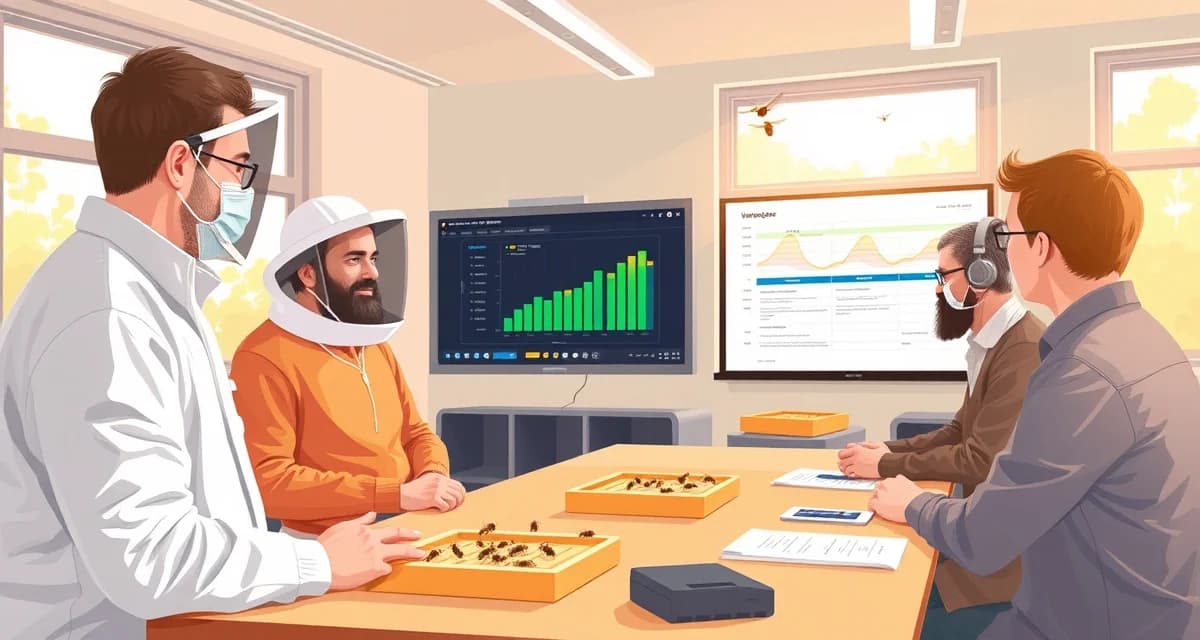
Teaching Varroa Mite Management in Bee School: A Curriculum Guide
Bee school graduates who learn varroa management with a digital tracking tool retain 60% more protocol information at 6 months than those who learn purely conceptually. That retention gap reflects a well-established principle in adult education: information connected to practice persists better than information presented in the abstract.
For bee school instructors, this creates both an opportunity and a practical question: how do you incorporate hands-on varroa monitoring practice into a curriculum that's already packed with content? This guide answers that question with a session-by-session curriculum framework built around VarroaVault's educational resources.
TL;DR
- This guide covers key aspects of teaching varroa mite management in bee school: a curriculum
- Mite monitoring should happen at minimum every 3-4 weeks during active season
- The 2% threshold in spring/summer and 1% in fall are standard action points based on HBHC guidelines
- Always run a pre-treatment and post-treatment mite count to calculate efficacy
- Treatment records including product name, EPA number, dates, and counts are required for state inspection compliance
- VarroaVault stores all monitoring and treatment data with automatic threshold comparison and state export formatting
What Bee School Students Need to Learn About Varroa
Before building the curriculum, it's worth being specific about outcomes. What does a bee school graduate need to actually know and be able to do regarding varroa by the end of the program?
Knowledge outcomes:
- What varroa is and how it damages colonies
- The 21-day worker brood cycle and why it matters for treatment timing
- Standard treatment thresholds and how they change by season
- Which treatments are registered, how they work, and their limitations
- What PHI means and why it matters for honey production
Skill outcomes:
- Perform an alcohol wash correctly with the right sample size
- Calculate mite infestation percentage from a count
- Interpret a count result in the context of the current season
- Record a complete treatment log entry with all required fields
- Set up a monitoring calendar for the first season
Practice outcomes:
- Logged at least one practice count in a digital system before their first real apiary visit
- Set up a VarroaVault (or similar) account with a hive record ready for their first count
- Built a first-season monitoring calendar with reminder dates
Session-by-Session Curriculum Framework
Session 1: What Varroa Is (30 minutes within a broader biology session)
Objectives: Students can explain what varroa is, how it reproduces, and why it kills colonies.
Content: Cover the varroa lifecycle with particular emphasis on the brood cell reproductive stage. Use the deformed wing virus connection to explain why mites aren't just a population burden -- they're disease vectors. The first-year beekeeper varroa guide provides instructor-level content for this section.
VarroaVault resource: Projected display of the mite count trend graph showing a colony population rising from 0.5% to 5% over a season without treatment. Visual context for what "population growth" looks like in practice is more memorable than a description.
Discussion prompt: "What would you do differently if varroa didn't exist?" (Sets up the later discussion of why management is necessary.)
Session 2: How to Monitor (45 minutes, hands-on preferred)
Objectives: Students can perform an alcohol wash and calculate a mite percentage.
Content: Equipment needed, 300-bee sample standard, collection from the brood nest, alcohol wash procedure, counting method, percentage calculation.
Hands-on exercise: If bees are available (warm classroom conditions), practice collection with a practice jar. If not available, use a demonstration video and practice the percentage calculation math with sample data.
VarroaVault resource: The classroom demo account includes sample count data that students can enter to practice logging. Each student enters a "practice count" and sees how it appears in the trend graph. This connects the physical counting skill to the digital recording habit.
Key point to emphasize: Alcohol wash is the standard. sugar roll underestimates by 20-40%. This matters when the decision is whether to treat.
Session 3: Understanding Thresholds (30 minutes)
Objectives: Students can interpret a count result in the context of the current season and explain why thresholds are seasonal, not fixed.
Content: The 2% in-season threshold, the 1% pre-winter threshold, why August is different from April. Present the concept of exponential population growth: a 1% count in May reaches 3-5% by August without intervention in 60% of cases.
VarroaVault resource: Show the risk context screen from the demo account. Enter the same percentage (2%) for April versus August and show students how VarroaVault's interpretation changes. The visual contrast between "borderline, monitor and recount" in April and "treat immediately" in August makes the seasonal concept concrete.
Session 4: Treatments and PHI (45 minutes)
Objectives: Students can name at least 4 registered treatment products, explain the difference between organic and synthetic options, and calculate a PHI for a specific product.
Content: The 9 EPA-registered products with their active ingredients, application methods, temperature requirements, and PHI. The concept of treatment rotation to prevent resistance. The relationship between honey super presence and treatment eligibility.
VarroaVault resource: The classroom demo account's treatment planner. Students select a hive condition (brood present, supers on, temperature 78°F) and see which products the planner surface as eligible. This makes the "it depends" nature of treatment selection tangible.
PHI exercise: Give students a treatment date and a honey harvest target date. Have them calculate whether the PHI is cleared and which products they could use. VarroaVault's PHI calculator shows the math automatically.
Session 5: Building Your First-Season Calendar (30 minutes)
Objectives: Students have a monitoring calendar for their first season with specific reminder dates.
Content: Walk through setting up a VarroaVault account with their hive records. Set the installation date, hive count, and location. Generate the first-season monitoring calendar. Export it to phone calendar.
Hands-on: Each student (or student pair) sets up a trial VarroaVault account during class. By the end of the session, they have a hive record and monitoring calendar set up for their actual colonies. This is the activity with the highest retention value -- they're doing the real thing, not practicing.
Free Educator Resources from VarroaVault
The bee school curriculum pack includes:
- A VarroaVault classroom demo account with realistic sample data
- Lesson plan outlines for each session
- Student handouts covering the key content areas
- Practice count exercises with worked examples
- A "your first season" planning worksheet
Instructors can request these resources through VarroaVault's beekeeping software for educators page. The demo account and curriculum materials are free for certified instructors at nonprofit bee schools.
Frequently Asked Questions
How do I incorporate VarroaVault into a bee school curriculum?
The most effective approach is to use VarroaVault as the platform where students practice logging counts and interpreting results, rather than just teaching the concepts. Use the classroom demo account (free for instructors) to project real count trend graphs and treatment planning screens during relevant sessions. Dedicate the final session to helping each student set up their own account with their actual hive records and first-season monitoring calendar. The practice of real logging during class is what drives the 6-month retention advantage.
Is there a free bee school demo account for instructors?
Yes. VarroaVault provides a free classroom demo account to certified bee school instructors at nonprofit beekeeping education programs. The demo account includes realistic sample data (count trends, treatment history, winter outcome records) so students see what a populated, multi-season account looks like before they've completed a full season themselves. Instructor access also includes the curriculum materials, lesson plan outlines, and student handout templates. Request access through the educator partnership page.
What educational resources does VarroaVault provide for bee schools?
VarroaVault's bee school curriculum pack includes a classroom demo account with sample data, session-by-session lesson plan outlines for a 5-session varroa module, student handout templates covering monitoring methods and threshold interpretation, practice count exercises, a PHI calculation worksheet, and a first-season planning template. All materials are free for certified instructors at nonprofit bee schools. Commercial bee school programs can apply for a discounted educator license that includes the same materials with multi-instructor access.
How do I know if my varroa treatment is working?
Run a mite count 2-4 weeks after the treatment ends and compare it to your pre-treatment count. The efficacy formula is: ((pre-count - post-count) / pre-count) x 100. A result above 90% indicates effective treatment. Results below 80% should trigger investigation for possible resistance, application error, or reinfestation. Log both counts in VarroaVault to track efficacy trends across treatment cycles.
How often should I check mite levels in my hives?
At minimum, once per month (every 3-4 weeks) during the active season. Increase to every 2 weeks when counts are near threshold or after a treatment to verify it worked. In fall, monitoring frequency matters most because the window to treat before winter bees are raised is narrow. VarroaVault's monitoring reminders can be set to your preferred interval for each apiary.
What records should I keep for varroa management?
Each record should include: date of count or treatment, hive identifier, monitoring method used, number of bees sampled, mites counted, infestation percentage, treatment product name and EPA registration number, dose applied, treatment start and end dates, and PHI end date. State apiarists typically expect this level of detail during inspections. VarroaVault captures all of these fields in a single log entry.
What is Teaching Varroa Mite Management in Bee School: A Curriculum Guide?
This is a session-by-session curriculum framework designed to help bee school instructors teach varroa mite management effectively. It integrates hands-on monitoring practice with digital tracking tools, based on the principle that adult learners retain information better when connected to real practice. The guide covers mite monitoring schedules, treatment thresholds per HBHC guidelines, record-keeping for state compliance, and how to use VarroaVault's educational resources to reinforce protocols throughout a packed bee school curriculum.
How much does Teaching Varroa Mite Management in Bee School: A Curriculum Guide cost?
The curriculum guide itself is a free educational resource available on VarroaVault. VarroaVault's digital tracking platform, which the curriculum is built around, offers tiered pricing for beekeepers and bee school programs. There is no cost to access the instructional framework or reference materials. Schools and instructors looking to adopt VarroaVault as a classroom tool should visit the platform directly for current plan details and any available educational or group pricing.
How does Teaching Varroa Mite Management in Bee School: A Curriculum Guide work?
The guide structures bee school sessions around active varroa monitoring practice rather than purely conceptual instruction. Students learn to conduct mite counts every 3-4 weeks during active season, compare results against the 2% spring/summer and 1% fall action thresholds, and record treatments with required details like EPA registration numbers and dates. VarroaVault logs all data automatically, enables pre- and post-treatment efficacy calculations, and generates state-compliant inspection exports — turning classroom learning into a repeatable, trackable workflow.
What are the benefits of Teaching Varroa Mite Management in Bee School: A Curriculum Guide?
Students who learn varroa management with a digital tracking tool retain 60% more protocol information at six months compared to conceptual-only instruction. The guide gives instructors a ready-made, evidence-based framework that fits into existing bee school schedules. Beekeepers graduate with practical monitoring habits, accurate treatment records for state inspections, and familiarity with a tool that supports long-term colony health — reducing first-year colony losses driven by undetected or mismanaged varroa infestations.
Who needs Teaching Varroa Mite Management in Bee School: A Curriculum Guide?
This guide is primarily for bee school instructors and program coordinators who want a structured, practical approach to varroa education. It is equally relevant for new beekeepers enrolled in bee school who want to build strong mite management habits from the start, and for experienced beekeepers mentoring others. Anyone involved in designing apiculture curricula — whether through local bee clubs, extension programs, or state associations — will find the session framework and VarroaVault integration directly applicable.
Sources
- American Beekeeping Federation (ABF)
- USDA ARS Bee Research Laboratory
- Honey Bee Health Coalition
- Penn State Extension Apiculture Program
- Project Apis m.
Get Started with VarroaVault
The information in this guide is most useful when you have your own mite count data to apply it to. VarroaVault stores every count, flags threshold crossings automatically, and builds the treatment history you need for state inspections and effective management decisions. See pricing and free tools at varroavault.com.