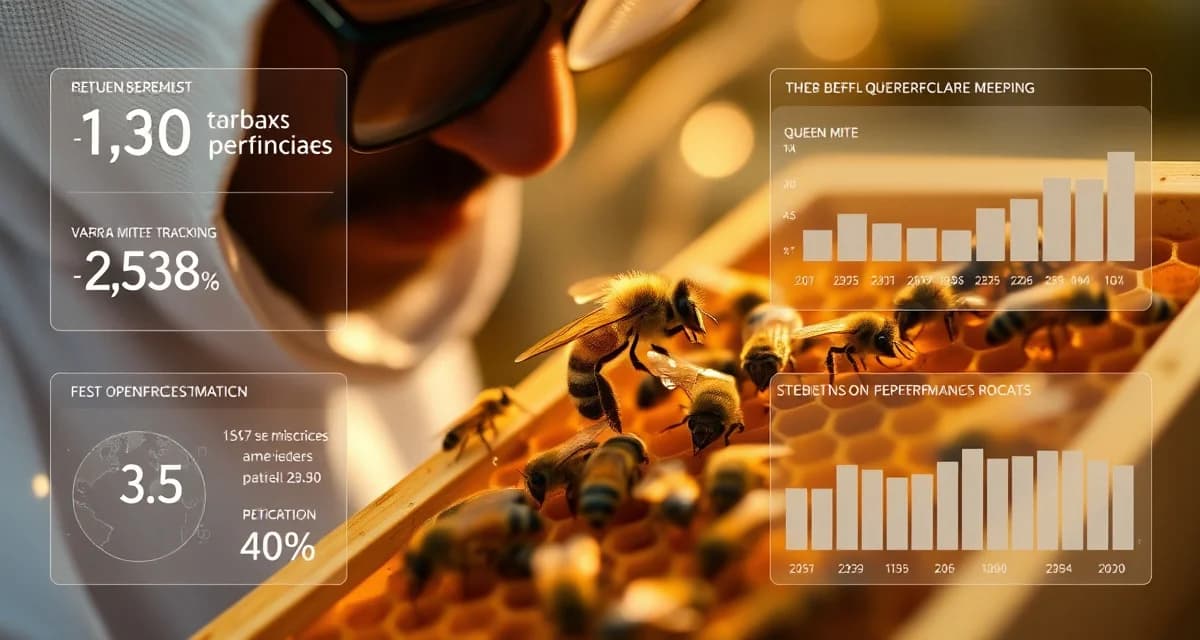
VarroaVault for Queen Breeders: Track Mite Outcomes by Queen Line
Queen breeders who use mite outcome data for line selection report 40% improvement in low-mite colony performance within 5 years. That's the difference between hoping your breeding program improves varroa resistance and actually measuring it.
VarroaVault was built for beekeepers who manage mite pressure in their production colonies. For queen breeders, it does that too, but it adds a layer of data the standard beekeeping software doesn't offer: the ability to link every mite count to the queen that was in the colony when it was taken, and compare outcomes across your lines.
TL;DR
- High varroa loads directly damage queen quality by infesting the queen cell during development
- Mite-damaged queens show reduced sperm viability, shorter productive lifespans, and higher supersedure rates
- Colonies with persistent mite loads above 3% show significantly higher queen failure rates than well-managed colonies
- Track queen events (introduction, supersedure, loss) alongside mite count data to identify correlations
- Spring queen problems that seem random often trace back to fall varroa pressure on the previous queen cohort
- VarroaVault links queen event records to mite count history for each colony
Why Queen Breeders Need Varroa Data More Than Anyone Else
If you're breeding for low-mite traits, including VSH behavior, hygienic response, or general mite tolerance, your selection decisions are only as good as your data. Selecting queens based on visual inspection or neighbor reports doesn't give you the statistical foundation to confidently claim you're making progress.
What you need:
- Mite counts from colonies headed by each queen line, taken at consistent points in the season
- Post-introduction count trends showing how mite populations develop under each daughter queen
- Multi-season data to see whether low-mite performance is heritable and consistent across daughters
- Comparison data showing which lines produce the most reliably low-mite colonies across different apiaries and conditions
VarroaVault's queen line mite performance report ranks your lines by average post-introduction mite count trend. After one season, you can see which lines are performing and which aren't. After three seasons, you have selection data worth trusting.
Setting Up Queen Line Tracking in VarroaVault
Step 1: Create a tag for each queen line.
In VarroaVault, go to Settings > Queen Line Tags. Create a tag for each line you're tracking. You might use the breeder's name, the year of introduction, or your own internal line code (e.g., "VSH-2023-A" or "Carniolan-Low-Mite-2").
Step 2: Record queen introductions with line tags.
When you introduce a queen into a colony, log the introduction in VarroaVault's queen event log with the date, queen ID or line tag, and any relevant notes (grafted from which colony, mated at which nuc yard, etc.).
Step 3: Log mite counts on schedule.
Count mites on a regular schedule: once in spring (May), once in early summer (June/July), once in August (critical pre-winter window), and once in fall (October). Log every count in VarroaVault with the hive ID and date.
Step 4: Run the queen line performance report.
In VarroaVault's reports section, select "Queen Line Performance." The report shows average mite count by season point for each tagged line, along with the count trend over time post-introduction.
Interpreting Queen Line Performance Data
What you're looking for in the data:
Low and stable counts: The best lines show consistently low mite counts across multiple measurement points and multiple colonies. A line that shows 0.5-1% counts in June, 0.8-1.2% in August, and 0.5-0.8% in October is performing well without any treatment in that window.
Slow mite population growth: Even lines that start at a moderate count (1-1.5% in May) can be high performers if mite populations grow slowly. Compare the slope of the trend, not just the absolute numbers.
Consistency across colonies: If one colony from a line shows exceptional low-mite performance but others in the same line are average, you have an outlier, not a trait. Look for lines where most daughters show similar performance.
Treatment response: Compare efficacy outcomes after treatment across lines. Some lines may respond better to OA, which could indicate differences in hygienic behavior or mite-seeking behavior.
Tracking Multiple Queen Lines Across Apiaries
If you're distributing queens from multiple lines across several apiaries, VarroaVault handles this by linking the queen line tag to each colony regardless of which apiary it's in. Your performance report aggregates data across all locations for each line.
This is important because apiary conditions (forage, reinfestation pressure, microclimate) affect mite counts. A line that looks weak in an apiary near high-mite neighbors might look much better in an isolated test yard. Having count data across multiple locations lets you separate genetic performance from environmental noise.
Connecting Queen Introduction Records to Mite Outcomes
The specific features in VarroaVault that support queen breeding programs:
Queen event log: Records introduction date, queen source, queen ID, and line tag for every hive. Supersedure and replacement events are also logged, so you can see whether high-mite colonies are also showing more queen problems.
Post-introduction count tracking: VarroaVault can optionally prompt you for a mite count at 30, 60, and 90 days post-introduction. This standardized count schedule generates comparable data across all your introduced queens.
Line performance report: Aggregates count history by queen line tag, showing average infestation rate at each seasonal checkpoint, trend slope, and treatment frequency for colonies in each line.
Mating nuc tracking: If you use mating nucs, you can track mite levels in those nucs separately from production colonies. High mite loads in mating nucs damage queen development; tracking this helps identify whether mating nuc management is affecting queen quality independently of genetics.
Using Treatment Data for Breeding Decisions
An underused data point in breeding programs is treatment frequency. A line that consistently requires three treatments per year to stay below threshold is fundamentally different from a line that stays below threshold with one treatment per year.
VarroaVault's line performance report shows not just count levels but the number of treatment events logged per colony. Over three seasons, lines with lower treatment frequency and lower peak counts are the ones worth selecting from.
Sharing Data With Customers
If you sell queens, documenting the mite management performance of your production colonies adds value to your queens and differentiates you from breeders who can only claim varroa resistance without data to back it up.
VarroaVault allows you to export a queen line summary in a format suitable for sharing with customers. This shows the average mite performance data for colonies headed by that line without exposing your full operational records.
Building a Multi-Year Selection Program
Year 1: Establish baselines. Log every colony's queen line tag and all mite counts through the season. By the end of Year 1, you have comparative data across your current lines.
Year 2: Make initial selection decisions. Keep and expand the lines showing the best performance. Evaluate underperforming lines for replacement. Begin graft selection from top-performing mothers.
Year 3: Validate selection gains. Are daughter colonies from your selected mothers performing better than the original line baseline? Consistent improvement across multiple daughters over multiple seasons is the confirmation that your selection is working.
Year 5 and beyond: If your program is working, you should be seeing measurable improvement. The 40% improvement in low-mite colony performance that data-driven breeders report after 5 years reflects consistent selection pressure on a heritable trait.
What VarroaVault Can't Do for Your Breeding Program
VarroaVault tracks count and treatment data. It doesn't run VSH assays or measure specific behavioral traits. If you want to formally characterize VSH frequency or hygienic behavior in your colonies, those tests require specific protocols and equipment beyond what a mite count can tell you.
What the data does is give you the field-level selection signal. Colonies that consistently show low counts without excessive treatment are demonstrating mite-resistant behavior of some kind, whether VSH, grooming, or other mechanisms. That's the starting point for genetic selection.
Frequently Asked Questions
How does VarroaVault help queen breeders select for low mite loads?
VarroaVault links every mite count to the queen line tag of the colony's current queen. After logging counts throughout the season, the queen line performance report shows average mite count trends by line, allowing you to compare which lines produce consistently lower mite levels. This data-driven approach lets you make selection decisions based on actual field performance rather than anecdote.
Can I track multiple queen lines in one VarroaVault account?
Yes. You can create an unlimited number of queen line tags and apply them to individual colonies. Your performance report aggregates data by tag across all colonies and apiaries, so you can compare 10 lines in one view regardless of how many hives or locations are involved.
What reports does VarroaVault generate for queen breeders?
VarroaVault generates a queen line mite performance report that ranks your lines by average post-introduction mite count trend, treatment frequency per line, and consistency across colonies. You can export this report for internal selection decisions or to share summarized performance data with customers.
How do I know if my varroa treatment is working?
Run a mite count 2-4 weeks after the treatment ends and compare it to your pre-treatment count. The efficacy formula is: ((pre-count - post-count) / pre-count) x 100. A result above 90% indicates effective treatment. Results below 80% should trigger investigation for possible resistance, application error, or reinfestation. Log both counts in VarroaVault to track efficacy trends across treatment cycles.
How often should I check mite levels in my hives?
At minimum, once per month (every 3-4 weeks) during the active season. Increase to every 2 weeks when counts are near threshold or after a treatment to verify it worked. In fall, monitoring frequency matters most because the window to treat before winter bees are raised is narrow. VarroaVault's monitoring reminders can be set to your preferred interval for each apiary.
What records should I keep for varroa management?
Each record should include: date of count or treatment, hive identifier, monitoring method used, number of bees sampled, mites counted, infestation percentage, treatment product name and EPA registration number, dose applied, treatment start and end dates, and PHI end date. State apiarists typically expect this level of detail during inspections. VarroaVault captures all of these fields in a single log entry.
What is VarroaVault for Queen Breeders: Track Mite Outcomes by Queen Line?
VarroaVault for Queen Breeders is a specialized beekeeping tool that links varroa mite count data directly to individual queen lines, allowing breeders to measure which genetic lines produce colonies with better mite resistance. Unlike standard beekeeping software, it records queen events—introductions, supersedures, and losses—alongside mite monitoring data. This creates a structured dataset that reveals whether your breeding program is genuinely improving varroa resistance over time, rather than relying on anecdotal observation.
How much does VarroaVault for Queen Breeders: Track Mite Outcomes by Queen Line cost?
VarroaVault offers a free tier for basic mite tracking, with premium plans available for advanced features including queen line analytics and multi-colony comparison tools. Pricing details are available on the VarroaVault website. For queen breeders managing multiple lines across many colonies, the premium tier provides the data linkage and reporting features that make line selection decisions evidence-based rather than guesswork.
How does VarroaVault for Queen Breeders: Track Mite Outcomes by Queen Line work?
VarroaVault works by recording every mite count against the specific colony and queen present at the time of sampling. When you log a mite wash or sticky board result, the platform associates that data point with the active queen's lineage. Over multiple seasons, patterns emerge across queen lines—some lines consistently show lower reinfestation rates, shorter recovery times after treatment, or fewer queen failures linked to high mite loads.
What are the benefits of VarroaVault for Queen Breeders: Track Mite Outcomes by Queen Line?
The core benefit is turning anecdotal breeding intuition into measurable genetic progress. Queen breeders using mite outcome data for line selection report up to 40% improvement in low-mite colony performance within five years. Additional benefits include identifying correlations between fall varroa pressure and spring queen failures, detecting mite-damaged queens earlier through behavioral flags, and building a defensible data record that supports claims of mite-resistant stock when marketing queens to other beekeepers.
Who needs VarroaVault for Queen Breeders: Track Mite Outcomes by Queen Line?
VarroaVault's queen line tracking features are built for serious queen breeders—hobbyists raising a few queens annually, commercial operations selecting breeder queens from hundreds of colonies, and research apiaries documenting heritable mite resistance traits. It's especially valuable for breeders propagating VSH, hygienic, or locally adapted stock, where proving genetic progress to buyers requires more than observation. Any breeder who wants their selection decisions driven by data rather than hope will benefit from this tool.
Related Articles
- VarroaVault Data Insights for Beekeeping Researchers and Extension Agents
- Varroa Data Visualization in VarroaVault: Charts That Drive Better Decisions
- VarroaVault Hive Check Schedule Tool: Auto-Generate Your Annual Calendar
Sources
- American Beekeeping Federation (ABF)
- USDA ARS Bee Research Laboratory
- Honey Bee Health Coalition
- Penn State Extension Apiculture Program
- Project Apis m.
Get Started with VarroaVault
The information in this guide is most useful when you have your own mite count data to apply it to. VarroaVault stores every count, flags threshold crossings automatically, and builds the treatment history you need for state inspections and effective management decisions. See pricing and free tools at varroavault.com.