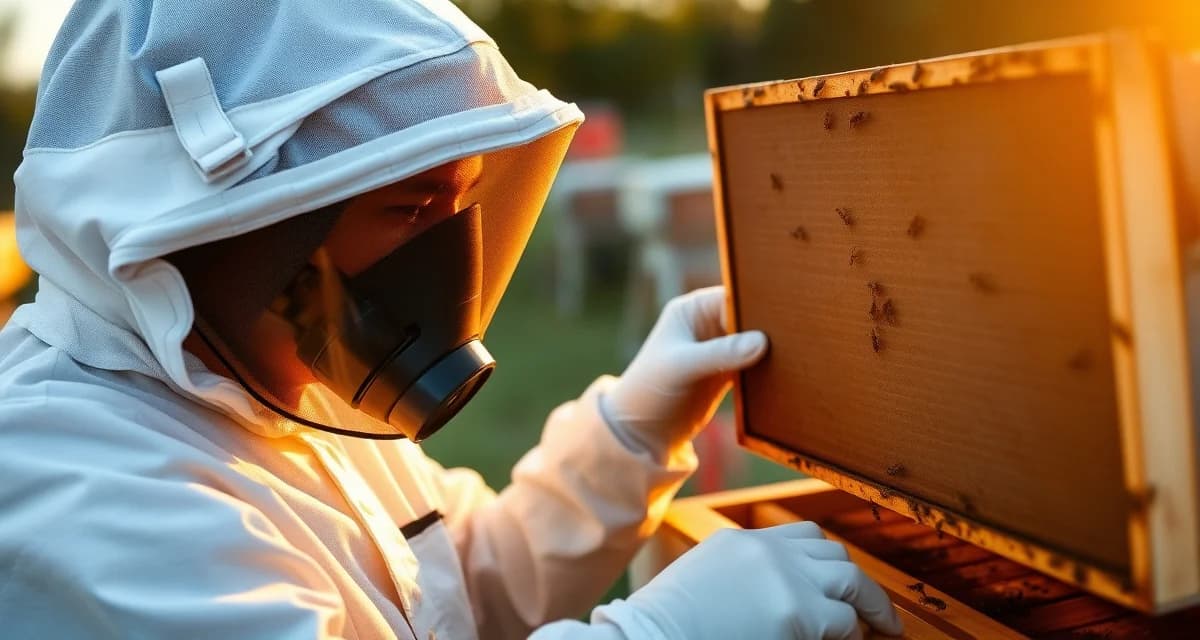
Formic Acid Safety for Beekeepers: Handling MAQS and Formic Pro Safely
Formic acid vapors can cause eye and respiratory damage. All label instructions for MAQS and Formic Pro require full-face respirator during application. This is the label requirement, not a precautionary suggestion, and inspectors reviewing treatment records in some jurisdictions can ask whether PPE protocols were followed.
Formic acid is also one of the most effective varroa treatments available, particularly for its ability to penetrate capped brood where other treatments can't reach. Using it properly and safely means the same thing: following the label.
TL;DR
- Formic acid (MAQS, Formic Pro) is one of the few treatments that penetrates capped brood to kill mites inside cells
- Apply only when temperatures are between 50-85 degrees F; above 85 degrees risks queen loss and excessive bee mortality
- MAQS uses a 7-day treatment; Formic Pro can be applied as a 14-day extended protocol
- Formic acid has no PHI for honey supers when applied according to label instructions
- Efficacy typically ranges from 70-90% depending on temperature consistency during treatment
- Track daily temperatures during formic acid application in VarroaVault to correlate temperature with efficacy outcomes
Understanding Formic Acid Hazards
Formic acid (methanoic acid) is a carboxylic acid that occurs naturally in ants and is produced by honey bees. At the concentrations in MAQS and Formic Pro, it's highly corrosive to skin, eyes, and mucous membranes.
The primary hazard is its volatility. Formic acid evaporates readily at room temperature, and at treatment temperatures (which accelerate evaporation), vapor concentrations near open hives during application can be significant. Unlike some hazards that only affect you on direct contact, formic acid vapor travels and can affect you if you're standing in the wrong place relative to wind direction.
The secondary hazard is that formic acid burns from vapor are not always immediately painful. You may not realize you've received a damaging dose until hours later when symptoms develop. This is why waiting for pain to tell you to move away is not a reliable safety strategy.
Required PPE for MAQS and Formic Pro
What the Label Requires
MAQS and Formic Pro labels require:
- Full-face respirator with organic vapor/acid gas combination cartridges (not just a dust mask or N95)
- Chemical-resistant gloves
- Long sleeves and pants to minimize skin exposure
- Eye protection (typically covered by the full-face respirator)
The organic vapor/acid gas combination cartridge is the same type needed for OA vaporization. If you're already equipped for OA vapor, your respirator setup likely covers formic acid application as well.
Why Your Bee Veil Isn't Enough
Your standard beekeeping veil protects against stings. It does not protect against chemical vapor. The mesh gaps in most veils allow free exchange of air, meaning formic acid vapor passes through completely. Wearing a bee suit with a veil during formic acid treatment provides no protection from the acid vapors without the respirator underneath or integrated.
Some beekeepers combine a full-face respirator with a standard bee suit. This is fine. The respirator handles the chemical vapor; the suit handles stings. You need both.
Temperature: The Critical Safety and Efficacy Variable
Formic acid treatment has a temperature window that matters for both safety and efficacy. The standard guidance is 50-85°F for MAQS. Formic Pro extends the range slightly, but upper limits still apply.
Why High Temperatures Are Dangerous
Above the label maximum temperature, formic acid evaporates much faster than intended. This creates two problems:
Bee mortality: The colony is exposed to higher formic acid concentrations than safe for brood and adult bees. Queen loss and significant bee mortality can occur at temperatures above the label maximum.
Beekeeper exposure: The vapor cloud near the hive is larger and more concentrated at high temperatures. Even with proper PPE, the increased vapor concentration elevates risk during the application window.
Never apply formic acid treatments on days expected to exceed 85°F at the site, even if the forecast says temperatures will drop later. Temperature at the hive can be several degrees higher than ambient air temperature, particularly in direct sun.
Why Low Temperatures Reduce Efficacy
Below the minimum application temperature, formic acid evaporates too slowly to achieve adequate treatment concentration within the hive. This isn't a safety issue for you, but it's a treatment failure issue for the colony. Applying MAQS at 45°F won't harm you or the bees significantly, but it also won't control mites effectively.
In shoulder seasons where temperatures fluctuate, target application on days with multiple days of forecast temperatures in the proper range. A single warm day surrounded by cold ones is not ideal for formic acid treatment.
Application Safety Procedures
Before Opening the Hive
- Put on all required PPE before handling the product packaging
- Check the current temperature and forecast for the next several days
- Position yourself upwind of the hive entrance
- Have a water supply accessible for emergency rinse if needed
During Application
- Open the hive minimally, using only enough access to place the strips
- Place strips per label instructions (typically on top of frames in the brood box, not between frames)
- Close the hive promptly, minimizing your time in the vapor zone
- Move upwind after closing the hive
The label specifies where strips go and how many to use. Do not modify the placement based on what seems logical. The label placement is calibrated for safe distribution of vapor within the hive.
After Application
Leave the hive closed for the label-specified treatment period. Formic Pro and MAQS have different treatment durations. Do not open the hive during the treatment period to "check on things." Opening the hive releases concentrated vapor that has built up inside.
When the treatment period ends, remove the strips using gloves. The strips still contain residual formic acid and should be treated as hazardous material during removal.
VarroaVault requires MAQS safety acknowledgment before the treatment log can be submitted. The acknowledgment checklist confirms PPE use, temperature check, and proper strip placement before the treatment record is created.
Formic Acid and PHI
Formic acid has a relatively short pre-harvest interval under most product labels, which is part of its appeal for beekeepers working near harvest dates. Verify the current label for the specific product you're using. Label PHI information is what governs, not general guidance.
VarroaVault's PHI countdown starts automatically from your treatment log date using the correct PHI for the specific product selected. Track your harvest clearance through the pre-harvest interval tracker and log your MAQS treatments through the MAQS tracking guide.
Disposal of Used Strips
Used MAQS or Formic Pro strips still contain residual formic acid and must be handled as hazardous material:
- Wear gloves when removing strips after the treatment period
- Seal used strips in a plastic bag
- Dispose of according to local hazardous waste guidelines
- Do not reuse strips from one hive in another colony
Frequently Asked Questions
What PPE is required for MAQS formic acid application?
MAQS and Formic Pro labels require: a full-face respirator with organic vapor/acid gas combination cartridges (not a dust mask or N95, which do not protect against acid vapors), chemical-resistant gloves, long sleeves and pants, and eye protection. The full-face respirator typically covers eye protection. Your standard bee veil does not provide vapor protection. A full-face respirator worn under or in place of a standard veil is needed for safe formic acid application. All required PPE must be on before opening any product packaging.
Is formic acid safe near food contact surfaces?
During and immediately after application, formic acid vapor should be kept away from uncapped honey, open food containers, and surfaces that contact food. The treatment should not be applied when honey supers with exposed comb are present. Formic acid leaves residues in honey that dissipate after the PHI period, which is why the PHI requirement exists. After the PHI has been met, honey from treated hives is considered acceptable for harvest. Do not apply MAQS or Formic Pro in hives with honey supers in place during the treatment period.
Does VarroaVault include safety steps in the MAQS treatment log?
Yes. VarroaVault requires acknowledgment of a MAQS safety checklist before the treatment log entry can be submitted. The checklist confirms: PPE items worn (respirator type, gloves), current temperature is within the label treatment range, no honey supers are in place, and strips are being placed per label instructions. The acknowledgment is logged with the treatment record, creating documentation that safety protocols were reviewed before each application. After logging the treatment, VarroaVault starts the PHI countdown automatically and schedules a post-treatment monitoring reminder at 30 days.
Can I use MAQS with honey supers on?
Yes. Formic acid (MAQS and Formic Pro) is approved for use with honey supers in place according to label instructions. This is one of the primary advantages of formic acid over amitraz. However, formic acid can impart off-flavors to honey if used under very high temperatures. Follow label temperature restrictions to minimize this risk.
What happens if temperatures drop below 50 degrees F during a MAQS treatment?
Formic acid vaporization slows significantly below 50 degrees F, reducing efficacy. If temperatures drop below 50 degrees F for an extended period during a MAQS or Formic Pro treatment, the treatment may not deliver its full dose. Document the temperature disruption in your records and consider running a post-treatment count sooner than normal to verify results. A repeat treatment may be needed.
Does formic acid work on mites in capped brood?
Yes, this is one of formic acid's key advantages over oxalic acid and thymol. Formic acid vapor penetrates capped brood cells and kills mites reproducing inside. This makes it more effective than oxalic acid when significant brood is present, though it also makes temperature management more critical since the active ingredient is an acid vapor.
What is Formic Acid Safety for Beekeepers: Handling MAQS and Formic Pro Safely?
Formic acid safety for beekeepers covers the correct handling, PPE requirements, and application protocols for MAQS and Formic Pro — two formic acid-based varroa treatments. These products release formic acid vapors that can damage eyes and lungs, so label-mandated precautions like full-face respirators are legally required, not optional. This guide helps beekeepers apply these treatments effectively while protecting themselves and their colonies.
How much does Formic Acid Safety for Beekeepers: Handling MAQS and Formic Pro Safely cost?
MAQS and Formic Pro are commercially available varroa treatments purchased through beekeeping suppliers. Prices vary by retailer and strip count, but both are considered cost-effective given their ability to treat mites inside capped brood — something many other treatments cannot do. There is no additional cost for safe application beyond standard PPE like a full-face respirator, which any serious beekeeper should already own.
How does Formic Acid Safety for Beekeepers: Handling MAQS and Formic Pro Safely work?
Formic acid works by releasing vapors inside the hive that penetrate capped brood cells, killing varroa mites even during the phoretic and reproductive stages. MAQS uses a 7-day strip application; Formic Pro offers a 14-day extended protocol. Both require ambient temperatures between 50–85°F. Above 85°F, vapor release accelerates, risking queen loss and elevated bee mortality.
What are the benefits of Formic Acid Safety for Beekeepers: Handling MAQS and Formic Pro Safely?
The primary benefit is efficacy against mites in capped brood, where most other treatments cannot reach. Formic acid also carries no pre-harvest interval (PHI), meaning honey supers can remain on the hive during treatment when label directions are followed. Treatment efficacy typically ranges from 70–90%, depending on temperature consistency — making daily temperature tracking during application a valuable practice.
Who needs Formic Acid Safety for Beekeepers: Handling MAQS and Formic Pro Safely?
Any beekeeper using MAQS or Formic Pro needs this safety information — from hobbyists with a single hive to commercial operators managing hundreds. It is especially critical for new beekeepers unfamiliar with formic acid's hazards, and for anyone in jurisdictions where PPE compliance may be reviewed during treatment record inspections. If you are treating for varroa with formic acid, this guidance applies to you.
Sources
- American Beekeeping Federation (ABF)
- USDA ARS Bee Research Laboratory
- Honey Bee Health Coalition
- Penn State Extension Apiculture Program
- Project Apis m.
Get Started with VarroaVault
Formic acid's temperature requirements make timing critical. VarroaVault logs your treatment dates and the temperature window you applied in, so you can correlate conditions with efficacy outcomes over multiple seasons. Start your free trial at varroavault.com and build a treatment record that actually helps you improve results.