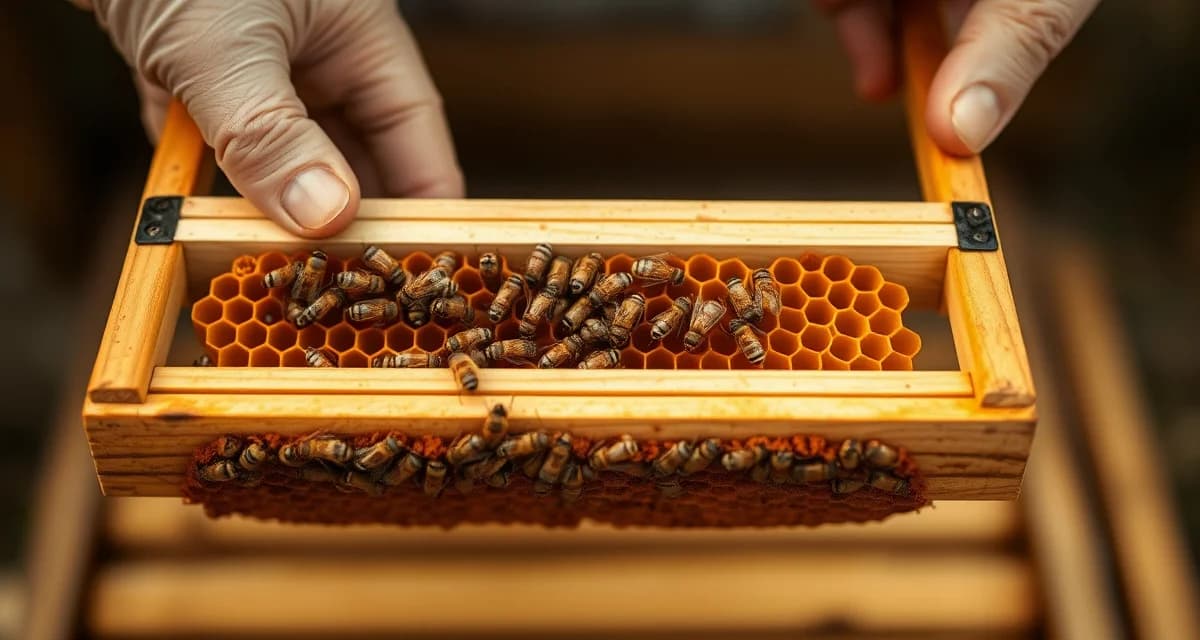
Varroa in Top-Bar Hives: Monitoring and Treatment Challenges
Top-bar hives attract beekeepers who want a more natural approach. The horizontal configuration, the comb-building freedom, and the gentler inspection style all appeal to people who want to work with bees on their terms. What that approach doesn't change, unfortunately, is varroa. The mites don't care what shape your hive is.
Managing varroa in a top-bar hive takes the same biological understanding as in a Langstroth, but the practical application requires some adaptation. Standard monitoring and treatment protocols were written for vertical Langstroth boxes. You'll need to adjust the method, not the goal.
TL;DR
- This guide covers key aspects of varroa in top-bar hives: monitoring and treatment challenges
- Mite monitoring should happen at minimum every 3-4 weeks during active season
- The 2% threshold in spring/summer and 1% in fall are standard action points based on HBHC guidelines
- Always run a pre-treatment and post-treatment mite count to calculate efficacy
- Treatment records including product name, EPA number, dates, and counts are required for state inspection compliance
- VarroaVault stores all monitoring and treatment data with automatic threshold comparison and state export formatting
Doing an Alcohol Wash in a Top-Bar Hive
The alcohol wash is still your most reliable monitoring method in a top-bar hive. The challenge is finding the brood nest and sampling bees from the right area. In a horizontal hive, the brood nest occupies the center section, with honey and pollen stores on either side. You want to sample nurse bees from frames at the edge of the brood nest, where mite density is highest.
Here's how to adapt the standard alcohol wash for a top-bar hive:
- Identify the active brood area by looking for capped brood cells and nurse bees working open cells.
- Without shaking the queen (she may be anywhere in the horizontal nest), take bees from 2-3 top bars at the brood-pollen interface by shaking or brushing them into your sample cup.
- Collect approximately 300 bees (roughly half a cup by volume).
- Follow the standard alcohol wash protocol: submerge in alcohol, agitate, pour through mesh, count mites.
- Calculate the infestation percentage using the [oxalic acid dribble calculator](/oxalic-acid-dribble-calculator) or the standard formula.
The same 2% summer threshold and 1% fall threshold apply regardless of hive configuration. Mite biology doesn't change based on what box the bees live in.
Treatment Options for Top-Bar Hives
Most varroa treatments were designed for Langstroth equipment, but several work well in top-bar configurations with minor adjustments.
Oxalic acid dribble: Works well in top-bar hives. Dribble 5ml of 3.5% OA solution per 10 bees. In a horizontal configuration, work along the top bars, dribbling across the bee cluster on each bar. During a broodless period, efficacy is similar to a standard Langstroth treatment.
oxalic acid vaporization: Works in top-bar hives with some setup considerations. The entrance location and hive volume affect how you position the vaporizer. Seal secondary entrances during treatment. The dose (2 grams of crystals per application) is based on colony size, not hive volume.
Apivar strips (amitraz): Can be hung in a top-bar hive between bars near the brood nest. Hang strips on either side of the brood cluster, repositioning midway through the treatment period to ensure all bees contact the strips.
MAQS and formic acid: These treatments rely on vapor distribution throughout the hive. In a horizontal hive with a different airflow pattern than a vertical Langstroth, formic acid vapor distribution may be less consistent. Some top-bar hive keepers report variable efficacy; others use it successfully. Monitor with a post-treatment count.
What doesn't work well in most top-bar hives: sticky board mite counts. The angled floors and non-standard bottom configurations in many top-bar designs make sticky boards unreliable. Alcohol wash remains the gold standard.
Setting Up a Top-Bar Hive Profile in VarroaVault
VarroaVault's top-bar hive profile adjusts the dose calculator and inspection templates for the horizontal hive configuration. When you create a hive profile, select "Top-Bar" as the hive type. This changes:
- The dribble dose calculation to account for the horizontal application method
- The inspection templates to reflect top-bar terminology and brood nest location fields
- The treatment application notes to include horizontal-specific guidance
The mite count tracking app stores your top-bar hive counts with the same threshold alerts and trend tracking as any other hive type. Your monitoring history builds over time, giving you a clear picture of population trends season to season.
Monitoring Frequency for Top-Bar Hives
Top-bar hive keepers who prefer a more hands-off management style sometimes let monitoring slide. This is one of the most common mistakes in any hive type, but it's particularly consequential in top-bar hives because the population can build in the more expansive comb nest before you notice.
A practical monitoring schedule: count in April, June, August, and October. That's the minimum. If you're getting counts above 1%, increase frequency to every 3-4 weeks until you treat and confirm efficacy.
Frequently Asked Questions
How do I do an alcohol wash in a top-bar hive?
Sample from the brood-pollen interface on the edge of the brood nest. Brush or shake bees from 2-3 top bars into your sample cup, aiming for approximately 300 bees from the nurse bee population. Follow standard alcohol wash procedure: submerge in isopropyl alcohol, agitate for 30 seconds, pour through mesh, count mites in the strained liquid. Calculate percentage as (mites / bees) x 100.
What varroa treatments work in top-bar hives?
OA dribble, OA vaporization, and Apivar strips are all adaptable to top-bar configurations with minor adjustments. Formic acid treatments have more variable efficacy in horizontal hives due to different vapor distribution. Sticky board mite counts are generally unreliable in top-bar designs. Post-treatment alcohol wash counts confirm efficacy regardless of which treatment you used.
How do I set up a top-bar hive in VarroaVault?
When adding a new hive, select "Top-Bar" from the hive type menu. VarroaVault adjusts the dose calculators, inspection templates, and treatment application notes for the horizontal configuration. Your count and treatment history are tracked with the same threshold alerts and season-specific guidance as any other hive type in the system.
How do I know if my varroa treatment is working?
Run a mite count 2-4 weeks after the treatment ends and compare it to your pre-treatment count. The efficacy formula is: ((pre-count - post-count) / pre-count) x 100. A result above 90% indicates effective treatment. Results below 80% should trigger investigation for possible resistance, application error, or reinfestation. Log both counts in VarroaVault to track efficacy trends across treatment cycles.
How often should I check mite levels in my hives?
At minimum, once per month (every 3-4 weeks) during the active season. Increase to every 2 weeks when counts are near threshold or after a treatment to verify it worked. In fall, monitoring frequency matters most because the window to treat before winter bees are raised is narrow. VarroaVault's monitoring reminders can be set to your preferred interval for each apiary.
What records should I keep for varroa management?
Each record should include: date of count or treatment, hive identifier, monitoring method used, number of bees sampled, mites counted, infestation percentage, treatment product name and EPA registration number, dose applied, treatment start and end dates, and PHI end date. State apiarists typically expect this level of detail during inspections. VarroaVault captures all of these fields in a single log entry.
What is Varroa in Top-Bar Hives: Monitoring and Treatment Challenges?
Varroa in Top-Bar Hives: Monitoring and Treatment Challenges is a practical guide for top-bar hive beekeepers navigating varroa mite management. It covers how the horizontal hive design affects standard monitoring techniques like alcohol washes, explains threshold-based treatment decisions using HBHC guidelines, and addresses how to adapt Langstroth-oriented protocols to top-bar configurations. The guide also outlines record-keeping requirements for state inspection compliance and introduces VarroaVault as a tool for tracking mite counts and treatment outcomes.
How much does Varroa in Top-Bar Hives: Monitoring and Treatment Challenges cost?
This guide is free educational content published on VarroaVault. There is no cost to read it. VarroaVault offers a monitoring and record-keeping platform where beekeepers can log mite counts, track treatment history, compare results against threshold benchmarks, and generate state-compliant inspection reports. Pricing for the VarroaVault platform, if applicable, would be listed on the VarroaVault website separately from this article.
How does Varroa in Top-Bar Hives: Monitoring and Treatment Challenges work?
The guide works by walking top-bar beekeepers through each stage of varroa management: how to conduct an alcohol wash in a horizontal hive, when to act based on mite percentage thresholds (2% in spring/summer, 1% in fall), how to select and apply treatments suited to top-bar configurations, and how to measure treatment efficacy with pre- and post-treatment counts. It adapts existing best-practice protocols to the practical realities of top-bar hive inspection and brood access.
What are the benefits of Varroa in Top-Bar Hives: Monitoring and Treatment Challenges?
The primary benefit is confidence. Top-bar beekeepers often feel underserved by standard varroa guidance written for Langstroth hives. This guide closes that gap by translating proven monitoring and treatment methods into top-bar-specific terms. Beekeepers gain a clear action framework, threshold benchmarks to remove guesswork, and record-keeping structure that satisfies state inspection requirements. The result is healthier colonies, earlier mite interventions, and documentation that protects the beekeeper during compliance reviews.
Who needs Varroa in Top-Bar Hives: Monitoring and Treatment Challenges?
Any beekeeper managing a top-bar hive during varroa season needs this guidance. It is especially relevant for natural-beekeeping enthusiasts who may have assumed their management style reduces varroa pressure — it does not. New top-bar beekeepers learning monitoring basics, experienced beekeepers switching from Langstroth, and hobbyists who want to meet state inspection standards will all benefit. If you have a top-bar hive and bees, varroa is a present risk that requires active monitoring regardless of hive style.
Sources
- American Beekeeping Federation (ABF)
- USDA ARS Bee Research Laboratory
- Honey Bee Health Coalition
- Penn State Extension Apiculture Program
- Project Apis m.
Get Started with VarroaVault
The information in this guide is most useful when you have your own mite count data to apply it to. VarroaVault stores every count, flags threshold crossings automatically, and builds the treatment history you need for state inspections and effective management decisions. See pricing and free tools at varroavault.com.