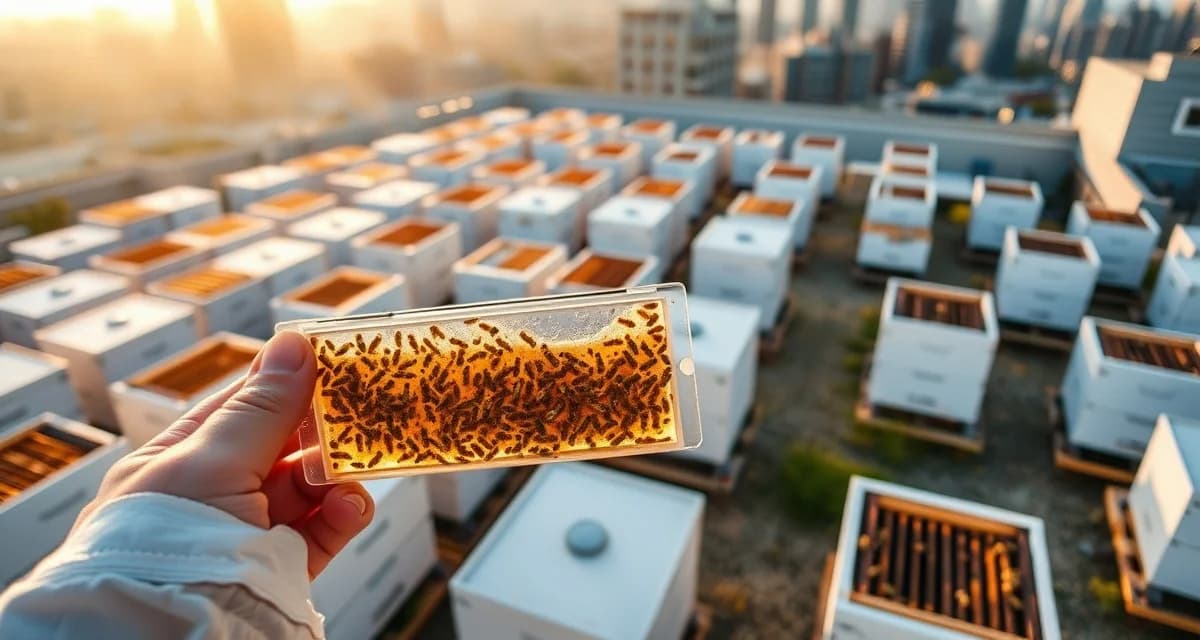
Rooftop Beekeeping and Varroa: Monitoring in Urban High-Rise Apiaries
Urban rooftop apiaries within 500 meters of other beekeeping operations show reinfestation within 14 days of treatment in 65% of cases. That's the defining varroa challenge for city beekeepers: you can treat perfectly and watch mite counts climb again within two weeks because your neighbors' colonies are acting as a constant reservoir. Standard rural monitoring frequency simply doesn't work in this environment.
Rooftop beekeeping is one of the fastest-growing segments of the hobby, and most new urban beekeepers are surprised to discover just how densely populated the city's airspace is with other hives. In a typical dense urban neighborhood, your bees may be flying within 1-2 km of dozens of other colonies managed with wildly different levels of varroa vigilance.
TL;DR
- Varroa monitoring should happen at minimum once per month during active season (every 3-4 weeks)
- Sticky board counts are the least accurate method; alcohol wash is the gold standard
- The 2% threshold in spring/summer and 1% in fall are widely recommended action points
- Monitoring before and after every treatment allows efficacy calculation and resistance detection
- A count from the outer frames or entrance produces lower, less accurate results than brood nest samples
- VarroaVault stores every count with date, method, and result to build a trend dataset over multiple seasons
Why Urban Apiaries Face Higher Reinfestation Risk
In rural settings, reinfestation typically comes from neighboring apiaries or wild colonies within a few kilometers. Treatment achieves lower mite levels and those lower levels persist for weeks or months because the surrounding mite pressure is relatively low.
In a dense city, that picture changes. A single square kilometer of urban area in a beekeeping-active city can contain 20-50 managed colonies. Some of those will be well-managed. Some will be neglected. The ones with high mite loads become sources that continuously push mites outward through robbing, drifting, and swarms.
Even if you maintain excellent management, a high-mite collapsed colony a few blocks away will spend weeks as a mite bomb, spreading infested bees across the neighborhood until it finally dies out. When your freshly treated colony sends out foragers that encounter infested drifting bees or rob from a failing hive, your mite count climbs again fast.
The 2-Week Testing Interval
Standard monitoring guidance suggests testing every 30 days or at key seasonal milestones. For urban rooftop apiaries, the recommended interval drops to 14 days during peak mite season (June through September).
This more frequent monitoring serves two purposes. First, it catches post-treatment reinfestation early, before counts climb back to threshold levels. Second, it gives you data to assess whether your treatment is holding or whether reinfestation is driving your counts back up despite successful initial treatment.
If your counts go from 1% post-treatment to 2% within two weeks, you're dealing with active reinfestation, not treatment failure. The response to those two situations is different, and the data is what tells you which one you're facing.
Sampling Technique for Rooftop Hives
Alcohol wash is the recommended method for rooftop monitoring because it gives the most accurate count in a small sample. sugar roll is less reliable because the confined rooftop environment often makes bees more defensively active, leading to more bees jumping out of the jar before you get a good count.
Standard protocol: Collect 300 bees (about half a cup) from the brood nest area. Add 70% isopropyl alcohol, shake for 60 seconds, and pour through a strainer over a white plate or tray. Count the mites on the plate and calculate the percentage.
On a rooftop, you need to manage a few practical considerations:
Wind. Rooftops are often windier than ground-level apiaries. Work in a sheltered corner if possible, or use a container with a secure lid to prevent bees from escaping before you can add alcohol.
Heat. Rooftop temperatures in summer can be significantly higher than at ground level. Bees may be more defensive and more prone to bearding. Work early in the morning or in the evening when temperatures are lower.
Access. Alcohol wash requires a source of wash solution. Pre-measure and bottle your alcohol before going to the rooftop to reduce the number of items you're carrying.
Coordinating With Other Urban Beekeepers
The single most effective thing you can do to reduce reinfestation in a dense urban area is coordinate treatment timing with other beekeepers in your neighborhood. Neighborhoods where 80%+ of beekeepers treat within the same 2-week window reduce post-treatment reinfestation significantly compared to uncoordinated treatment schedules.
Finding those beekeepers isn't always easy, but local beekeeping associations often maintain lists of members' apiary locations. Introducing yourself to other urban beekeepers and establishing a loose coordination on treatment timing costs nothing and pays substantial dividends.
VarroaVault's cooperative group feature allows neighboring beekeepers to share apiary-level mite status without sharing individual hive data. You can see whether your neighbors' apiaries are above or below threshold without seeing their specific colony details. This makes coordination conversations much more productive, instead of asking "how are your mites?" you can see that a nearby apiary is showing 3% average counts before you treat and decide to reach out.
Use the urban beekeeping management guide for broader context on managing a rooftop apiary, and review the varroa reinfestation guide to understand the mechanics of how post-treatment counts rise.
Setting Up a Rooftop Profile in VarroaVault
VarroaVault's rooftop apiary profile activates an urban reinfestation risk alert with recommended 2-week testing intervals. When you register your apiary as a rooftop location, the system:
- Adjusts the default monitoring interval from 30 days to 14 days for the June-September window
- Activates the urban reinfestation alert, which flags unusually fast post-treatment count increases as likely reinfestation rather than treatment failure
- Shows the cooperative group feature for connecting with nearby beekeepers
To set this up, go to your apiary settings and select Location Type: Rooftop Urban. Enter your approximate elevation above ground and ZIP code. The system uses the ZIP code to estimate urban density and calibrate the reinfestation risk level.
Frequently Asked Questions
How often should I test varroa mites on a rooftop apiary?
Urban rooftop apiaries should be tested every 14 days during peak mite season from June through September. The high density of other colonies in urban environments means reinfestation after treatment happens much faster than in rural settings, often within two weeks of a successful treatment. Monthly monitoring is insufficient to catch these fast rebounds before they reach threshold. Outside of peak season, from October through May, you can return to monthly monitoring unless counts were elevated at the end of the previous season. The 14-day interval provides early warning of reinfestation events and helps you distinguish between treatment failure and post-treatment contamination from neighboring colonies.
Does proximity to other urban apiaries increase my reinfestation risk?
Yes, significantly. Urban apiaries within 500 meters of other beekeeping operations show post-treatment reinfestation in the majority of cases, often within 14 days of treatment. The reinfestation sources are robbing behavior (your bees robbing high-mite collapsing colonies), drifting bees (infested bees from neighboring colonies landing in your hive), and swarms with high mite loads landing on nearby structures. You can't control what your neighbors do, but you can monitor more frequently to catch rebounds early, coordinate treatment timing through local beekeeping associations, and use VarroaVault's cooperative group feature to stay informed about mite levels in nearby apiaries.
Does VarroaVault have a rooftop apiary profile setting?
Yes. VarroaVault includes a rooftop apiary profile that adjusts the monitoring recommendations and activates the urban reinfestation risk alert system. When you register an apiary as a rooftop location, the default monitoring interval automatically adjusts to 14 days for the June-September peak season. The urban reinfestation alert identifies unusually fast count increases after treatment as likely reinfestation events rather than treatment failure, so you can respond with the right approach. The profile also activates the cooperative group feature for connecting with nearby beekeepers who use VarroaVault, allowing neighborhood-level mite status sharing to support coordinated treatment timing.
How do I know if my varroa treatment is working?
Run a mite count 2-4 weeks after the treatment ends and compare it to your pre-treatment count. The efficacy formula is: ((pre-count - post-count) / pre-count) x 100. A result above 90% indicates effective treatment. Results below 80% should trigger investigation for possible resistance, application error, or reinfestation. Log both counts in VarroaVault to track efficacy trends across treatment cycles.
How often should I check mite levels in my hives?
At minimum, once per month (every 3-4 weeks) during the active season. Increase to every 2 weeks when counts are near threshold or after a treatment to verify it worked. In fall, monitoring frequency matters most because the window to treat before winter bees are raised is narrow. VarroaVault's monitoring reminders can be set to your preferred interval for each apiary.
What records should I keep for varroa management?
Each record should include: date of count or treatment, hive identifier, monitoring method used, number of bees sampled, mites counted, infestation percentage, treatment product name and EPA registration number, dose applied, treatment start and end dates, and PHI end date. State apiarists typically expect this level of detail during inspections. VarroaVault captures all of these fields in a single log entry.
What is Rooftop Beekeeping and Varroa: Monitoring in Urban High-Rise Apiaries?
Rooftop beekeeping in urban high-rise apiaries presents unique varroa management challenges due to dense colony populations within flight range. This article covers how urban beekeepers can monitor and manage Varroa destructor mites effectively when standard rural protocols fall short. Because city apiaries sit within 500 meters of other hives, reinfestation is rapid and frequent monitoring is essential. The guide outlines monitoring frequency, accurate counting methods, and action thresholds tailored to the urban beekeeping environment.
How much does Rooftop Beekeeping and Varroa: Monitoring in Urban High-Rise Apiaries cost?
Varroa monitoring itself requires no significant financial investment. An alcohol wash kit costs under $20, and sticky boards are often free or included with hive equipment. The real cost of inadequate monitoring is colony loss. Urban beekeepers may spend more on treatments due to higher reinfestation rates, but consistent monitoring helps optimize treatment timing and avoid waste. Approved miticides range from $15 to $60 per treatment course depending on the product chosen.
How does Rooftop Beekeeping and Varroa: Monitoring in Urban High-Rise Apiaries work?
Urban varroa monitoring works by regularly sampling bees from the brood nest area and testing for mite load using alcohol wash or sugar roll methods. A sample of around 300 bees is tested, and the mite-to-bee ratio calculated as a percentage. In urban apiaries, monitoring should occur every 3 to 4 weeks during active season due to rapid reinfestation from neighboring colonies. Pre- and post-treatment counts allow beekeepers to measure treatment efficacy and detect potential mite resistance.
What are the benefits of Rooftop Beekeeping and Varroa: Monitoring in Urban High-Rise Apiaries?
Consistent varroa monitoring in rooftop apiaries helps urban beekeepers catch dangerous mite loads before colony health deteriorates. It enables timely, targeted treatment rather than reactive or calendar-based applications. Tracking counts over time reveals reinfestation patterns tied to neighboring hive activity. Monitoring before and after treatment also confirms whether a product is working, which is especially valuable in dense urban areas where mite pressure is high and resistance can develop faster due to larger local mite populations.
Who needs Rooftop Beekeeping and Varroa: Monitoring in Urban High-Rise Apiaries?
Any beekeeper managing hives on rooftops, terraces, or urban green spaces needs this guidance, particularly beginners who assume rural varroa protocols apply in city settings. Experienced beekeepers relocating from rural areas will find urban reinfestation rates surprising without adjusted monitoring schedules. Community beekeeping programs, rooftop garden operators, and urban agriculture educators also benefit, as understanding neighborhood-wide mite pressure is essential for responsible hive management that protects both your colonies and those of nearby beekeepers.
Sources
- American Beekeeping Federation (ABF)
- USDA ARS Bee Research Laboratory
- Honey Bee Health Coalition
- Penn State Extension Apiculture Program
- Project Apis m.
Get Started with VarroaVault
The information in this guide is most useful when you have your own mite count data to apply it to. VarroaVault stores every count, flags threshold crossings automatically, and builds the treatment history you need for state inspections and effective management decisions. See pricing and free tools at varroavault.com.