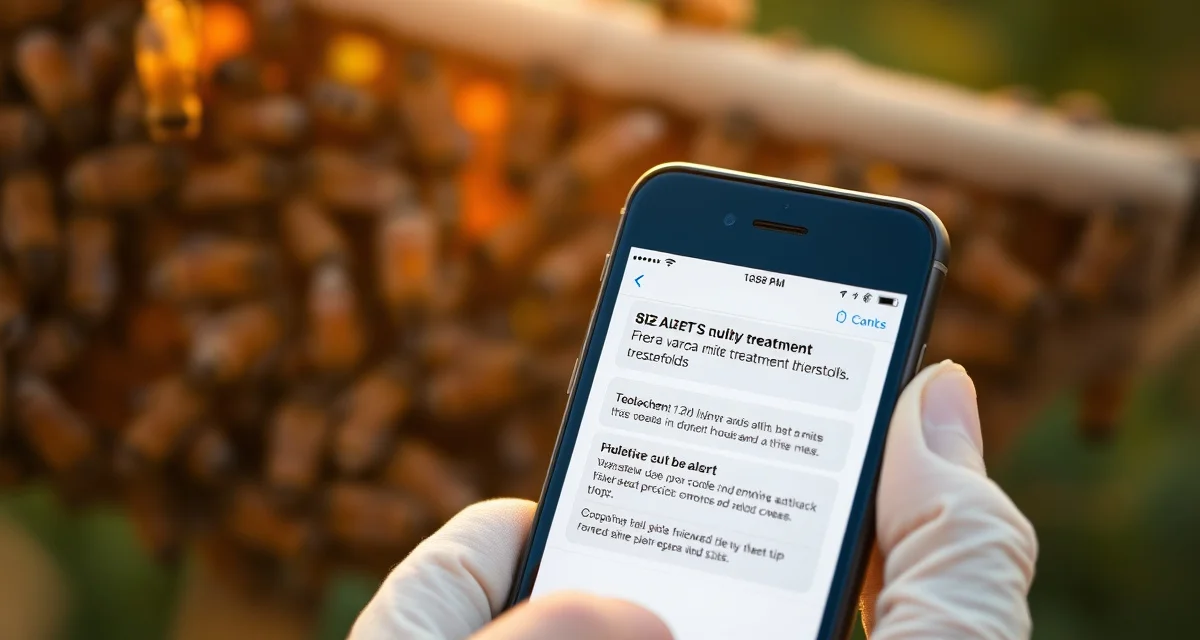
Varroa Mite SMS Alerts: Get Notified Before Your Colony Crashes
Beekeepers who receive proactive threshold alerts treat 21 days earlier than those who check manually. That's three extra weeks of protection for your winter bee cohort. The difference between an August treatment and a September treatment isn't just timing. It's colony survival.
VarroaVault's SMS alert system fires 14 days before your projected threshold breach based on your count trend, not just when you cross it. Most apps wait until you're already over threshold before notifying you. By then, you've lost time you can't get back.
TL;DR
- This guide covers key aspects of varroa mite sms alerts: get notified before your colony cras
- Mite monitoring should happen at minimum every 3-4 weeks during active season
- The 2% threshold in spring/summer and 1% in fall are standard action points based on HBHC guidelines
- Always run a pre-treatment and post-treatment mite count to calculate efficacy
- Treatment records including product name, EPA number, dates, and counts are required for state inspection compliance
- VarroaVault stores all monitoring and treatment data with automatic threshold comparison and state export formatting
How the SMS Alert System Works
VarroaVault monitors your count trend after every mite test you log. If your counts are rising, the system projects forward using your colony's specific trajectory. When that projection shows you'll hit threshold in 14 days, you get an SMS.
This predictive approach changes how you manage. Instead of logging a 3.2% count and then scrambling to figure out which treatment to use, you've had two weeks of lead time. You've already ordered your product, checked the weather forecast for temperature windows, and scheduled your treatment day.
The SMS includes your hive name or ID, your current count, the projected date of threshold breach, and a direct link to your treatment options in the app.
Events That Trigger a VarroaVault Alert
VarroaVault sends five types of alerts via SMS and email:
1. Threshold approach alert
Fires 14 days before your projected threshold breach based on count trend analysis. This is the most important alert for proactive management.
2. Count overdue alert
If you haven't logged a mite count within your scheduled testing interval, VarroaVault sends a reminder. The default interval is 30 days during active season (April-October), but you can customize it to match your management style.
3. PHI expiry alert
When you log a treatment with a PHI, VarroaVault tracks the countdown. You'll receive an alert 7 days before PHI expires, then again 1 day before. This prevents the accidental early harvest that creates compliance and residue problems.
4. Treatment step reminder
For multi-step treatments like Apiguard (two doses, 14 days apart) or extended OA vaporization protocols (multiple applications 5-7 days apart), VarroaVault sends a reminder for each subsequent step.
5. Resistance flag alert
If your post-treatment count shows less than 90% efficacy reduction, VarroaVault flags a potential resistance concern and alerts you to consider switching treatment class.
Setting Up SMS Alerts: 2-Minute Setup
- Log into your VarroaVault account and go to Settings > Notifications.
- Enter your mobile number and verify it with a one-time code.
- Toggle on the alert types you want. All five are enabled by default for new accounts.
- Set your threshold level if you want something different from the default (2% before winter, 3% during season).
- Save. Your alerts are live immediately.
You can set different threshold levels for different hives or apiaries. If you're managing mating nucs or first-year colonies, you can set a lower alert threshold to catch problems earlier in those sensitive populations.
Setting Your Own Threshold Level
VarroaVault's default thresholds are aligned with Honey Bee Health Coalition recommendations: 2% in August before winter preparations, 3% during the active season. But your operation may have different needs.
If you're in a region with extended brood seasons, like Florida or Southern California, you may want to keep your threshold at 2% year-round. If you're running treatment-free trials on selected hives, you might set a higher observation threshold at 5% to watch colony response before intervening.
To change your threshold: go to Apiary Settings, select the hive or apiary you want to adjust, and modify the threshold field in the Monitoring Settings section. You can set colony-level thresholds that override your account-level default.
SMS alerts will fire based on whatever threshold is set for that specific hive.
Why SMS Beats App-Only Notifications
Push notifications require you to open the app. If you're not thinking about mite management in late July because you're focused on honey harvest, that notification sits unread.
SMS goes directly to your messages. You'll see it when you get a call or text about anything else. For time-sensitive management windows like the August treatment deadline, the delivery method matters.
VarroaVault sends SMS for threshold and PHI alerts by default. You can add email as a secondary notification for any alert type. If you're managing an operation with employees, you can route specific alerts to multiple phone numbers so a treatment manager gets the same notification you do.
Frequently Asked Questions
How do I set up SMS mite alerts in VarroaVault?
Go to Settings > Notifications in your VarroaVault account, enter and verify your mobile number, then toggle on the alert types you want. Setup takes about 2 minutes. All five alert types are enabled by default for new accounts.
What events trigger a VarroaVault SMS alert?
VarroaVault sends SMS alerts for five events: projected threshold approach (14 days before breach), overdue mite count, PHI expiry countdown, treatment step reminders (second doses, strip removals), and resistance flags when post-treatment efficacy falls below 90%.
Can I set my own threshold level for SMS alerts?
Yes. VarroaVault's default thresholds follow HBHC recommendations (2% pre-winter, 3% in-season), but you can set custom thresholds for individual hives or entire apiaries. Threshold-based SMS alerts fire based on your custom setting, not the default.
How do I know if my varroa treatment is working?
Run a mite count 2-4 weeks after the treatment ends and compare it to your pre-treatment count. The efficacy formula is: ((pre-count - post-count) / pre-count) x 100. A result above 90% indicates effective treatment. Results below 80% should trigger investigation for possible resistance, application error, or reinfestation. Log both counts in VarroaVault to track efficacy trends across treatment cycles.
How often should I check mite levels in my hives?
At minimum, once per month (every 3-4 weeks) during the active season. Increase to every 2 weeks when counts are near threshold or after a treatment to verify it worked. In fall, monitoring frequency matters most because the window to treat before winter bees are raised is narrow. VarroaVault's monitoring reminders can be set to your preferred interval for each apiary.
What records should I keep for varroa management?
Each record should include: date of count or treatment, hive identifier, monitoring method used, number of bees sampled, mites counted, infestation percentage, treatment product name and EPA registration number, dose applied, treatment start and end dates, and PHI end date. State apiarists typically expect this level of detail during inspections. VarroaVault captures all of these fields in a single log entry.
What is Varroa Mite SMS Alerts: Get Notified Before Your Colony Crashes?
VarroaVault's Varroa Mite SMS Alert system is a proactive monitoring tool that notifies beekeepers before their colony reaches a dangerous mite threshold. Unlike standard apps that alert you after you've crossed the threshold, VarroaVault analyzes your mite count trend and sends an SMS warning 14 days before a projected breach. This gives you critical extra time to treat effectively and protect your winter bee cohort before population collapse becomes inevitable.
How much does Varroa Mite SMS Alerts: Get Notified Before Your Colony Crashes cost?
VarroaVault's SMS alert system is included as part of the VarroaVault platform subscription. Pricing details are available on the VarroaVault website, but the alert feature is not sold separately — it's built into the core monitoring dashboard alongside mite count logging, treatment records, threshold tracking, and state-compliant data export. Given that a single lost colony can cost hundreds of dollars, the early warning system delivers significant value relative to its cost.
How does Varroa Mite SMS Alerts: Get Notified Before Your Colony Crashes work?
After you log each mite test, VarroaVault calculates your count trend over time. If that trend projects a threshold breach within 14 days, the system automatically sends an SMS to your registered number. Standard thresholds follow HBHC guidelines: 2% in spring and summer, 1% in fall. The alert fires based on trajectory, not a single data point, so you're warned while you still have a full treatment window rather than after the damage is done.
What are the benefits of Varroa Mite SMS Alerts: Get Notified Before Your Colony Crashes?
The primary benefit is time. Beekeepers using proactive threshold alerts treat an average of 21 days earlier than those relying on manual checks alone. In late summer, those three weeks determine whether your August treatment protects your winter bees or your September treatment arrives too late. Additional benefits include automated record-keeping for state inspection compliance, pre- and post-treatment efficacy tracking, and a complete audit trail of all mite monitoring and treatment activity stored in one place.
Who needs Varroa Mite SMS Alerts: Get Notified Before Your Colony Crashes?
Any beekeeper managing one or more colonies during active season should use SMS mite alerts, but they're especially critical for hobbyists who can't check hives weekly and commercial or sideliner beekeepers managing multiple yards. Beekeepers heading into their first winter are particularly vulnerable to varroa collapse. If you monitor every 3–4 weeks as recommended, there's a real window where mite loads can spike between visits — SMS alerts based on trend analysis close that gap automatically.
Related Articles
- How to Count Varroa Mites in a Nucleus Colony: Adapting the Standard Method
- Varroa Mite Count Video Guide: Watch Before Your First Alcohol Wash
- Early Varroa Mite Detection: How to Catch Infestations Before They Are Critical
Sources
- American Beekeeping Federation (ABF)
- USDA ARS Bee Research Laboratory
- Honey Bee Health Coalition
- Penn State Extension Apiculture Program
- Project Apis m.
Get Started with VarroaVault
The information in this guide is most useful when you have your own mite count data to apply it to. VarroaVault stores every count, flags threshold crossings automatically, and builds the treatment history you need for state inspections and effective management decisions. See pricing and free tools at varroavault.com.